
Open Hands
Aug 30 – Sep 15, 2024
Hyundai Hwarang
Participating Artists
Choi Minhwa, Woosung Lee, Jesse Chun, Yong Soon Min, Eusung Lee, Oh Inhwan, Kang Seung Lee, Sung Neung Kyung
Gallery Hyundai presents Open Hands, a collaborative exhibition with Commonwealth and Council from August 30 through September 15, 2024. Open Hands is a kind gesture, a generous invitation to gather works by an intergenerational group of artists: Choi Minhwa, Jesse Chun, Eusung Lee, Kang Seung Lee, Woosung Lee, Yong Soon Min, Oh Inhwan, and Sung Neung Kyung. They share a vested interest in Korea while inhabiting different positions in the global diaspora, some in close proximity to marginalized communities and events. This collaboration between the two galleries also offers a site for mutual exchange across continents.
Extending open-endedness beyond physicality and temporality, the title of this exhibition offers the self in perpetuity as a mode of being present with others in the moment of now, alongside those who came before us and those still yet to come. From hands that shake, caress, and express to those that reach out as if to grasp at something, hands that thumb their way through a newspaper, and hands that create, “hands” carry rich associations to cultural functions and meanings. Expanding the reach of gestures to possibilities of interfacing between human beings, the hands in this exhibition explore the boundaries between the symbolic, abstraction, and materiality as well as the embodiment of individual and collective experiences. Indeed, the word “digital” that is so essential to contemporary culture is derived from “digits,” or fingers. Here, the fingertips not only mark where one body ends, but also point towards the beginnings of other bodies in our haptic coexistence.
Oh Inhwan’s The Blind Spot-Drawing (2024) is a photographic collaboration with participants which maps areas on their backs that are out of reach. Applied with eye pencil, a tool designed to accentuate the organs of sight, the scale and contour of Oh’s stylized graphic vary with each individual. Spots that the participants cannot touch with their own hands manifest as uncanny visualizations akin to speech bubbles, perhaps, in this case, of overdue sighs of relief. Through his ongoing examination of public and personal blind spots, Oh suggests that private blind spots can be intangible even to oneself.
Yong Soon Min’s Both Sides Now (2018) consists of postcards the artist purchased while visiting the DMZ Joint Security Area in South Korea in 1995 and Panmunjom, North Korea, in 1998. Juxtaposing the personal nature of postcards with the heavy reality of Korea’s division, the objects of choice readily refer to the interconnectedness between individual memory and historical narratives. Namely, as Min was born in the midst of the Korean War but immigrated to the United States at a young age, she herself became politicized by the country’s fraught political history through collective memories, even as an individual who did not directly experience it. As visualized by the thin alternating strips of postcards (recto verso) hand-cut by the artist, North and South Korea may geographically exist on opposite sides of a single border almost within a hand’s reach, but the reality is perhaps more aptly expressed as countless gaps of loss and absurdity that must be constantly rearranged like a puzzle in the collective consciousness.
Eusung Lee’s Dandelion Acceleration, Deceleration Container, and Dragonfly Speed (all 2020) each reimagine velocity, which is simultaneously a culturally determined concept and an embodied sensation. Lee captures potential energy by condensing the signified meaning of each found object into its simplest form, often taking the shape of a hand-carved, relief sculpture in a period of rest while on reserve power, ready for reactivation. Meanwhile, Trunk 3 (Backbone) (2021), the third work in the tripartite relief Trunk, was created from three pieces of wood from the same log that were most likely initially prepared as components of a table. The artist observed and dwelled on the slabs’ affinities to the human body. While refraining from direct representation, Lee assigned a spatial interpretation to each of the three sections. Trunk 3 (Backbone) emphasizes the narrow side of the wood instead of its wider face, creating the edge of an elongated spine undulating up and down its profile.
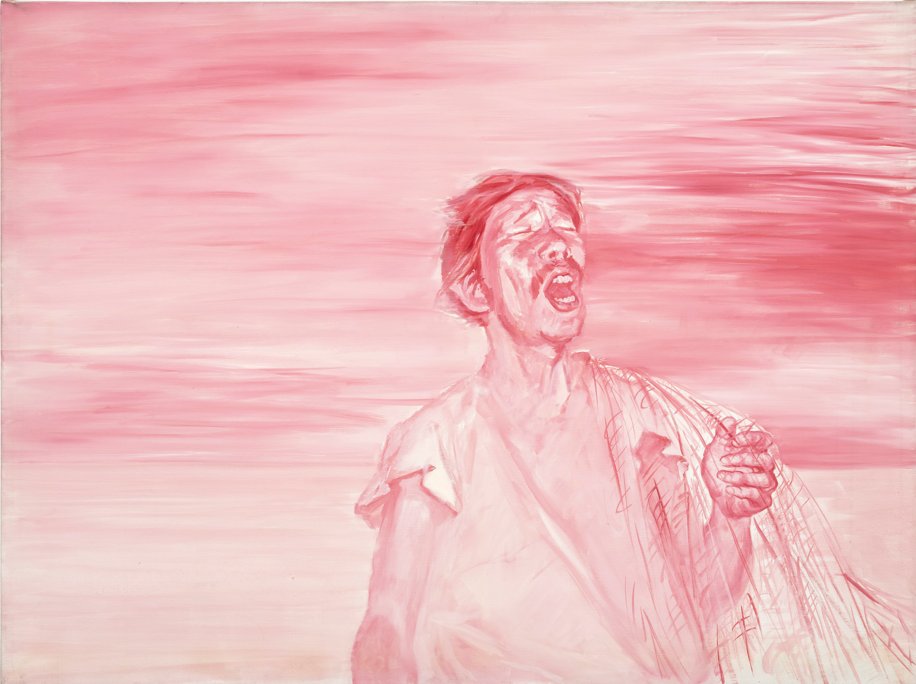
Choi Minhwa’s Again, in Inferno-2 (1991) features the flushed face of a lone figure covering one ear with his hand as if to pantomime a chronic ache compounded with an unnatural set of white teeth exposed through a forced smile. The artist paints a bitter laughter in the aftermath of Korea’s June Democratic Struggle against military dictatorship that revealed itself not to be the birth of democracy, but instead the start of another military regime: divine comedy on repeat. Choi’s distinctive portraiture style employs rapid brushstrokes and a sense of movement to capture emotional and psychological states. In a painting from the artist’s Pink series (1989–1999), a solid hue of atmospheric turbulence engulfs his subject. With eyes shut and mouth wide open, the inaudible utterance of despair and frustration is amplified by the figure’s open hand in midgesture.
Kang Seung Lee proposes possibilities of interconnectedness among various figures throughout time and geographical locations. Lee’s work commemorates and preserves the legacies of queer creative voices by gathering their lives and work into a rich constellation that extends beyond the finite temporalities of their own lifetimes. Lee’s act of “redrawing” bodies of past lives as shadows or smoke evokes the physical and cultural “disappearing” of figures through their absent presence, as evidenced in Untitled (Goh Choo San 4) (2019), in which only the gesturing hands of the Singaporean-born choreographer remain. Lee’s collaborative video work The Heart of A Hand (with Joshua Serafin and Nathan Mercury Kim) (2023) brings together Goh Choo San, Xavier Villaurrutia, Martin Wong, Samuel Barber, and KIRARA to manifest a queer futurity imaginable through transnational inheritance and intergenerational memories.
Jesse Chun’s 시: concrete poem (2024) reinterprets the Korean shamanist tradition of paper cutting, created by dyeing hanji paper with ottchil lacquer followed by drawing repeated graphite lines and cutting them out. What results is an abstract pattern that illuminates through negative space and shadows as much as positive space, appearing both pictorial and linguistic like a newfound codex. If the meticulous, hands-on process of working with delicate hanji imbues the work with a ritualistic element of “writing as practice” inspired by the artist’s own late grandmother, who was a Korean folk dancer and Buddhist monk, then the repeated circles point to graphemes of Korean (“ㅇ”) and English (“O”) to meditate on the structural conditions of language itself. As a talismanic portal, 시: concrete poem collapses time and space to commune with others beyond speech and articulation.
Sung Neung Kyung’s Newspaper Reading (1976–ongoing) is an iconic performance in the history of Korean contemporary art, encapsulating the artist’s sustained practice that has utilized action with media objects such as newspapers and photographs. Reading Newspaper: Performance of 100 People, presented during Frieze Seoul 2023, was the largest in scale since its first iteration in 1976. The artist has stated that “collectively reading newspapers out loud and cutting out articles is a kind of ‘collaborative doing’ comparable to a chorus, and such attempts announce a liberating shift from ‘fossilized creative acts’ to ‘open forms of doing.’” In its original context of Korea’s dictatorship period, Newspaper Reading can be read as a young artist’s gesture of resistance. Meanwhile, in our present, where print media faces extinction and Seoul has become a major global city unimaginable half a century ago, the reenactment of Sung’s performance promises to continue transforming with its shifting contexts and growing network of helping hands.
Woosung Lee’s Leaning, overlapping, and repeating (2021) layers multiple pairs of hands in what could be either unison or disharmony. While both graphite drawings reference the artist’s own hands in relation to those familiar to him (a lover or his parents), Lee is interested in depicting hands that resemble each other by either shifting the scale or removing visible signs of individuality such as wrinkles, scars, and moles. What results are subtle mutations of synchronized time and an ambiguity between revealing and concealing, legibility and illegibility, leaving us with a profound longing for interconnectedness.
참여 작가
최민화, 이우성, 제시 천, 민영순, 이유성, 오인환, 이강승, 성능경
갤러리현대는 커먼웰스앤카운슬(Commonwealth and Council)과 공동으로 기획한 전시 《Open Hands》를 8월 30일부터 9월 15일까지 개최한다. 《Open Hands》는 세대를 넘나드는 한국 작가 8 인의 신작과 주요작을 소개하는 다정한 손짓이다. 세계적인 디아스포라 속 각자 다른 장소에 거주하지만, 공통적으로 한국과 그 주변부에 존재하는 인물이나 사건에 관심을 가지고 작업 세계를 펼치는 최민화, 제시 천, 이유성, 이강승, 이우성, 민영순, 오인환, 그리고 성능경의 작업을 아울러 선보인다. 본 전시는 두 주최 갤러리 간의 프로그램의 일부와 공동의 관심사를 제안하는 자리이기도 하다.
전시 제목 《Open Hands》는 개인의 주체성이 물리적인 신체와 시간성에 머무르지 않고 과거와 현재, 아직 오지 않은 미래에 함께하게 될 타자들과 영원히 맞닿아 있음을 의미한다. 악수하는 손, 쓰다듬는 손, 표현하는 손, 무언가를 잡으려는 듯이 내뻗는 손, 종이 신문의 글자를 하나씩 짚어 나가는 손, 무언가를 만드는 손 등 ‘손’은 문화와 인간사의 다양한 기능과 의미를 가진다. 물리적 제스처의 범위를 넘어 인간 사이의 접속 방식으로 확장하는 이번 전시의 ‘손'은 상징, 추상, 물질성 사이의 경계와 더불어 개인과 공동체적 경험의 체화된 요소를 탐구한다. 현대 문화에서 빼놓을 수 없는 키워드인 ‘디지털(digital)’이라는 용어는 ‘손가락'을 뜻하는 단어인 ‘digit’에서 유래되었다. 손끝은 한 사람의 신체가 끝나는 지점일 뿐 아니라 항상 우리와 함께하는 사회 속 다른 사람들의 신체로 향하는 ‘열린’ 손이다.
오인환의 〈사각지대 드로잉〉(2024)은 참여자들이 자신의 몸에서 손이 닿지 않는 등의 부위를 작가가 그 부분을 시각화한 사진 연작이다. 시각 기관인 눈을 강조하기 위해 사용되는 아이펜슬은 참여자 마다 각기 다른 크기와 모양의 ‘사각지대'를 디자인화하는 도구가 된다. 손으로 직접 만질 수 없는 부위를 대신 구획하는 기묘한 형태들은 후련한 한숨을 내쉬는 말풍선이기도 하다. 공적, 사적인 사각지대를 지속적으로 탐구해 온 오인환은 개인에게 사각지대란 가깝지만 쉽게 만질 수 없는 무형의 존재임을 제시한다.
민영순의 〈Both Sides Now〉(2018)는 작가가 1995 년에 DMZ 공동경비구역, 1998 년에 북한 판문점을 방문하며 수집한 엽서를 재구성하여 만든 작업이다. 엽서의 사적인 용도와 엽서에 담긴 분단의 현실이 대조되며 개인의 기억과 역사적 내러티브 사이의 상호 연결성을 지시하고 있다. 한국전쟁 도중 태어나 어린 나이에 미국으로 이민한 작가는 직접 경험하지 않았어도 집단 기억을 매개로 하여 한반도 특유의 대립 상황에 개입될 수밖에 없었다. 손으로 가늘게 자른 엽서 조각들에서 보이듯, 지리적으로는 남북한이 손을 뻗으면 닿을 것 같은 경계선 하나를 두고 마주하고 있지만 퍼즐처럼 맞추어 나가야 할 무수한 상실과 부조리함의 틈으로 이루어져 있는 것이 아닌지 질문을 던진다.
이유성의 〈민들레 가속〉, 〈감속 컨테이너〉, 〈잠자리 스피드〉(모두 2020)는 ‘속도'라는 문화적으로 결정된 개념과 체화된 감각의 의미를 다시금 환기하게 하는 작업이다. 작가는 각 사물이 가진 의미를 가장 간단한 형태로 구성하여 잠재 에너지를 포착한다. 이 조각들은 손으로 조각한 부조 형태를 띠며 절약 모드에 대기하면서 활성화되기를 기다리는 듯하다. 〈척추(Trunk 3)〉(2021)는 세 작품으로 이루어진 연작 〈Trunk〉 중 세 번째 작업이다. 〈Trunk〉는 테이블을 만들기 위해 준비된 한 통나무에서 나온 목재 세 조각을 구입해 두고, 인체의 스케일과 비슷한 느낌에 충분히 머물고 관찰하면서 시작된 부조 연작이다. 작가는 신체 이미지를 재현하지 않는 방식으로 세 작품에 각각 신체에 대한 공간적 해석을 분배했다. 〈척추〉는 목재의 넓은 면이 아닌 좁고 긴 옆면을 사용하여, 관객이 작품을 관람할 때 척추의 길고 좁은 뼈대가 넓게 늘여 뜨려지는 장면을 목격할 수 있다.
최민화의 〈다시 지옥에서-2〉(1991)에서 얼굴이 붉게 상기된 인물은 오랜 두통에 시달리듯 손으로 머리를 감싸고 있는데, 억지로 짓는 웃음 속 유난히 하얗게 빛나는 이빨이 허탈하기만 하다. 군부정권에 맞선 6 월항쟁의 결과는 민주화의 태동이 아니라 또 다른 군사정권의 시작이었음을, 작가는 ‘다시’ 지옥에 살고 있다고 작품을 통해 실소를 내뿜는다. 붓을 빠르게 움직여 화면의 운동성으로 감정적, 심리적 상태를 드러내는 작가의 대표적 인물화 기법이 돋보인다. 〈분홍〉(1989–1999) 연작은 화면 전체에서 요동치는 단색이 인물과 주변 공간을 모두 삼키고 있다. 꾹 감긴 눈과 열린 입, 손짓 중에 멈춘 손가락들로부터 절망과 좌절의 외침이 울려 퍼질 것만 같다.
이강승은 서로 다른 시공간 속에서 존재했던 인물들을 엮어내어 상호 관계 맺기의 가능성을 제시한다. 각기 다른 지역, 배경에서 활약했던 퀴어 예술가들을 시간적 경계를 넘어 하나의 성좌에 소환함으로써 그들의 행적을 보전하고 기념한다. 그러나 과거에 존재했던 신체들을 부드러운 흑연으로 그림자나 연기처럼 표현하는 작가의 ‘다시 그리는(redrawing)’ 행위는 작품의 존재를 통해 퀴어적 인물의 부재를 환기하며 육체적, 문화적 소멸 또한 암시한다. 예를 들어 〈무제(고추산 4)〉은 싱가포르 출신 안무가인 고추산의 손의 제스처만을 보여주고 있다. 영상 작업 〈손의 심장(조슈아 세라핀, 네이슨 머큐리 킴과 협업)〉(2023)은 고추산, 자비에 빌라루티아, 마틴 웡, 사무엘 바버, 키라라와 함께 초국가적 유산과 세대 간의 기억을 바탕으로 한 퀴어 미래를 상상해 본다.
제시 천의 〈시: concrete poem〉(2024) 연작은 무속적인 소통 방법이며 한국전통 종이오리기인 '설위설경'을 재해석한 작품으로, 옻칠한 한지에 흑연으로 무수히 선을 그은 뒤 수작업으로 작가만의 추상 언어를 잘라내 완성한 작업이다. 남은 한지의 모양만큼이나 잘려 나간 빈 공간과 그림자가 대조되어 생긴 추상적 패턴은 마치 알려지지 않은 문명의 암호 같다. 섬세한 수작업의 과정에서 전통 무용수이자 불교 승려였던 작가의 할머니에게 배운 온 ‘수행으로써 쓰기’의 영향을 찾아볼 수 있고, 한국어(‘ㅇ’)와 영어(‘O’)에 공통된 문자를 연상시키는 원 형태에서는 언어의 구조적 본질에 대한 작가의 탐구가 드러난다. 〈시: concrete poem〉은 시공간을 허물어트리는 하나의 부적이자 관문으로써 발화, 표현을 넘어 타자들과 만남의 장을 마련한다.
성능경의 〈신문 읽기〉(1976–)는 신문, 사진, 행위가 융합된 성능경 만의 독자적 작품 세계를 대표하는 퍼포먼스이자, 한국 현대미술사에서 아이콘과 같은 작품이다. 〈신문읽기: 100 인의 퍼포먼스〉는 2023 년 프리즈 서울 기간에 갤러리현대와 함께 거행된 1976 년 첫 발표 이후 사상 최대 규모로 진행된 퍼포먼스다. 작가는 "단체로 신문을 읽고 기사를 오려내는 행위는 합창이나 중창을 하는 듯한 '협동 하기질'이며, 나아가 이러한 변환의 시도가 '고착된 예술 행위'에서 '열린 하기질'로의 개방적 태도를 견지한다"라고 설명한다. 1970년대 유신 체제에 맞서는 젊은 예술가의 저항의 몸짓을 상징했던 〈신문 읽기〉는 현재라는 종이 신문의 위기 시대에, 또 반세기 전과는 비교가 안 되는 도시의 위상을 갖게 된 서울에서 다양한 언어로 인쇄된 종이 신문을 읽는 퍼포먼스로 진화하여 새로운 맥락과 뻗어나가는 무수한 손들을 계속해서 만들어 나갈 것이다.
이우성의 〈기대고 포개고 반복하는〉(2021)은 여러 손이 포개지며 반복해 연결되거나 분열되는 장면을 표현한다. 두 흑연 드로잉 작품 모두 작가 자신을 포함해 연인, 부모님과 같이 가까운 사람들의 손을 담고 있지만, 주름과 흉터, 점과 같은 개별성을 지우거나 크기를 조절함으로써 서로 닮아있는 손처럼 보이는 효과를 낳는다. 그 결과로 동기화된 시간에 미묘한 변형의 지점들이 발생하고, 드러냄과 드러내지 않음, 읽을 수 있음과 읽기 어려움의 사이의 모호함은 우리에게 상호–연결을 향한 깊은 갈망을 남긴다.
Installation Views
{{ lbCurrent.title }}
{{ lbCurrent.text }}