Press
Kim Bohie 김보희: Marie Claire Korea Interview
Sep 4, 2026
Kim Bohie (b. 1952) paints the beauty of Jeju with a quiet warmth that brings a sense of calm to those who encounter her work. Her exhibition at Kumho Museum of Art, held during the pandemic, offered a particular kind of solace at a time when many needed it most. Since settling in Jeju in 2003, the island has opened a new chapter in her practice, its extraordinary natural surroundings continually feeding her imagination. The landscapes Kim paints are not direct representations of places she has seen. They emerge instead from memory and imagination, places that may not exist before her eyes, but could perhaps be found somewhere in this vast world. Her paintings are figurative, yet abstract at the same time. Kim believes that painting requires a certain equilibrium of both mind and body. When she is troubled, she finds that the work simply does not come together; she even remembers discarding paintings made in moments of distress because they no longer felt right. Some artists channel anger and sorrow into their work, she says, but that has never been her way. What she wants to share is the joy she feels when confronted with something beautiful. She sometimes worries that sadness can pass quietly from one person to another. If so, perhaps tranquility and happiness can be shared in much the same way. And then there is that curious feeling when something is so beautiful it almost makes you sad. Kim Bohie’s solo exhibition TOWARDS: There Was Light, on view at Gallery Hyundai from August 26 through October 18, brings together new works imbued with precisely this warmth and sensibility.
What first drew you to Jeju? You settled on the island in 2003, so it has now been twenty-three years since you made it your home.
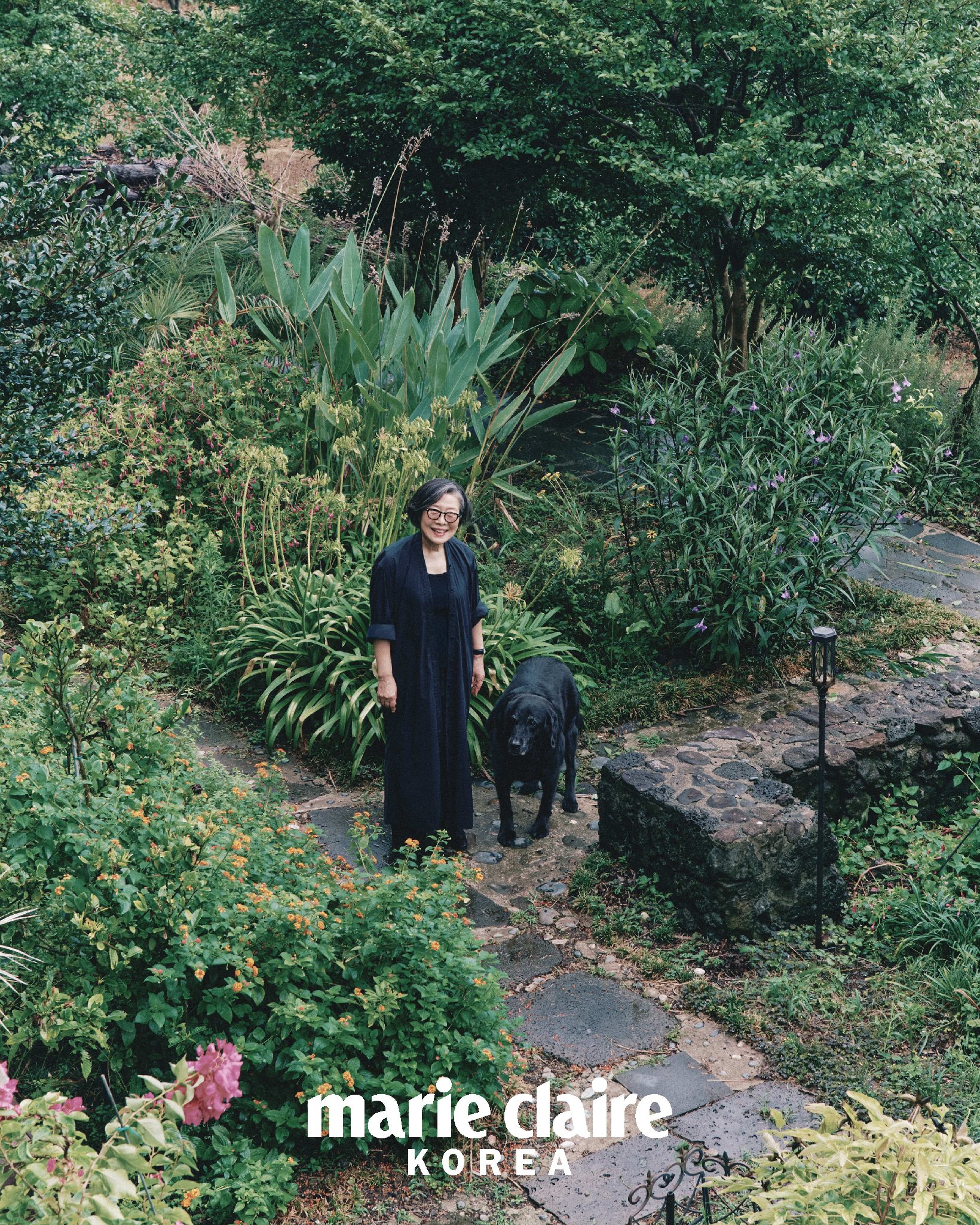
We came to Jeju for our honeymoon in 1975, and after that, my husband and I returned every year for our wedding anniversary. We loved the island so much that we eventually settled here in 2003. We spent a long time looking for the right piece of land before finding this place, which used to be a tangerine orchard. My husband came down first to finish the house, and I joined him soon after. I think I began using much more green after moving to Jeju—I can tell simply by how quickly I go through green paint. Jeju is green everywhere you look, so naturally I began using more of it myself. It wouldn’t be an exaggeration to say that I came here because I loved that green so much. I prefer summer to winter, and there are hardly any winter landscapes in my work. I vaguely remember painting one or two winter scenes by the water near Seoul many years ago. Perhaps I’ll paint winter again someday, but for now, I have no plans to.
Your second-floor studio overlooks the sea, yet there are no windows facing it. Was that a deliberate choice to protect the paintings from sunlight?
When sunlight comes directly through a window, it casts shadows across the paintings, so I decided not to have windows there. But if I step outside to the terrace on the right, I can look out at the Jeju sea whenever I want.
So the first floor is your residence, and the second floor is your studio. As you were building this house, what were your priorities as an artist?
When we first got married, we lived in a small apartment and I used the living room as my studio. As we gradually moved into larger homes, I eventually joined two rooms in a large apartment to make a studio, but even that felt too small. My husband came to Jeju ahead of me and designed this house himself. He built me a studio with very high ceilings so that I could paint as large as I wanted. The Days, which was shown at the National Museum of Modern and Contemporary Art, Korea and later at Kumho Museum of Art, consists of twenty-seven size-100 canvases joined together. The entire work measures 15 meters wide and four meters high—the exact dimensions of the wall in this studio. I began painting it in 2011 and worked on it for two and a half years. I wanted to make something large partly as a way of expressing my gratitude to my husband. At Kumho Museum of Art, there wasn’t a single wall long enough to accommodate it, so it was installed around a corner in an L-shape. The size of a studio matters enormously to an artist. Without this space, I don’t think I could ever have imagined making such large works. I also painted here the version of The Days made up of twelve size-100 canvases that was recently presented in the Unlimited sector at Art Basel Basel. That work is now on view in my solo exhibition TOWARDS: There Was Light at Gallery Hyundai.
I’ve heard that you hold beautiful landscapes in your mind before bringing them into your paintings. I wonder if all landscapes in your paintings are based in reality, or if you occasionally paint from your inner landscape. The seed paintings, for instance, feel so exotic that I wondered whether they might depict imaginary forms of life.
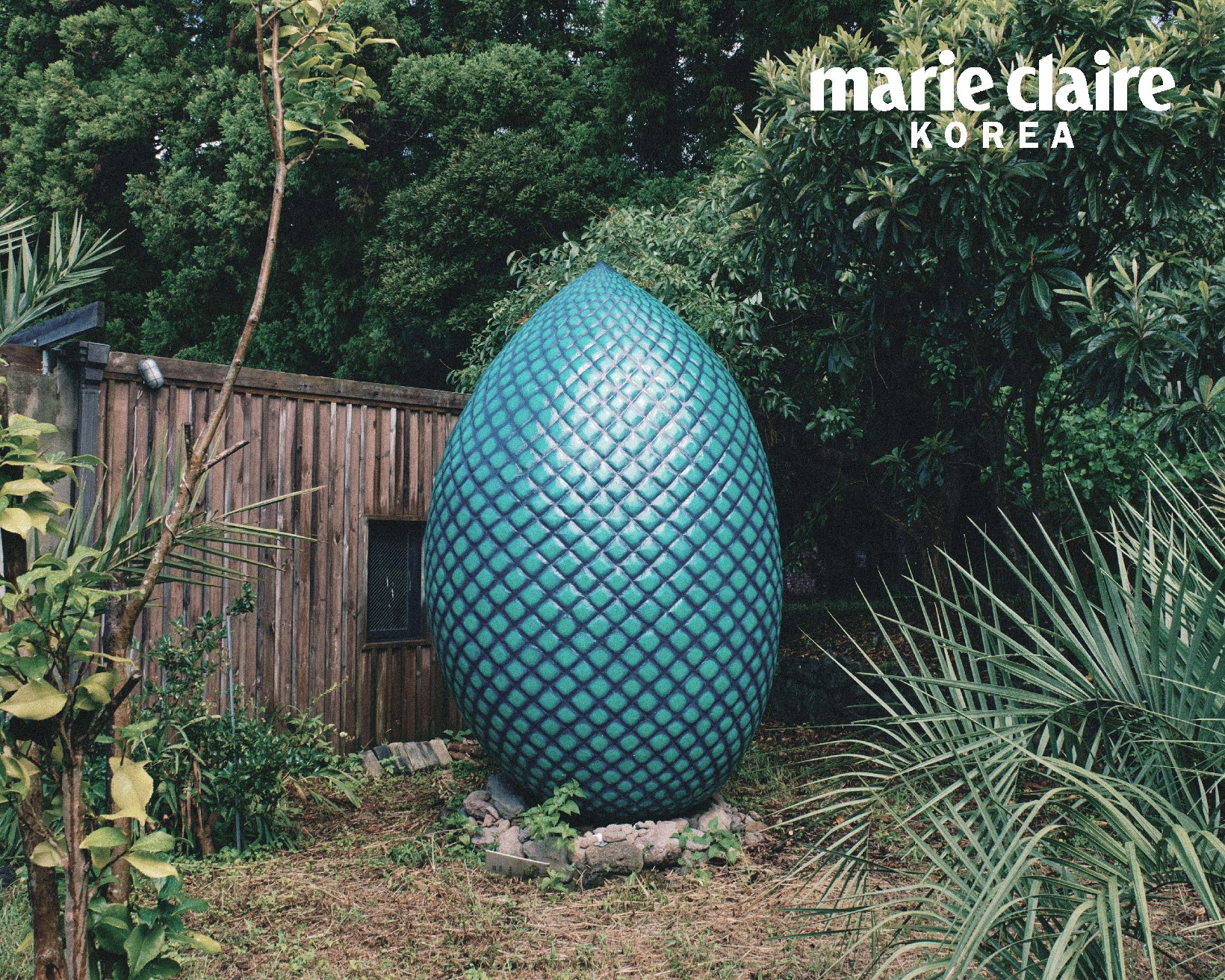
I love tropical plants. I enjoy visiting Yeomiji Botanical Garden, and we have many tropical plants in our own garden as well. My husband created both the garden and the pond. Sometimes I look at plants in different places and then paint them through my imagination. The landscapes in my paintings could exist somewhere, but I don’t paint them directly from what I see. They are landscapes in my mind. The world is enormous, isn’t it? I like to imagine that somewhere out there, a landscape I have imagined might actually exist. It’s the same with the seed paintings. I invented those seeds, but I like to imagine that perhaps they, too, exist somewhere in the world.
You work with traditional Korean pigments on canvas. Has your process of turning over canvas to apply the base coat, and subsequently painting on top, remained the same?
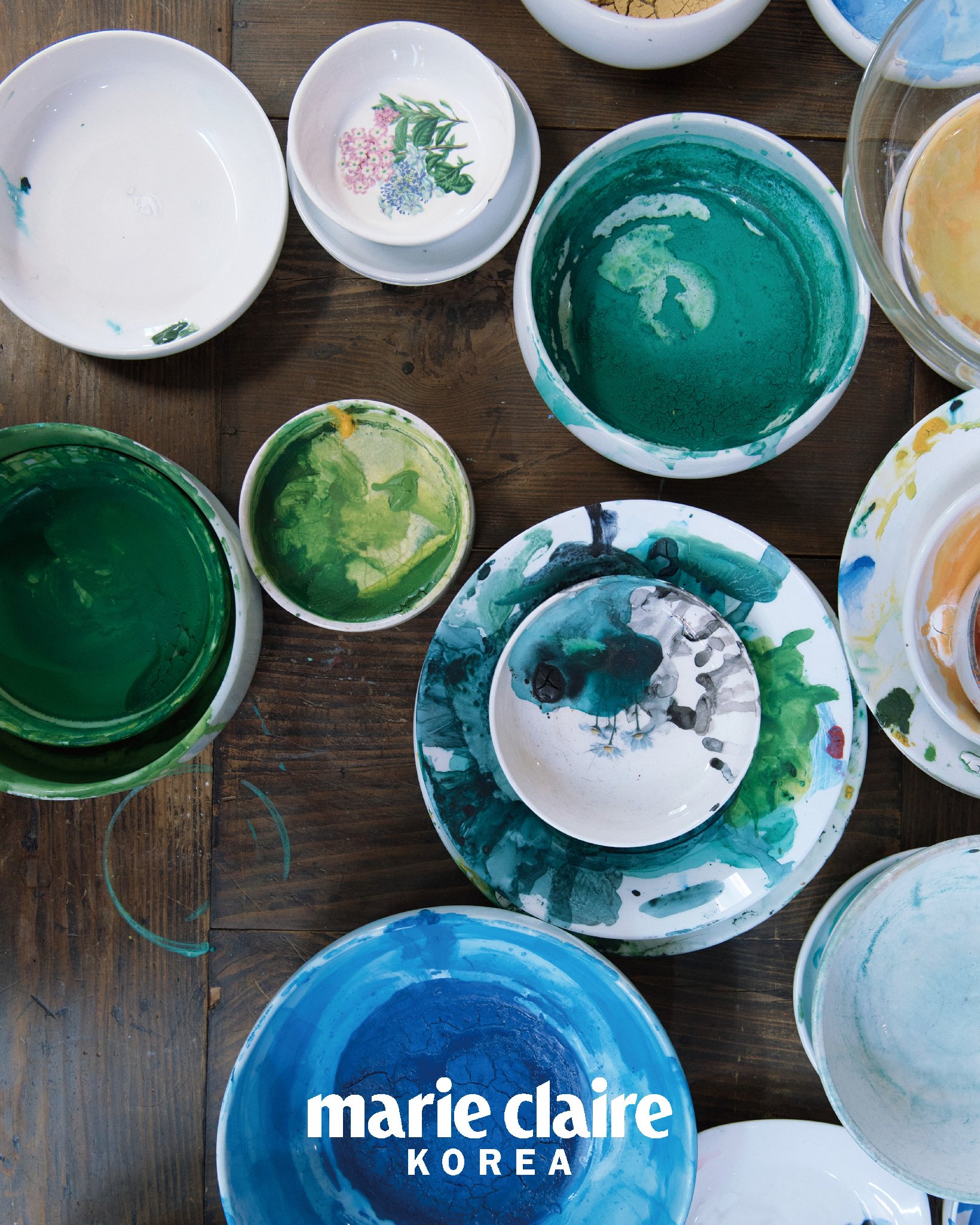
I used to paint on jangji, a type of thick Korean paper. But because I use traditional Korean pigments whether I’m working on paper or canvas, the support doesn’t make a great difference to the color itself. Korean painting has historically been made on silk, hemp and cotton as well, so using canvas has never felt particularly foreign or unusual to me. Paper was more fragile. I would mount it onto a thin wooden frame, almost like a window lattice, and it could easily become damaged. Joining separate sheets of paper together was another concern. Canvas, on the other hand, is strong and much better suited to large-scale paintings. I’ve become very accustomed to working with it now, so the process feels much easier. I used to struggle when applying traditional Korean pigments over gessoed canvas because the surface wouldn’t take the color very well. These days, I apply a traditional ground directly onto ungessoed canvas before adding the pigments, which allows the color to absorb much more effectively. If the canvas has already been gessoed, I sometimes simply turn it over and work on the reverse.
Many artists work with traditional Korean pigments, yet your colors are immediately recognizable. The blues of the Jeju sea and the night sky around the moon can sometimes look uncannily like the colours in your paintings. What makes your palette so distinctive?
Perhaps people feel that way because my Jeju paintings became more widely known after the exhibition at Kumho Museum of Art. (Laughs.) I love every kind of color, not only green and blue. Every color has its own appeal. I love red, I love blue—they’re all beautiful. What matters is how they come together. A long time ago, professors of Korean painting discouraged students from using color. They regarded colored painting as something influenced by study in Japan, a lingering remnant of Japanese painting. Working only in black ink can perhaps create a certain distance from the subject and make it appear more contemplative. But when I look at something, I see its color as much as its form, so I never felt any desire to suppress it. We aren’t color-blind, after all. If the world gives us color, why turn away from it? On a misty, overcast day, the whole world already looks like an ink painting.
Could you tell us about the title of this exhibition, TOWARDS: There Was Light? I understand that Towards, a title you have returned to for many years, suggests a way of looking continually beyond rather than arriving at a fixed destination.
For the fuller story, I think it’s best to read the exhibition essays. I’ve always used the title Towards because I want viewers to imagine for themselves. Without light, there can be no painting, so for me it is perhaps the most essential condition of all. You’ll find both sunlight and moonlight in the new works. Ninety-nine percent of this exhibition consists of new work. The only work that has been shown before is the large-scale The Days, made up of twelve canvases, which was previously presented at Art Basel Basel and Jeju Museum of Contemporary Art. All of these paintings come from what I have felt while living in Jeju. Nature gives me so much. What I feel changes from one day to the next, and no matter how often I see it, the nature of Jeju remains mysterious to me.
Leo is such a charming presence in your paintings. You’ve said that while he is your real-life companion, he also serves as a kind of alter ego. In what ways do you see yourself in him? Has he also become a source of inspiration for your work?
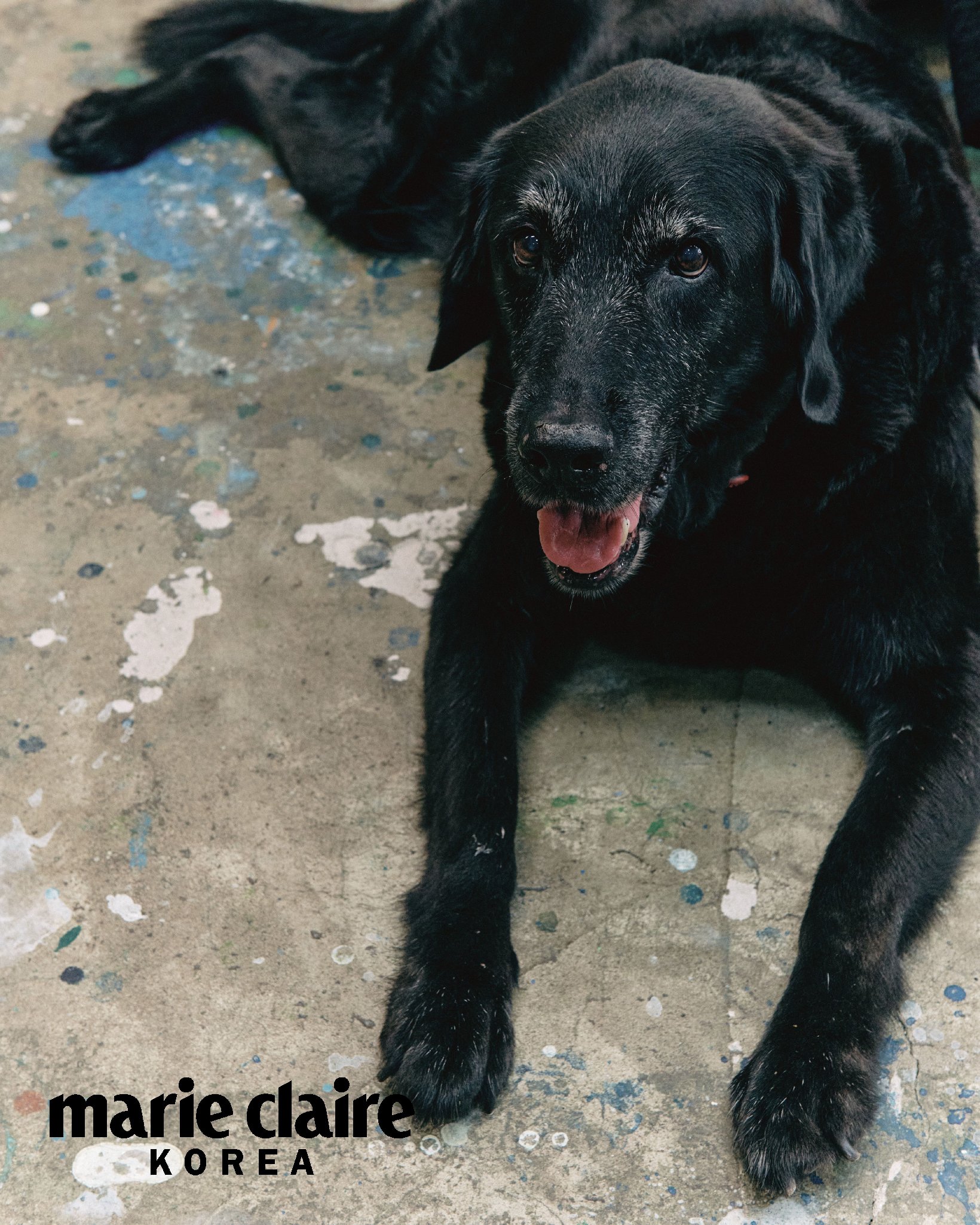
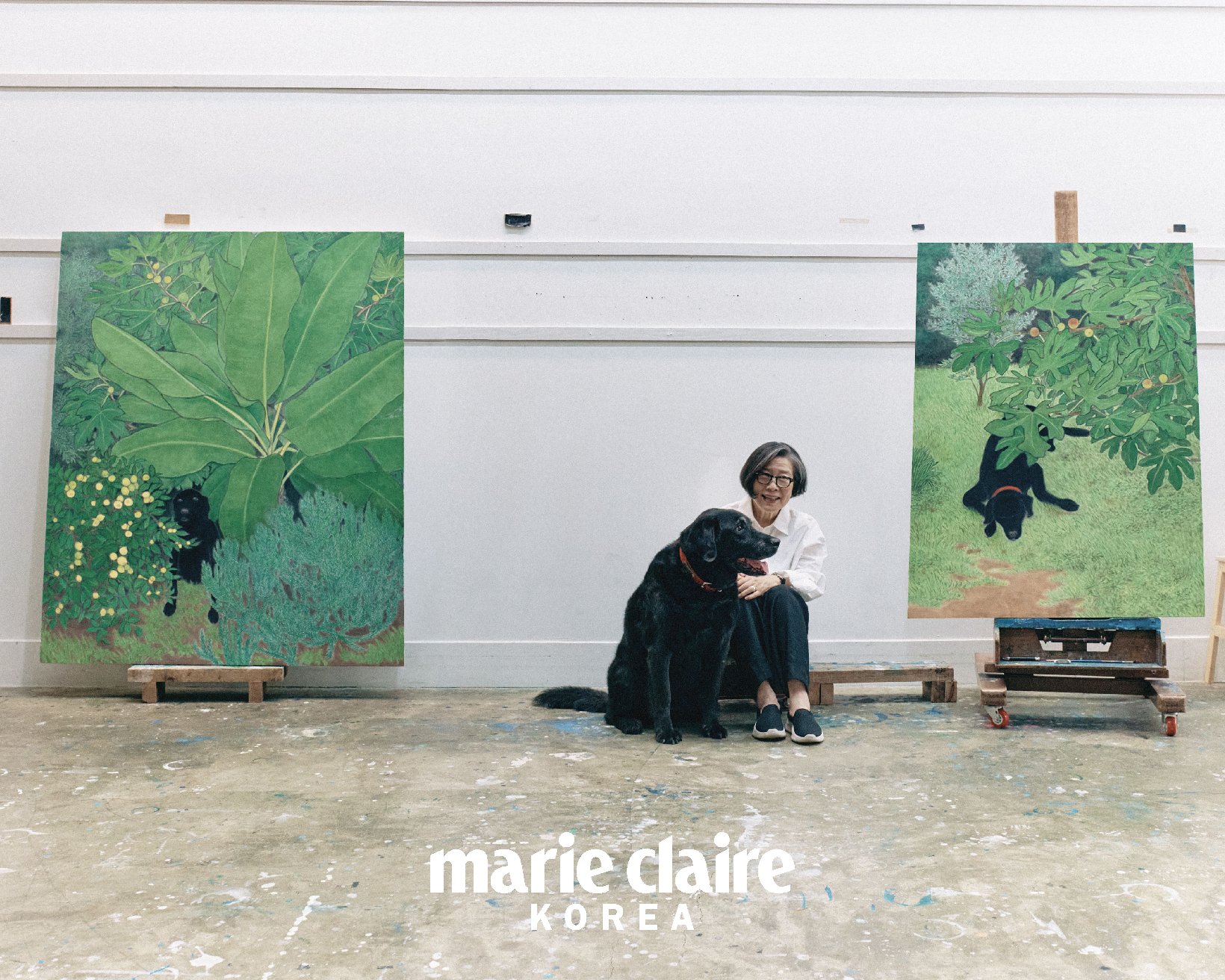
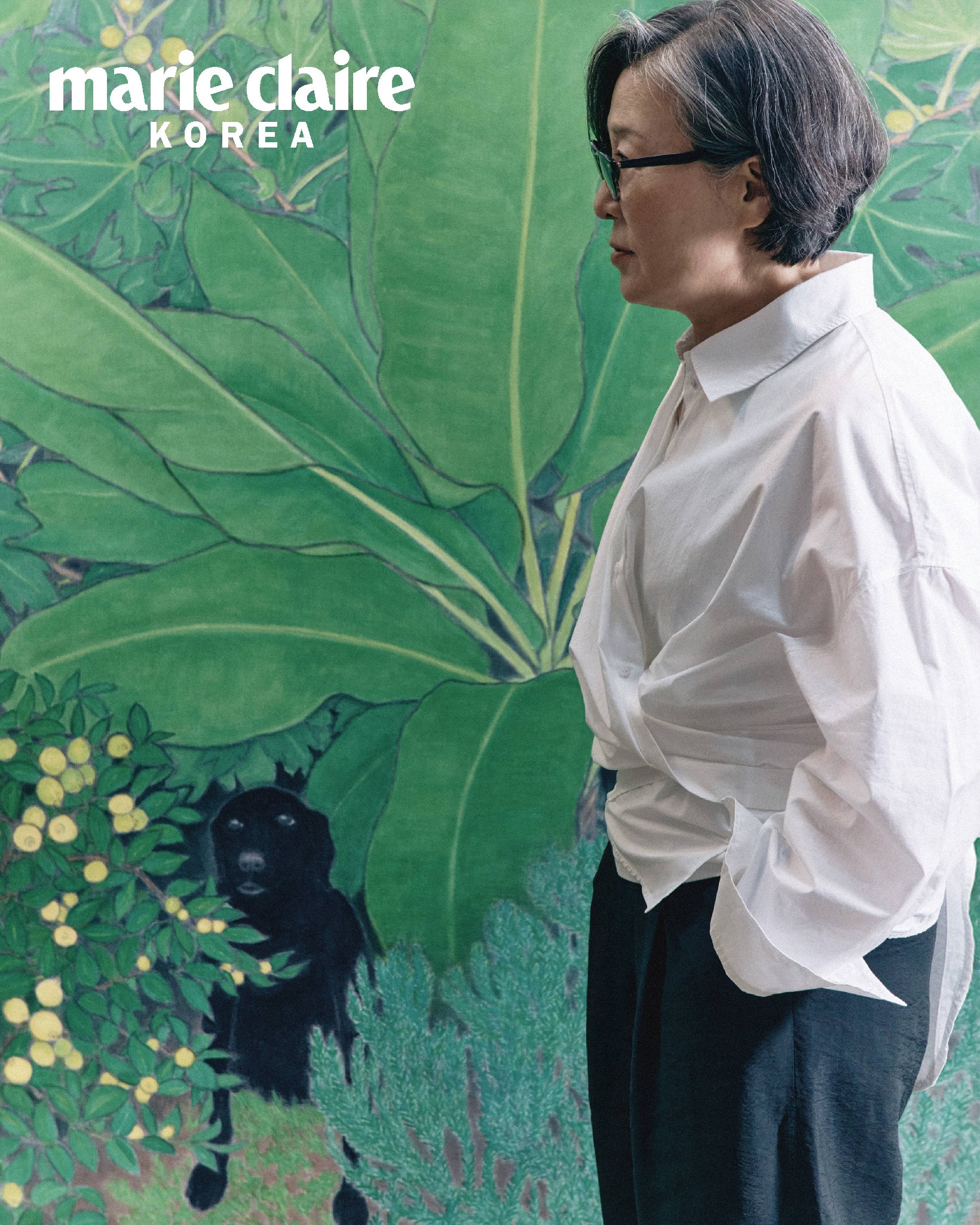
Leo has been part of our family for fifteen years. I don’t really want to put people in my paintings, but because Leo is black, he stands out beautifully against the natural landscape. He’s a wonderful subject and a beloved companion. I never imagined he would become so popular. Before Leo, I painted Jordan. He was such a clever, gentle dog. We had him from our days in Seoul, and when he passed away at nineteen, we buried him at the far end of the garden. These days Leo has put on a little weight, so I make him slimmer in my paintings. His eyebrows have turned white, too, but I still paint them black. (Laughs.) When Leo sits looking out at the sea, I see something of myself in him. Sometimes, when I paint him gazing at the ocean, he is really standing in for me. And when he disappears into the forest, it reflects my own desire to lose myself in nature.
In Self Portrait, you bring together seeds, flowers and withered stamens on a single branch. You’ve also described the mug that appears in your paintings as a trace of yourself. Why do you choose to leave these subtle signs of your presence within the work?
Self Portrait is the only painting I’ve ever given that title. I painted it after seeing, on a single branch, a withered flower alongside fruit and a new bud. If you look closely, even something withered can be graceful and beautiful. The flower had shrivelled like corn silk, yet it still held seeds within it. Looking at it, I thought perhaps there is beauty in growing old, even as our faces become lined with wrinkles. I thought, I’d like to grow old like that. If I could age like that flower, I could do so with confidence. It was a little promise to myself not to be ashamed of my wrinkles.
A while back, I encountered your paintings of rivers and mountains. Their colors feel quite different from those in your work today. Was that a result of a different technique, or do you think something changed in you or perhaps in the way we look at the paintings?
People have sometimes told me that my earlier paintings seem lonely. The truth is, I like a certain sense of solitude. I prefer quietness to busyness. Perhaps my recent paintings don’t seem as lonely because Leo is there. (Laughs.) In those days, my husband and I often saw each other only on weekends, or sometimes only at the end of the year, because his work for a construction company kept him overseas for long periods. Here in Jeju, I’m always with my husband and our dog. Perhaps that change in my life has found its way into the paintings as well.
You recently presented your work at one of the biggest art fairs in the world, Art Basel Basel, for its Unlimited sector, which focuses on large-scale projects. Your exhibitions at The Modern Institute in Glasgow and kaufmann repetto in Milan were also warmly received. International audiences may not necessarily be familiar with the colors of Jeju or the traditions of Korean painting. What have you heard about how your work is received abroad?
The response from audiences hasn’t actually been all that different. Some people find the materials unusual, but the exhibitions in Glasgow and Milan were very well received. At Frieze New York last year, Apple CEO Tim Cook acquired one of my paintings of a dawn landscape. I was deeply touched to discover that people from other countries responded to my paintings as well. After all, we love Matisse and Monet regardless of where they came from. I would like to make paintings that can be appreciated in that way, too. Having exhibited abroad several times has given me greater confidence. And when I’ve attended gallery and art fair openings, I’ve been amazed by how many people come to see the work.
What does an ordinary day look like for you? Does your routine change when you’re preparing for an exhibition?
When I have plenty of paintings around me, I feel rich, so I paint all day. My husband tells me not to work too hard, but when there aren’t enough paintings in the studio, I feel poor and impatient. I wake up early every morning, say my dawn prayers and have breakfast. I paint until after eleven, when I start thinking about what to have for lunch. My husband used to do all the cooking, but he’s getting older now, so these days I cook sometimes as well. I might take a short nap, and then before I know it, after more painting, evening has arrived. I often go for walks around Jungmun Beach or along the coast in Seogwipo. There are always people fishing, and the scenery is beautiful. Leo is getting older and doesn’t enjoy walks by the sea as much as he used to, so these days we mostly walk around our neighborhood. It’s a lovely place to walk. Sometimes I take photographs, but I don’t go out deliberately searching for things to paint. I simply look at whatever happens to catch my eye. If you try too hard to find a beautiful sunset, somehow you don’t see it. You have to let yourself look naturally
Painting alone in a quiet studio can seem almost like a form of meditation or spiritual practice. Do you find a sense of peace through painting?
Painting itself is always difficult. To get the color I want, one or two layers are rarely enough. Often I have to paint over the same area many times. Canvas has a warp and weft, with tiny ridges between the threads, and it’s difficult to work the pigment deeply into that texture. That’s why I use Western-style painting brushes rather than the softer brushes traditionally used in Korean painting. It takes quite a lot of pressure from the hand, so the process can be physically demanding. I never used to notice the pain in my hands, but these days I’m more conscious of it. It’s only when the painting is finished and the color finally comes alive in the way I wanted that I feel a sense of peace. That’s why I prefer to live with a painting for a while rather than finish it too quickly. The more you look, the more you begin to see things you hadn’t noticed before. I’m an emotional person rather than a rational one. When something in nature moves me deeply, I want to paint it so that I can share that feeling with other people. That is also why I’ve never been able to leave figuration behind. I want others to feel something with me; I want that sense of connection. Perhaps I’ll make very different paintings someday. But I think I’ll continue playing with color and enjoying the emotions it brings.
You held your first solo exhibition in 1980, which means this year marks forty-six years since your debut. What would you say has been the greatest change in the Korean art world during that time?
For a long time, we were like frogs in a well, looking only within Korea. Now we live in a time when every artist hopes to be known internationally. I think Korean artists can gain recognition abroad as well. Just as we know and admire celebrated artists from other countries, our artists should also become widely known beyond Korea. Korean artists are certainly no less accomplished. Perhaps we’ve reached a point where people can simply appreciate a good painting, regardless of the artist’s nationality.
Your paintings feel both figurative and abstract. How do you see the relationship between the two?
Nature is more abstract than anything else. You see it when you look closely, and the deeper you go, the more abstraction you find. Even a single leaf contains life, with veins running through it. Every form exists for a reason. What humans make is nothing compared with nature. There is an order to the way a branch grows; even mutations, however unusual, follow principles of their own. And there is something endlessly mysterious about the way a tree bears fruit. Every tree changes in its own way. The form may be figurative, but what it contains is abstract. My mind is abstract, too. Sadness and joy are abstractions for any artist.
Over the years, you’ve lived as an artist, a professor and a woman. Have there been moments of particular difficulty or crisis in your life? How did you find your way through them?
There was a time when I wondered, ‘Do I need to live like Chun Kyung-ja to make extraordinary paintings?’ I worried that because my own life seemed so ordinary, perhaps my paintings would be ordinary too. I don’t share Chun Kyung-ja’s love of snakes, although I do paint lizards quite often. (Laughs.) I was born in 1952 as the eldest daughter of a middle-class family. I was actually my parents’ fourth child. My three older siblings were all killed in an accident during the January 4 Retreat, when the truck they were travelling in overturned. I was born during those difficult years of displacement, but after entering Ewha Womans University, my own life unfolded relatively smoothly. I was able to continue painting and eventually became a professor. Becoming a professor isn’t something that happens simply because you want it, so I was fortunate in that respect as well. I’m grateful that I’ve been able to keep painting, and I’m happy that people respond to my work. I never painted out of a sense of obligation; I painted for myself. Still, I think I would have felt a little sad if I were the only person who liked my paintings. Of course, there were difficult periods when I couldn’t paint the way I wanted to. But I always tried to take the long view. I believed that if I simply kept working, eventually I would make a good painting. I was an ordinary university student, and I used to envy friends who seemed naturally gifted at painting. But if there is one thing I’ve learned over a lifetime, it is this: no matter how talented you are, talent means very little if you don’t keep at it.
What exhibitions or projects are coming next for you?
At my previous exhibition at Jeju Museum of Contemporary Art, I presented video and sculpture for the first time. The video work is also included in my current solo exhibition. There is also a new video work at Incheon International Airport Terminal 1, produced with Kim Youngjun, a professor of visual communication design at Hongik University. It extends 23 meters from the first to the second floor and will remain on view through November 14. I’m excited that people arriving in Seoul for KIAF and Frieze will be able to encounter it as soon as they land in Korea. After this exhibition, I would like to have a museum exhibition. I need to work diligently and build up enough paintings for that. Until now, I’ve been so busy preparing for one exhibition after another that I haven’t had much time to reflect on how my work itself has changed. Going forward, I’d like to give myself more room to think and to make new work. I want to remain honest with myself and true to what I feel at each moment.
Editor Ye Sol Kang and SoYoung Lee