
Shared Destinies
Aug 28 – Oct 20, 2024
Gallery Hyundai
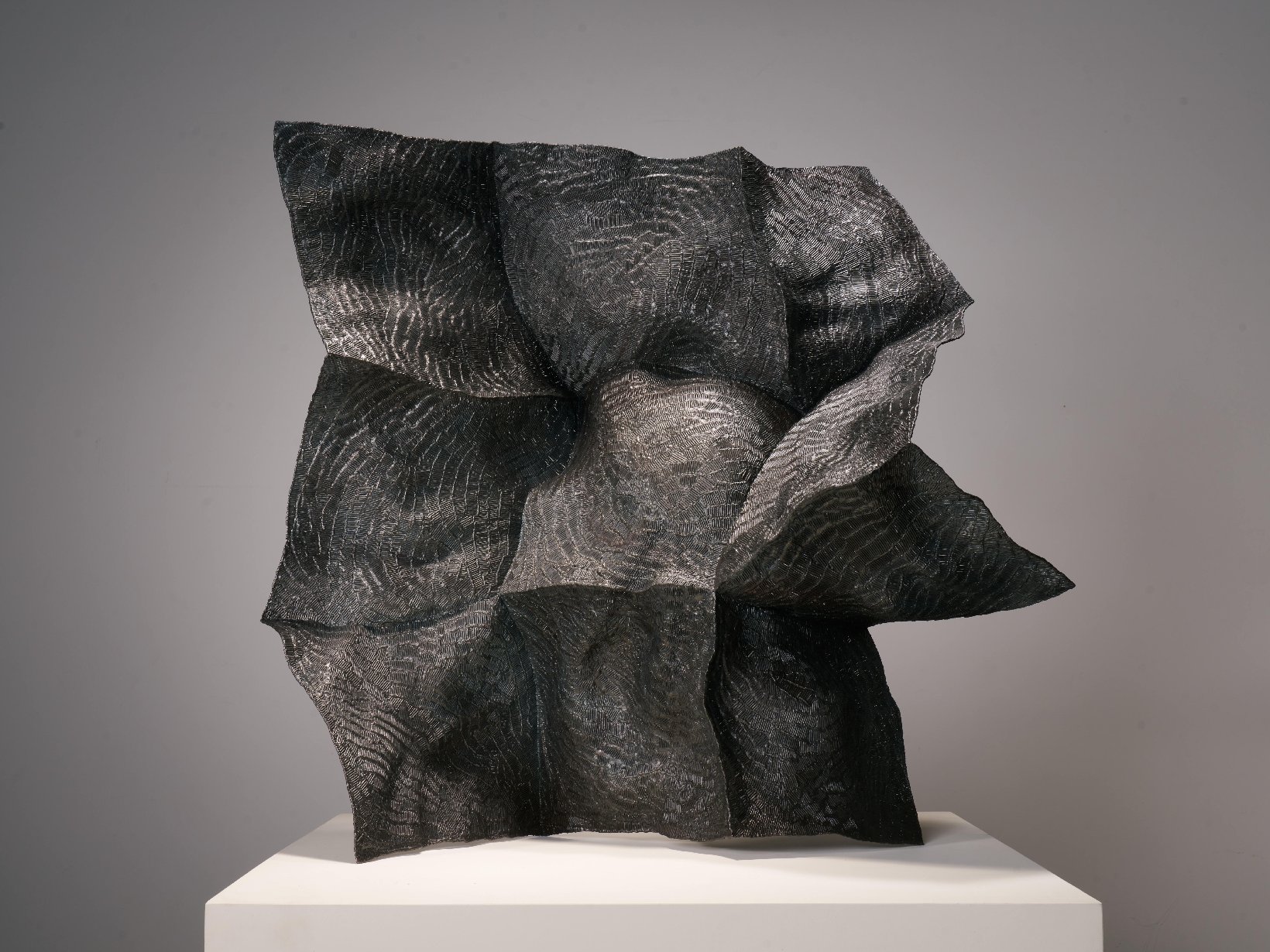
“My work embarks from a musical note—comparable to a single point or line within space. (…) Leonard Bernstein once said, “Music is about the next note.” Likewise, my process is about determining which note comes next (…) It is like having a conversation. As I determine the third, fourth, fifth [note], every point and line affects the whole.”—John Pai
Gallery Hyundai is pleased to present the solo exhibition of John Pai (b. 1937) from August 28 through October 20, 2024. Shared Destinies marks Pai’s solo exhibition in Korea in over a decade following In Memory’s Lair (2013) at Gallery Hyundai, and the exhibition presents a comprehensive journey through the artist’s seventy-year-long career. With early steel sculptures inspired by Constructivism that the artist created in the beginning of the 1960s as its starting point, the exhibition introduces around forty works comprising welded steel sculptures, drawings, and painting that represent each era of Pai’s oeuvre.
Born in 1937 in Seoul, John Pai spent his childhood in Ilsan, Korea, before moving to the United States in 1949. As a Korean American artist, he occupies a singular position within the field of welded steel sculpture. While Pai’s welded sculptures are formally and aesthetically distinct from American Minimalism, they were closely informed by other major currents in the Western art world. His signature use of countless thin, short steel rods echoes burgeoning movements in postwar New York: the American Bauhaus, the spirit of Russian Constructivism that was reconjured in the name of Neo-Avant-Garde, and reductionist abstract sculpture. Atop this rich cultural soil, Pai developed his own interdisciplinary sphere of interests encompassing music, visual art, mathematics, and science. Notably, Pai considers each steel rod in the manner of a musical note, achieving a harmony of interconnected parts and a whole that mirrors concepts found in East Asian philosophy. Pai’s artistic language is inseparable from the conceptual implications of his process of melting solid steel with fire into a fluid, alchemical liquid to activate the transfer between one medium to another and to venture beyond the dualism of East and West.
In an essay that accompanies the exhibition, art historian Yeon Shim Chung highlights the sense of movement and ambiguous spatiality in Pai’s steel sculptures. She notes that the artist’s prolonged physical labor gives birth to a flexible yet geometric, open yet closed structure that has neither a beginning nor end, like a Möbius strip. His grid sculptures depart from symmetry and the modernist pursuit of an ideal form, instead foregrounding spontaneity in both their production that begins without a sketch and in their dialogue with the surrounding environment. The points and lines created by connecting steel rods, as well as the planes created with rods and their surroundings, all exist within a matrix of interconnectedness and mutual dependence, embracing dualities of vulnerability and strength, fluidity and solidity.
John Pai’s sculptures embark from a point or line within empty space. Like a composer progressing from one note to the next to arrive at an exquisite melody, Pai grasps the moving forces of points and lines as well as their mutual relationships and principles of motion to guide the development of his work. Pai’s artistic process reveals parallels not only to musical composition but also to scientific concepts, as reflected in the artist’s references to the straightforward, lucid, and penetrating thought processes of scientists. The artist’s interest in science emerged early in the 1960s, when he experimented with mathematical models such as tetrahedrons to understand the relationship between parts and wholes within systems. This led to complex lineal sculptures composed from thin, short steel rods where the axis functions as the center of weight between the top and bottom sections, and yet their asymmetrical construction creates a sense of soaring movement. Pai begins without a predetermined result in mind, spontaneously conversing with points and lines within space as they start to coalesce into organic forms that, when finished, can defy even the artist’s expectations. The resulting works engage viewers like living beings that appear paradoxically both frozen in time and poised to transition into a different state.
John Pai describes his works as “drawing[s] within space.” He is often inspired by nature, creating amorphous web-like structures from circular curves that resemble entangled spiderwebs or coral reefs. These transparent, irregular webs are accented by small waterdrop-like units. Their overall image, built around a central core, can be read as plants, the curves of leaves, or swimming biomorphic organisms. Curved planes formed by entangled lines transform the heaviness of steel into a dynamic of light, spry, and soaring movement—the outcome of fire and the artist’s own hands together manipulating steel as if freely drawing in space, and creating a form that continuously changes its guise within a space depending on one’s angle and perspective.
John Pai’s rich artistic journey over seven decades reflects a series of surprising evolutions. He has consistently undertaken interdisciplinary inquiries spanning from art, human memory, and the subconscious to music, science, East Asian philosophy, and literature. In particular, his deep interest in music, athletics, ballet, and modern dance informs his intuition and heightens his perception of movement within space. At this momentous solo exhibition, audiences can look forward to enjoying John Pai’s works as they impart the animated vivacity of live music.
“저의 작품은 하나의 음표에서 시작한다고 이야기할 수 있어요. 많은 작품들이 말 그대로 하나의 점이나 선에서 시작하지요 (…) 레너드 번스타인은 “음악은 다음 음표에 관한 것이다”라고 쓰기도 했었죠. 제 작업도 마찬가지라고 볼 수 있어요. 다음에 올 음은 무엇일까? (…) 마치 대화가 일어나는 것과 같습니다. 세 번째, 네 번째, 다섯 번째를 이어 나가면서 각각의 점들과 선들이 전체에 영향을 미치게 되지요.”—존 배
갤러리현대는 존 배(1937년생)의 개인전 《운명의 조우》를 2024년 8월 28일부터 10월 20일까지 개최한다. 2013년 갤러리현대에서 열린 전시 《In Memory's Lair》 이후 10여 년 만에 열리는 국내 개인전으로 이번 전시는 존 배의 70여 년의 예술적 여정을 집약적으로 선보이는 자리이다. 1960년대 초반 구축주의에 영향을 받아 제작된 초기 강철 조각을 비롯하여 연대기별로 주요 철사 조각, 드로잉과 회화까지, 작가의 작품 세계 전반을 아우를 수 있는 작품 40여 점을 선별하여 소개한다.
존 배는 1937년생으로 서울에서 태어나 일산에서 유년을 보내고, 1949년 미국으로 이주한 코리안 아메리칸 미술가로 철을 이용한 용접 조각의 독보적인 위치를 차지하고 있다. 그의 아버지는 목사였으며, 어머니는 러시아 태생으로 러시아에서 엘리트 교육을 받았던 신여성 한국인이었다. 존 배는 태어난 이후 아버지와 떨어져 지내다 1949년 한국을 떠나 샌프란시스코를 거쳐 웨스트버지니아로 이주한다. 이후 존 배는 프랫 인스티튜트(Pratt Institute)의 디자인 학부에 4년 전액 장학생으로 입학한다. 당시 구축주의와 미국식 바우하우스를 접하며 조각가를 꿈꾸지만, 당시 프랫 인스티튜트에는 순수미술 전공이 없었다. 학교 측은 존 배에게 맞는 순수미술 프로그램을 신설하였으며, 1965년 존 배는 대학원 졸업 후 스물여덟이란 나이로 프랫 인스티튜트에 최연소 교수로 취임한다. 구축주의에서 예술 실천이 삶과 예술을 통합하는 교육적 방법론과 뗄 수 없는 관계이듯, 그에게 40여 년 간의 교수직은 단순한 직업의 의미를 넘어서 자신의 사고관을 계속해서 실험하고 조각 분야의 다학제적 연결 가능성을 확장하는 통로였다. 1979년부터는 조각부 의장을 맡으며 현상학과 생체공학 과목을 신설했고 여러 현대 예술가들을 초청하며 수학, 과학, 자연에 대한 관심을 다방면으로 탐구하는 계기로 삼았다. 2000년, 그는 작업 활동에 전념하고자 교수직을 내려놓는다. 존 배의 조각은 미국 미니멀리스트 조각가들의 용접 조각과 조형적, 미학적으로 확연한 차이가 있지만, 서구의 예술 운동의 흐름과 연결되는 지점이 있다. 가늘고 짧은 철사를 용접하여 사용하는 그의 조각에는 1950–1960년대 뉴욕에서 전후 추상과 미국식 바우하우스, 네오 아방가르드의 이름으로 새롭게 인정받기 시작했던 러시아 구축주의 정신, 전후 미국의 환원주의적 추상 조각 등의 흐름이 엿보인다. 나아가 존 배는 당시 미국의 예술적 토양을 넘어 음악과 미술, 수학과 과학 등 다학제적인 관심사를 발전시키고, 하나의 철심을 하나의 음처럼 사용하여 전체와 부분이 상호연결성을 갖는 조화와 내부와 외부의 경계를 무화하는 동양 철학의 세계까지 포괄하며 독창적인 예술관을 형성했다. 또한, 그의 예술 언어는 단단한 철을 녹여가는 과정으로서의 개념성을 동반하며 동서양의 범주를 넘어선다. 고체에서 액체라는 연금술적인 액체성과 불을 통해 하나의 매체에서 다른 매체로의 이동을 자유롭게 하는 전이성이 동반된다.
미술사학자 정연심은 존 배의 철 조각에 소요된 물리적인 노동의 시간성 자체보다 그 긴 노동을 통해 그가 구현한 탄력적이면서도 기하학적인, 열려 있으면서도 닫혀 있는, 시작과 끝이 없는 뫼비우스 띠와 같은 모호한 공간성과 운동성을 주목한다. 또한 좌우대칭과 같이 모더니즘적인 완결된 형태에서 벗어난 존 배의 그리드 조각이 주변의 상황과 교감하는 역할, 조각의 정밀함이 계획에 의해서가 아니라 우연적인 요소를 통해 형성된 점 등을 강조한다. 철사와 철사가 연결된 점과 선, 철사가 만들어내는 면과 주변 공간이나 환경이 서로 상호 연결되거나 상호 의존성을 보여주어 일종의 취약하지만 강인하고, 유연하지만 단단한 양가적인 공간을 만든다는 점이다.
존 배의 조각은 비어 있는 공간 속에서 점이나 선으로부터 시작된다. 이전 음표가 다음 음표로 대화하듯 연결되며 아름다운 선율로 완성되는 음악처럼, 그는 작업이 진행되는 동안 점과 선이 품는 움직임의 기류를 감지하고, 서로 간의 관계와 작동 원리를 관찰하며 작품을 발전시킨다. 그의 작업에서는 작곡과의 유사성뿐 아니라 과학과 수학의 원리도 발견할 수 있다. 과학자, 수학자들이 사고하듯 작가는 직설적이고 명료하게 중심을 관통하는 힘에 대해 숙고한다. 나아가 그는 얇고 짧은 철사를 용접해 복잡한 선형구조의 작품을 제작했고, 코어 축을 중심으로 하부와 상부가 나뉘지만 비대칭적인 구조를 구축하여 운동감을 적극 살렸다. 존 배는 미리 완성을 상정하지 않은 채 작업을 시작하고, 공간 속에 놓인 점과 선과 대화를 이어가며 유기적인 구조로 작품을 구축한다. 이렇듯, 완성된 작품은 그가 예측하는 범위 바깥의 형태를 띠게 되고, 역설적으로 멈춰 있지만 동시에 다음으로 전환하려는 움직임의 상태에 놓인, 마치 살아 있는 유기체처럼 관람객의 시선을 사로잡는다.
존 배는 자신의 작품을 ‘공간 속 드로잉’이라 말한다. 자연에서 많은 영감을 받은 그의 작업은 거미줄이나 산호가 얽혀 있는 듯한 형상과 원형의 곡선으로 만들어진 비정형을 보여주며 동시에 물방울같이 내부가 훤히 보이는 투명성을 가진다. 코어를 중심으로 형성된 형태는 하나의 뿌리와 줄기로부터 식물을 보는 듯하기도 하고, 나무의 곡선, 유영하는 생명체나 유기체로 보이기도 한다. 얽힌 선들의 집합체가 갖는 곡면은 보는 이에게 철제 재료를 날렵하고 가볍게 느껴지게 하고, 비상하는 듯한 운동성으로 다가온다. 불과 손을 사용하여 제작된 철이 무거운 속성에서 벗어나, 공간 속에 놓이며 보는 시점과 시각에 따라 다른 운동성을 가지고, 공간에 입체적으로 그려진 드로잉으로 다가온다.
자신만의 ‘길’을 걸어온 존 배의 예술적 여정은 놀라운 진화의 연속이라 할 수 있다. 그는 인간의 기억과 잠재의식, 미술뿐 아니라 음악, 과학, 동양 철학 및 문학을 횡단하는 학제 간의 탐구를 지속적으로 수행해 왔다. 특히 음악과 다양한 스포츠, 발레, 현대 무용 등에 대한 관심은 그에게 공간 속 움직임에 대한 직관과 감각을 일깨우는 영감으로 작동한다. 이번 존 배의 개인전에서 마치 연주되고 있는 음악 같은 작품들을 바라보며, 살아 있는 듯한 작품의 생명력을 경험할 것이다.
Installation Views
{{ lbCurrent.title }}
{{ lbCurrent.text }}