
Botched art: the meanderings of Sung Neung Kyung
Aug 23 – Oct 8, 2023
Gallery Hyundai
"Only visual art bears materiality. Other forms of art, such as poetry, literature, film, and music, do not exist in flesh. It is because of this materiality that the value of visual art is determined by an estimated worth. The conceptual art that constitutes the bedrock of my practice is fundamentally founded on the commitment to removing all materiality from visual art." - Sung Neung Kyung
Gallery Hyundai proudly presents a solo exhibition of Sung Neung Kyung (b. 1944), Botched art: the meanderings of Sung Neung Kyung, from August 23 through October 8. This exhibition marks the first collaboration between Gallery Hyundai—a leading gallery that has cast new light on Korean experimental art since the early 2010s—and Sung Neung Kyung, one of the great pioneers of Korean conceptual art. Subverting typical or accepted modes of thinking, as framed by the perimeters between reality and art, is a hallmark of Sung's artistic practice that is epitomized by the keywords “botched art” and “meanderings” that form the title of the exhibition. To this day, the artist has remained true to his non-mainstream identity and defines his own works as “botched art,” reflecting on traditional aesthetics and enacting variations of his “meanderings (performances)” that question conventional grammars of art and the conditions of human life itself.
Botched art: the meanderings of Sung Neung Kyung presents a selection of 140 works that are displayed compactly, sequentially forming a dense historical narrative that encompasses Sung’s five-decade-long career in the form of a mini-retrospective. The exhibition first introduces iconic works that merge together newspapers, photographs, and performance from the artist’s 1970s conceptual art period, including Contraction and Expansion and Index Finger, along with the Venue series from the 1980s, where Sung re-edited photographs from newspapers and transformed them into site-specific photography installations. Continuing to trace the trajectory of his career, the exhibition presents the artist’s innovative photographs and photography installations from the 1990s to 2000s, including S’s Posterity: Botched Art Is More Beautiful and Private Room (Sung’s self-proclaimed “botched art” based on his personal narrative as a full-time artist and a father of four children), along with a humorous performance that—quite literally—acts out the phrase, “art is short and the avant-garde life long”; the exhibition concludes with Everyday English, Handwashing, and Drawing by Your Bottom, works from the 2010s continuing through the present that challenge the boundaries or fissures between everyday life and art as engaged by the now-elderly experimental artist.
Since the early 1970s, Sung Neung Kyung was an active member of the Space & Time Group (hereafter ST), where he began to forge a unique practice distinct from that of other art movements of the time by foregrounding the artist’s body and action while minimizing materiality. Identifying photography as the best resolution to his artistic endeavors, in 1974 Sung purchased a secondhand Nikon F2 camera to self-study the medium. Producing a vast body of work with a commitment to digging into the conceptual roots of photography, in 1976 the artist announced two consecutive works that turned the page in Korean contemporary art history, Contraction and Expansion and Index Finger, which marked the arrival of a new format that merges performance with photographic records of a series of bodily actions. First introduced in Three Person Event in 1976, Contraction and Expansion consists of twelve photographs that document the artist as he stretches out his hands to “expand” his body, then kneels on the floor to “contract” it. This exhibition juxtaposes the first-ever photographic print of the work with the slide films produced from it, revealing the process of experimentation in Sung Neung Kyung’s unique strain of conceptual art that employs photography as its main medium. Index Finger, first presented at The 5th ST Exhibition in 1976, is shown as a vintage original, featuring a linear arrangement of seventeen photographs of nine shots where the artist stretches his arm to place the focus on his index finger, then gradually moves the finger to his mouth as he continues to adjust focus. On Sung Neung Kyung’s early photographic work that distills the artist’s physical acts, art historian Cho Soojin has remarked, “the artist’s body simultaneously [plays the role] as the main actor and subject of the photograph, recording the progress of an action within a particular context, and installing photographs in a consecutive sequence instead of following a particular aesthetic or hierarchical order…This particular series of works in Sung’s oeuvre bore similarities to other conceptual photography works that emerged in other parts of the world during the 1970s.” She evaluates the work as “a new type of portrait photography unique to the Korean avant-garde, challenging the idea of worshipping the artist as a sacred and heroic being” (Cho Soojin, Sung Neung Kyung’s “Botched” and Disruptive Art: Half a Century of Becoming Avant-Garde, 2023).
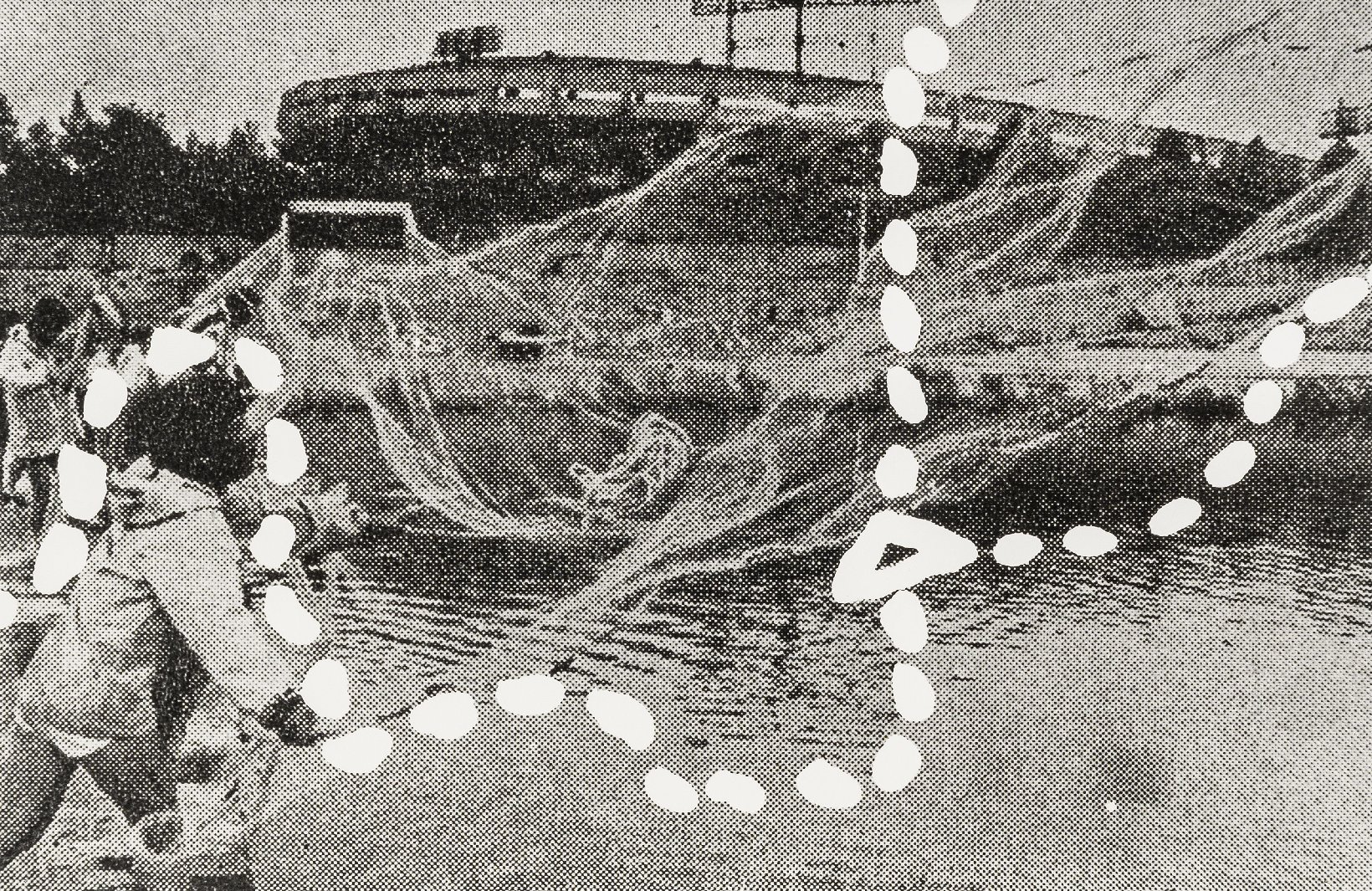
The photography installation Venue dominates the first floor, rhythmically punctuating the walls. Venue exemplifies Sung Neung Kyung’s utilization of news photography as a medium, incorporating newspapers, photography, and drawing. First introduced in 1979 at The 5th Seoul Contemporary Art Festival (National Museum of Modern and Contemporary Art (MMCA), Deoksugung), the series departs from symbols such as dotted lines, arrows, circles, triangles, and “X” marks that identify the site of each documented incident and guide the audience to interpret the photographs. In preparation for this series, the artist first collected an expansive body of news photographs for a number of years, out of which he selected 1,500 images that he shot close-up with a micro lens. He then proceeded to superimpose symbols with ink and a fine brush on the 35mm film, and enlarged it into gelatin silver prints measuring 23 x 35 cm in size. These photographs were then arranged site-specifically to expand throughout the space, constituting a photography installation that was groundbreaking in its methodology. Sung printed approximately 2,000 photographs from 1979 to 1985, of which over 1,000 originals remain. The artist explains the creative intention behind Venue as “an act of nullifying and reconstructing the interpretation suggested by news editors.” As such, Venue was conceived ahead of its time in its use of appropriation—an often employed methodology in contemporary art today—while also functioning as a historical archive that captured the rapidly shifting sociopolitical climate in Korea, as well as visual documents of the artist’s drawings and actions. Despite its foundation in photography, Venue is highly regarded as a series that bears originality, instead of mere reproductions, due to the artist's unique reinterpretations of each print.
Sung’s ceaseless experimentation with photographic images extends into the 1990s and 2000s with autobiographical photographs and photography installations. This idea harkens back to a work created in 1977 titled S. at Mid-Life, for which Sung had used his own image from different eras of his life, from student years to as a fully-fledged constituent of society. Pointing the lens back at his own self and surroundings, the artist broke away from the public and anonymous media that are newspapers and news reports, instead placing individual narrative at the forefront through personal photographs and mixed media with works such as An Album of Four Children, S’s Posterity: Botched Art Is More Beautiful, and Private Room. Presented at his solo exhibition in 1991 at Samduck Gallery in Daegu, S’s Posterity: Botched Art Is More Beautiful refers to “S” as the artist Sung Neung Kyung himself. Seen as a sequel to S. at Mid-Life, the work palpably visualizes the artist’s life as a parent. Taking on the upbringing of his four children in place of his wife who worked full-time as an elementary school teacher, Sung was able to capture his children on camera over the years, which allowed him to accumulate “botched photographs” for approximately a decade. As the title indicates, these images were “botched” from the perspective of professional photography—they were out of focus or taken when the shutter was pressed accidentally. These “botched” photographs were then exhibited in juxtaposition to the colorful candy and snack wrappers left uncleaned by the artist’s children. Such personal narratives of a struggling father and artist engender sympathy across generations, while the ironic beauty of “botched photographs” expands into a pivotal idea in Sung Neung Kyung’s practice beyond the 1990s: “botched art.”
True to its title, Private Room consists of 18 photographs of the artist’s own bedroom. Placed as the centerpiece of his solo exhibition Art Is the Shadow of Delirium - Sung Neung Kyung at the Korean Culture and Arts Foundation Fine Art Center (today known as Arko Art Center) in 2001, Private Room sketches Sung’s bedroom in a delirious vision. As if to intentionally create “botched art,” the shoot accompanied a bizarre procedure for which the artist restlessly shifted around his dark bedroom with the iris on the camera open, all the while activating a flash approximately 200 times. Printed on Cibachrome, each image features overlapping layers of colorful, frenzied landscape of household goods and appliances within the personal space. According to the artist, Private Room was an attempt to “recover [his] painterliness” by going back to “color,” which was long neglected in his lifetime practice of conceptual art. Aluminum-Foil Man, introduced in the same space as Private Room, features a collaboration between Sung and the photographer Kang-woo Lee. Posing comically with aluminum foil wrapped around his body, Sung is the sole figure in the work, while Lee’s presence behind the camera is insinuated from his absence from the pictorial plane. By effectively sharing the work, the two artists wittily play on the individual artist’s abuse of exclusive rights in the process of art production, distribution, and consumption.
Introduced in 1998, Rush About to No Purpose is a performance drawing series that serves as an extension of Sung’s early work such as Location or Index Finger from 1976, speaking for the artist’s renewed interest in placing his actions at the foreground of his practice from the mid-1990s onwards. For the artist, performance is “a useful tool that allows the artist’s body to remain a relevant artistic medium.” The works, which are initially 4B pencil drawings on paper depicting subjects such as an eye wide open, silhouettes of male and female bodies, a black abyss, and a big smile with its teeth bare, are first hung in the exhibition space. Appearing before the audience, the artist begins his performance with ritualistic acts of inscribing epigraphs on a Korean traditional bamboo fan, reading the words out loud, and setting the fan on fire. The following actions circuitously testify sociopolitical phenomena or the artist’s personal experiences, such as changing his outfit and shouting “joyful!”, “fresh!”, and “jolly!” while applying shaving cream on the audiences’ faces as well as his own, sharing a bottle of Coca-Cola, or smearing shaving cream in expressionistic gestures on the prepared drawings. Subtitles for each act (or work) are Like running water – IMF, Woman spitting poison – the perks of having seven valid reasons for divorce, Man down after being hit over the head, Hee! Hee! Hee! I like it here, The moon’s howl – don’t look at the fingertip, Apollo – epidemic keratoconjunctivitis, Endodontic treatment, and Black box, a ghost, the unidentified. Integrating the artist’s body, words, and actions, along with audience engagement, Rush About to No Purpose epitomizes Sung’s “botched art.” The performance portion of the series will be reenacted at the press conference and opening reception taking place in celebration of the artist’s solo exhibition at Gallery Hyundai.
In the 2010s, the elderly artist once again discovered and developed a new aesthetic vocabulary from his daily life. Having grown up watching his father read the newspaper, reading newspapers has long been an important part of Sung’s routine. “Everyday English,” a regular newspaper column on English colloquial phrases, was the main source of English language education for the artist, who took meticulous notes from his daily self-study sessions. The near septuagenarian artist’s habit of reading the daily papers and his endeavor to learn the lingua franca are projected onto the newspaper collage-drawing works entitled Everyday English. Displayed alongside Everyday English, Handwashing functions as an extension of Index Finger (1976) that reflects the times of the pandemic, while Drawing by Your Bottom features colorfully edited smartphone pictures of toilet paper that was used to wipe off the artist's waste. As such, mundane acts of survival like using the toilet and washing oneself are reborn as works of art that convey a sense of humor, challenging the boundaries or fissures between everyday life and art from the artist’s experience of a global pandemic, as well as reflect the search for an alternate aesthetic language.
Sung Neung Kyung’s modest works evoke genuine resonance perhaps because they are so deeply seated in the life of an artist who has tacitly weathered through the turbulence of the past century. Reflecting the social sphere of the late 20th- and early 21st-century Korea while at the same time as distilling the condition of human existence into incisive creative grammar, Sung’s practice calls for a renewed examination and discourse of his art historical significance both in Korea and abroad. Sung Neung Kyung’s “meanderings in botched art” continue to this day.
“예술 중 미술만 유독 물질이 있다. 시, 소설, 영화, 음악 모두 물질이 없다. 물질성 때문에 재산 가치로 평가된다. 미술에서 물질성을 제거하는 작업이 (나의) 개념미술이었다” - 성능경
갤러리현대는 성능경(1944년생)의 개인전 《성능경의 망친 예술 행각》을 8월 23일부터 10월 8일까지 개최한다. 2010년대 초반부터 한국 실험미술을 재조명해 온 갤러리현대와 ‘한국적 개념미술’을 개척한 선구자로 평가받는 성능경 작가가 함께하는 첫 전시다. 전시 타이틀인 ‘망친 예술’과 ‘행각’은 성능경 작업만이 지닌 삶과 예술의 경계에서 생각의 틈새를 제시하고자 하는 작가의 예술관을 응축한 키워드다. 작가는 평생 비주류적 태도를 고수하며 자신의 작품을 ‘망친 예술’로 명명함으로써 전통적인 예술 심미관을 재성찰하고, 틀에 박힌 예술의 문법과 인간 삶의 조건을 향해 질문하는 ‘행각(퍼포먼스)’의 변주를 오늘날까지 실천하고 있다.
《성능경의 망친 예술 행각》전은 작가의 시대별 대표작 140여 점을 엄선해 미니 회고전의 형식으로 작품 세계를 조망한다. 1970년대 신문, 사진, 행위가 융합된 ‘개념미술’ 시기의 대표작 〈수축과 팽창〉과 〈검지〉, 1980년대 신문 보도사진을 재편집하고 이를 공간의 조건에 따른 장소 특정적 사진-설치 형식으로 풀어낸 〈현장〉 연작, 1990년대부터 2000년대까지 전업 작가이자 네 아이를 둔 가장이라는 자신의 개인사를 내용으로 '망친 예술'을 표방하며 선보인 〈S씨의 자손들 - 망친 사진이 더 아름답다〉와 〈안방〉 등의 사진과 사진–설치 작품, “예술은 짧고 전위의 삶은 길다”를 실천하는 해학적 퍼포먼스, 2010년대 이후 노년의 삶을 사는 실험미술가가 일상과 예술의 틈새를 탐색하며 제작한 〈그날그날 영어〉, 〈손씻기〉, 〈밑그림〉 등의 작품들이 꼬리를 무는 밀도 있는 구성으로 전시장에 펼쳐진다.
성능경은 1970년대 초반부터 Space & Time 조형미술학회(ST) 회원으로 활동하면서 당대 미술 흐름과 차별화되는 물질성이 최소화되고 미술가의 몸과 행위가 중심이 되는 독자적 작품 세계를 구축했다. 1974년 사진 작업 제작을 결심한 그는 중고 니콘 F2 카메라를 구입하고 독학으로 사진술을 익혔다. ‘사진이란 무엇인가’라는 질문을 던지는 개념미술의 어법을 지닌 사진 작품을 발표하던 그는 1976년부터 한국 현대미술사의 한 페이지를 장식하는 〈수축과 팽창〉(1976)과 〈검지〉(1976) 등의 대표작을 잇달아 발표한다. 일련의 신체 행위를 기록한 사진과 퍼포먼스를 결합한 새로운 유형의 작품이다. 1976년 《3인의 EVENT》전에서 공개한 〈수축과 팽창〉은 작가가 손을 뻗어 몸을 최대한 부풀려 ‘팽창’시키고 바닥에 엎드려 최소한 ‘수축’시키는 행위를 기록한 사진 12장으로 구성된다. 이번 전시에는 사진 제작을 위해 인화한 최초의 ‘인쇄용 사진’과 그것으로 제작된 ‘인쇄용 필름’이 함께 전시되어, 사진이 주요 매체가 되는 성능경식 개념미술 작업의 실험 과정을 확인할 수 있다. 1976년 《제5회 ST전》에서 발표한 〈검지〉는 이번 전시에서 빈티지 원본으로 공개된다. 작가가 팔을 쭉 뻗어 검지에 카메라의 초점을 맞추고 점차 입으로 검지를 가져가면서 초점을 수정하며 촬영한 아홉 장면을 17장으로 인화해 수평으로 나열한 작품이다. 미술사학자 조수진은 작가 본인의 신체 행위를 절제된 형식으로 포착한 성능경의 초기 사진 작품이 “작가 신체가 작업의 주체이자 대상이 된 점, 특정 맥락에서의 행위의 과정을 기록한 사진이라는 점, 미학적이며 위계적인 구성 대신 사진을 연속으로 나열하는 설치 방식을 도입한 점 등에서 1970년대에 세계 각지에서 출현한 여러 개념사진과 유사한 특징을 지니고 있었다”라고 설명하며, “기성 미술이 신봉해 온 고상하고 영웅적인 미술가 관념에 도전하는, 한국 전위의 새로운 유형의 초상 사진”이라 분석한다. (조수진, 〈성능경의 ‘망친’ 예술: 반세기의 전위 되기〉, 2023, 갤러리현대 전시 도록, 발간 예정)
전시장 1층 사방 벽을 리듬감 있게 가로지르며 점령한 사진-설치작 〈현장〉은 신문의 보도사진을 작업의 매체로 활용한 성능경의 대표 연작으로 신문, 사진, 드로잉 행위가 혼합되어 완성된다. 1979년 국립현대미술관 덕수궁에서 열린 《제5회 서울 현대 미술제》에서 첫선을 보인 〈현장〉은 신문 보도사진에서 사건 현장을 지시하고 독자에게 보는 방법을 제시하기 위해 새겨진 점선, 화살표, 원, 세모, X표 등의 편집 기호에서 작업이 출발한다. 작가는 이 연작을 위해 몇 년에 걸쳐 모든 종류의 신문 보도사진을 채집하고 그중 1,500여 장을 선별하여 마이크로 렌즈로 접사 촬영하였다. 그 후 먹과 세필로 35mm 필름에 다양한 편집 기호를 추가로 그려 넣고 23 x 35 cm 크기의 젤라틴 실버 프린트로 확대 인화하였다. 작가는 이렇게 만들어진 사진들을 전시 공간의 조건을 고려하여 공간에 확장되는 사진-설치로 풀어내면서 혁신적 방법론을 구축한다. 그는 1979년부터 1985년에 걸쳐 2,000여 점의 사진을 인화했으며, 현재 1000여 점의 원본이 그대로 남아 있다. 작가는 〈현장〉의 제작 의도가 “신문 편집자가 제시하는 사진 해석을 무효화하고 재해석하는 행위”라고 강조한다. 동시대 미술의 방법론인 ‘차용’의 어휘를 시대를 앞서 구현한 〈현장〉 연작은 세월의 흐름에 따른 한국의 시대 상황을 고스란히 포착한 역사적 아카이브이자, 작가의 드로잉과 행위의 기록물이며, 사진을 출발점으로 삼은 작품임에도 복제가 아닌 원본성을 지닌다는 점에서 미술사적 가치를 높게 평가받는다.
성능경의 멈추지 않는 사진-이미지 실험은 1990년대와 2000년대로 넘어오며 발표한 자전적 성격의 사진과 사진-설치 작품으로 이어진다. 1977년 〈S씨의 반평생〉이란 작품에서 학창 시절부터 사회인이 된 자기 모습을 작품의 일부로 사용했던 작가는 카메라를 다시 자신과 그 주변으로 향한다. 공적 매체이자 익명성을 특징으로 하는 신문과 신문 보도자료에서 벗어나, 〈네 남매의 사진첩〉(1990), 〈S씨의 자손들-망친 사진이 더 아름답다〉(1991), 〈안방〉(2001) 등의 작품을 발표하며 개인의 서사를 끌어안는 사적 사진과 혼합매체를 작업의 전면에 내세운 것이다. 1991년 대구 삼덕 갤러리에서 열린 개인전에서 발표한 사진-설치 작품 〈S씨의 자손들-망친 사진이 더 아름답다〉에서 S씨는, 즉 작가 자신을 지시한다. 〈S씨의 반평생〉의 후속작이라 할 이 작품에는 한 가족의 가장이 된 그의 삶이 여과 없이 드러난다. 그는 초등학교 교사였던 아내 대신 많은 시간을 네 남매의 육아에 전념하며 아이들이 성장하는 과정을 카메라에 포착했다. 작가는 핀이 안 맞거나 실수로 셔터가 눌러져 찍힌, ‘프로 사진’의 관점에서 본다면 제목의 단어처럼 말 그대로 ‘망친 사진’을 10여 년 동안 모아 두었다. 이 사진은 아이들이 먹은 사탕과 과자의 현란한 포장지 등과 병치해 전시된다. 아빠로서 작가로서 치열했던 작가의 개인사는 세대를 초월해서 공감할 수 있는 미술로 다가오며, ‘망친 사진’으로 전하려 한 ‘아름다움’은 1990년대 이후 전개된 성능경 예술 세계의 핵심 주제인 “망친 예술”로 확장된다.
〈안방〉은 제목 그대로, 작가가 거주하던 안방을 촬영한 18장의 사진 작업이다. 2001년 한국문화예술진흥원 미술회관(현 아르코미술관)에서 개최한 개인전 《예술은 착란의 그림자 – 성능경전》의 중심 작업으로, 그는 자신의 안방 풍경을 ‘착란’적 풍경으로 시각화한다. 이번에는 작정하고 ‘망친 예술’을 의도하듯, 작가는 어두운 안방에서 카메라 조리개를 개방하고 이리저리 이동하며 200여 번의 플래시를 작동시켜 촬영하고 이를 시바크롬에 인화하였다. 이렇게 완성된 이미지에는 작가의 내밀한 사적 공간인 안방의 살림 도구와 모습이 형형색색의 착란적 이미지로 중첩되어 나타난다. 그는 이 작품에서 평생 개념미술을 해오며 멀어졌던 ‘색’과 가까워지는 “회화성의 회복”을 시도했다고 한다. 삶과 예술, 사적 공간과 공적 공간, 사진과 회화 등의 문제적 이슈가 혼합되어 관객에게 질문을 던진다. 〈안방〉과 같은 전시에서 공개한 〈쿠킹호일맨〉(2001)은 자기 몸에 쿠킹호일을 휘감아 부착하고 펼친 여러 가지 신체 동작을 사진가 이강우가 촬영한 두 작가의 합작이다. 한 작업을 두 사람이 공유함으로써 예술 생산과 분배, 소비에 이르는 과정에서 한 작가에게 남용되는 배타적이고 독점적인 소유 의식을 위트 있게 희석시킨다.
1998년 발표한 〈우왕좌왕(右往左往)〉은 1976년 작 〈위치〉나 〈검지〉의 연장선에서 작가의 행위가 다시 전면에 등장하는 1990년대 중반 이후 시기를 대표하는 ‘퍼포먼스 드로잉’ 작업이다. 그는 퍼포먼스가 “작가의 몸이 미술에서 여전히 유효한 매체일 수 있게끔 하는 유용한 도구”라고 강조한다. 〈우왕좌왕〉에서 작가는 장지에 커다란 눈, 남성과 여성 몸의 실루엣, 검은 구멍, 이를 드러낸 채 웃는 입 등을 4B 연필로 그린 드로잉 작품을 전시장에 미리 걸어 놓는다. 관객 앞에 등장한 작가는 부채에 시축문을 써넣고 이를 읽은 다음 불사르는 제의적 행위로 퍼포먼스를 시작한다. 의상을 갈아입고 자신과 관객의 얼굴에 “유쾌!”, “상쾌!”, “통쾌!”를 외치며 면도 크림을 바르거나, 콜라를 나눠 마시고, 미리 완성한 드로잉 작품에 다가가 면도 크림을 표현주의적 제스처로 문지르면서 여러 사회적 현상이나 작가 개인의 체험 등을 진술하는 행위를 펼쳤다. 각 행위의 소제목은 “I.M.F“, “독을 뿜는 여자“, “고개 숙인 남자“, “히! 히! 히! 나는 여기가 좋와“(여성의 여러 몸 부위), “달의 외침“, “유행성 각결막염“(속칭 아폴로눈병), “신경치료“(이), “블랙박스“(괴편지)였다. 작가의 몸과 말, 행위 그리고 관객과의 소통이 한데 어우러진 성능경만의 ‘망친 예술’을 대표하는 〈우왕좌왕〉은 갤러리현대의 개인전을 기념하며 기자간담회와 개막식에서 다시 공연될 예정이다.
2010년대 노년의 작가는 다시 일상에서 미술의 새로운 언어를 발견하고 발전시킨다. 어려서부터 아버지의 신문 읽는 모습을 보고 자란 작가에게 신문 읽기는 중요한 일상인데, 작가는 신문에 고정 코너로 존재하는 ‘그날그날 영어’를 열독하며 자신만의 방식으로 공부하는 흔적을 정성스레 남겨왔다. 70대에 접어든 노년의 작가의 일간 신문 정독의 습관은 국제적인 언어가 된 영어를 제대로 구사하고자 하는 미술가의 신문콜라주-드로잉 작품 〈그날그날 영어〉가 되었다. 1층에 전시된 〈검지〉의 연장선에서 2021년의 시대 상황을 반영한 버전으로 해석 가능한 〈손씻기〉, 본인의 배설물을 닦은 휴지를 휴대폰으로 촬영하고 이미지 컬러를 형형색색으로 편집 수정해 완성한 〈밑그림〉은 글로벌 팬데믹을 겪은 작가가 일상과 예술의 틈새를 찾아 세상에 건네는 유머이자 또 다른 미술 언어를 탐구하는 작품이다. 용변을 보고 신체를 깨끗이 하는 일상의 생존 행위가 미술 작품으로 재탄생했다.
성능경의 검소한 작품이 크나큰 울림을 전하는 이유는 그의 작품이 급변한 지난 세기를 묵묵하게 살아온 한 미술가의 실존에 기반을 두기 때문일 것이다. 20세기 후반과 21세기 초반의 한국 사회상을 반영하면서 인간의 실존을 촌철살인의 언어로 승화한 그의 작품이 국내외 미술계에서 그 미술사적 가치를 새롭게 평가받고 있다. 그의 ‘망친 예술 행각’은, 오늘도 현재 진행형이다.
Installation Views
{{ lbCurrent.title }}
{{ lbCurrent.text }}