
Christine Sun Kim
Moon Mind
Aug 26 – Oct 18, 2026
Hyundai Hwarang
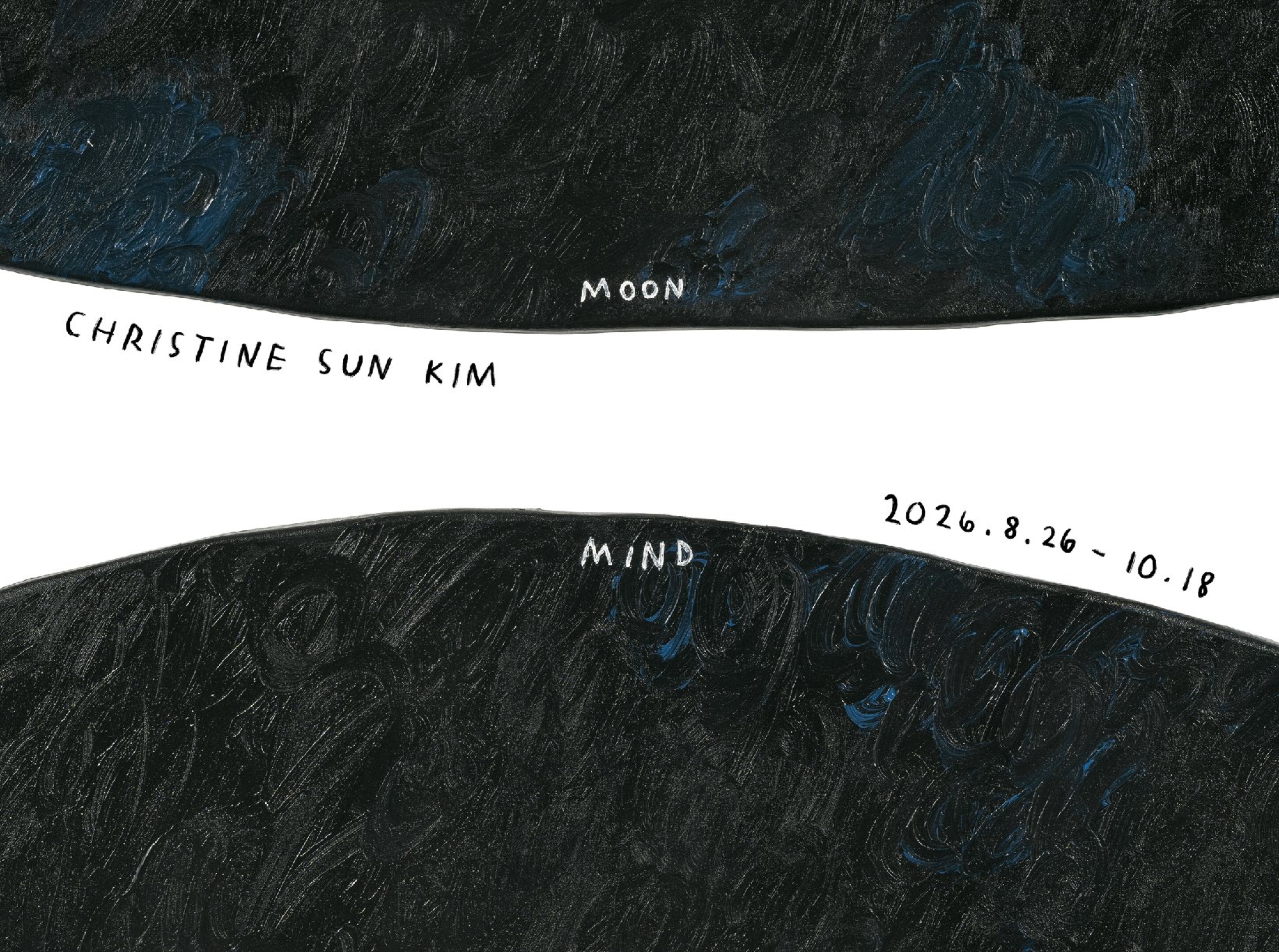
Gallery Hyundai is pleased to present Moon Mind, a solo exhibition by Christine Sun Kim (b. 1980), on view from August 26 through October 18. Marking Kim’s first gallery exhibition in Korea and her first solo presentation with Gallery Hyundai, the exhibition will debut the artist’s shaped canvas paintings for the first time. Kim has long transformed personal experience into new forms of language rather than direct representation, exploring the social structures of sound and language through her practice. In Moon Mind, Kim looks into her mind, memory, family, relationships with those around her, and her roots, presenting forty shaped canvas paintings and drawings in a rhythmic visual arrangement.
Christine Sun Kim’s practice studies how sound operates within society, addressing questions of sound, language, power, access, and social relations through a distinctive visual language. Working across drawing, performance, video, installation, large-scale murals, and public projects, Kim brings together American Sign Language (ASL), musical notation, written language, infographics, and humor as central elements of her work. Grounded in Deaf culture and her own experience, Kim examines the rules of communication assumed by a society organized around spoken language. Her work asks who gets to speak, who controls meaning, and which languages gain recognition in public space.
Moon Mind extends this line of inquiry while shifting Kim’s focus from social structures toward her own interior world. While her earlier works often foregrounded a critical engagement with the norms of a hearing-centric society and the histories of the Deaf community, the works in this exhibition treat the mind as a spatial form, giving it shape, weight, and a sense of proximity. Kim explores shifting emotions and memories through her relationships with herself, her family, her children, friends, and those around her. Through the experiences of becoming a mother, building a family, and seeing her language and work reach wider audiences, Kim begins to treat the form of the mind in a more playful and experimental way. Her focus, once directed toward social structures and the power relations embedded in language, deepens in this exhibition toward the personal mind, family, intimate relationships, and layers of time and memory, opening a new direction in her practice.
The shaped canvas paintings presented for the first time in this exhibition take the form of diptychs composed of an upper and a lower canvas. Continuing her recent Mind series, Kim develops this new body of canvas works by exploring the possibility of translating the mind into spatial and sculptural form. Depending on shifting emotional states, one’s mind may feel closer to or farther from another mind, a memory of the past, or an object such as the moon. Attentive to this fluid state of mind, Kim positions the mind and the object it encounters across the upper and lower canvases, using the distance between them to suggest shifting psychological proximity. The distance between the upper and lower canvases can change, suggesting the mind’s constantly shifting state.
The work Moon Mind, from which the exhibition takes its title, carries multiple layers of meaning that emerged as Kim reflected deeply on her inner world and roots. In ASL, the signs for “mind” and “moon” both involve a tap on the temple, creating a connection between the two words. The moon also appears in expressions that refer to time and the past, such as “once in a blue moon” and “many moons ago.” At the same time, Kim’s daughter is named Dal, which means “moon” in Korean. For Kim, the moon connects the mind, family, time, language, and her roots as a Korean American artist. It is also a recurring symbol found across expressions, myths, and stories in many languages. In this way, Moon Mind embraces a body of work that begins with the artist’s inner world and expands toward family, memory, cultural roots, and relationships with other minds.
The surface of the paintings also plays an important role in the exhibition. Just as charcoal leaves natural smudges and stains in Kim’s works on paper, the canvas works create another kind of trace. Kim builds up deep blues and greens through swirling brushwork, creating surfaces so dark they appear almost black, yet layered with depth. Unlike earlier works that often conveyed meaning clearly through text and symbols, the works in this exhibition allow color, brushwork, and the material qualities of paint to operate as a new visual language, revealing Kim’s inner world and sensibility. This shift and expansion also carries into the drawings made with acrylic paint. During her 2025 residency at the American Academy in Rome, Kim began experimenting with acrylic on paper, exploring the movement of the brush, the density of paint, and the ways it spreads and layers on the surface. In this acrylic series, words such as “Mind,” “Land,” “Mass,” “Tap,” “Touch,” and “Still” come together with arched lines, moving the work in a more abstract direction. Rather than guiding viewers toward one definitive interpretation, the works invite them to trace how the mind lands, touches memory, lingers in repetition, and gradually fades.
The exhibition also includes works that borrow musical dynamics, used to indicate volume in music, to visualize states of mind and the movement of time. Kim uses “p,” for “piano,” meaning to play softly, and “f,” for “forte,” meaning to play loudly, as signs for mapping states of mind and temporal direction. Here, p also refers to the past, connecting to roots, family, and home. As the number of ps increases, so does the weight of the past and the depth of time. By contrast, f refers to the future, connecting to energy, activity, speed, the unknown, and anxiety. The arched lines in the works evoke both the mind and land, while also suggesting the passage of time, in which a state continues and returns. Kim approaches the mind as a three-dimensional space and psychological terrain, using the arch to show how the sensations of the past, family, home, and homeland take root and accumulate within it. The softness or steepness of each arch reveals the rhythm and intensity of a mind moving through time, suggesting a motion that recedes and returns.
In Moon Mind, Christine Sun Kim brings together shaped canvases and drawings, musical dynamics and written language, and arched lines to present the mind not as a fixed state, but as a space in continual motion through time, relationships, and memory. Across the exhibition, the mind encounters the moon, land, the past, family, and other minds, creating different senses of distance, speed, and intensity. As viewers move through the exhibition, these elements form a visual rhythm of distance, return, and transformation, allowing viewers to sense how the mind’s relationships to others, to memory, and to itself continue to shift.
갤러리현대는 8월 26일부터 10월 18일까지 김 크리스틴 선(1980년생)의 개인전 《달 마음(Moon Mind)》을 개최한다. 이번 전시는 첫 국내 갤러리 전시이자 갤러리현대와 함께하는 첫 개인전으로, 작가의 셰이프드 캔버스 (shaped canvas) 페인팅 작업이 세계 최초로 공개된다. 김 크리스틴 선은 개인적 경험을 재현이 아닌 새로운 형식의 언어로 전환하며, 소리와 언어의 사회적 구조를 탐구해 왔다. 《달 마음》에서는 자신의 마음, 기억, 가족과 주변인들의 관계, 그리고 뿌리를 들여다본다. 이를 시각화한 셰이프드 캔버스 페인팅과 드로잉 40여 점이 시각적 리듬을 이루는 디스플레이를 통해 소개된다.
김 크리스틴 선은 소리가 사회 안에서 어떻게 작동하는지를 탐구하며, 소리와 언어, 권력, 접근성, 사회적 관계의 문제를 시각 언어로 다루어 왔다. 드로잉, 퍼포먼스, 비디오, 설치, 대형 벽화와 공공 작업에 이르기까지 폭넓은 매체를 아우르는 그의 작업은 미국 수어(ASL), 악보, 문자, 인포그래픽, 그리고 유머를 주요 구성 요소로 삼는다. 작가는 농인 문화와 자신의 경험을 바탕으로 청인 중심 사회가 전제해 온 소통의 규칙을 드러내고, 누가 말할 수 있으며 누가 의미를 통제하는지, 또 어떤 언어가 공적인 공간에서 인정받는지에 대해 질문해 왔다.
《달 마음》은 이러한 문제의식을 유지하면서도, 시선을 사회적 구조에서 자신의 내면으로 확장한다. 이전 작업에서 청인 중심 사회의 규범과 농인 공동체의 역사에 대한 비판적 태도가 두드러졌다면, 이번에 선보이는 작업들에서 작가는 마음을 하나의 공간이자 물성을 가진 대상으로 바라보며, 자신과 가족, 아이들, 친구, 주변인과의 관계 속에서 변화하는 감정과 기억을 탐색한다. 엄마가 되고, 가족을 이루고, 자신의 언어와 작업이 더 넓은 관객에게 도달하는 과정을 거치며 작가는 보다 유희적이고 실험적인 방식으로 마음의 형태를 다룬다. 사회적 구조와 언어의 권력관계를 향하던 작가의 시선은 이번 전시에서 개인의 마음과 가족, 가까운 관계, 시간과 기억의 층위로 깊어지며 새로운 방향으로 확장된다.
이번 전시에서 처음 공개되는 셰이프드 캔버스 페인팅은 상단과 하단의 두 캔버스로 이루어진 딥티크 형식이다. 최근 ‘mind(마음)’ 시리즈를 이어오고 있는 작가는 마음을 입체적이고 조각적인 형태로 옮길 수 있다는 가능성에 주목하며 캔버스 작업을 본격적으로 전개한다. 개인의 마음은 변화하는 감정에 따라 또 다른 마음, 과거의 기억, 달과 같은 대상에 가깝게 느껴지기도 하고 멀게 느껴지기도 한다. 작가는 이러한 유동적인 마음의 상태에 주목하며, 마음이 마주하는 대상을 상단과 하단 캔버스로 나누고 두 캔버스 사이의 간격을 조정해 심리적 거리를 드러낸다. 상단과 하단의 캔버스는 설치 때마다 시시각각 거리를 조절할 수 있어, 마음의 끊임없이 변화하는 상태를 암시한다.
전시명과 동명의 작품 〈Moon Mind〉는 작가가 자신의 내면과 뿌리를 깊이 들여다보며 떠올린 여러 층위의 의미를 담고 있다. 미국 수어에서 ‘마음’과 ‘달’은 모두 관자놀이를 두드리는 움직임으로 표현된다는 점에서 서로 맞닿아 있으며, 달은 “once in a blue moon”이나 “many moons ago”처럼 시간과 과거를 가리키는 표현 속에도 등장한다. 동시에 ‘달(Dal)’은 작가 딸의 이름이기도 하다. 작가에게 달은 마음, 가족, 시간, 언어, 한국계 미국인으로서의 뿌리를 연결하는 이미지이자, 세계 여러 언어의 표현과 신화, 서사 속에서 끊임없이 되돌아오는 보편적인 기호다. 〈Moon Mind〉는 이처럼 개인의 내면에서 출발해 가족과 기억, 문화적 뿌리, 그리고 또 다른 마음과의 관계로 확장되는 작업 세계를 아우른다.
페인팅의 표면 또한 이번 전시에서 중요한 요소로 작동한다. 종이 작업에서 목탄이 자연스럽게 번짐과 얼룩을 남겼듯이, 작가는 캔버스 작업에서 검은색처럼 보일 만큼 짙은 푸른색과 녹색을 소용돌이치는 듯한 붓질로 쌓아 올리며 화면에 또 깊은 레이어를 남긴다. 문자와 기호를 통해 의미를 명확하게 제시하던 이전 작업과는 달리, 이번 전시에서 색채와 붓질, 물감의 물성은 그 자체로 작가의 내면과 감각을 드러내는 새로운 시각 언어로 작동한다. 이러한 변화이자 확장은 아크릴 물감을 사용한 드로잉에서도 이어진다. 작가는 2025년 로마의 아메리칸 아카데미 레지던시에서 종이에 아크릴 물감을 사용한 작업을 실험하기 시작하며, 붓의 움직임과 물감의 농도, 화면 위에서 번지고 쌓이는 방식을 탐구했다. 아크릴 물감을 사용한 연작에서는 ‘Mind’ ‘Land’ ‘Mass’ ‘Tap’ ‘Touch’ ‘Still’ 같은 단어와 아치형 구조가 결합하며 더 추상적인 방향으로 나아간다. 관람자는 단어의 조합을 하나의 정답으로 해석하기보다, 마음이 땅에 가라앉고, 어떤 기억에 닿고, 반복적으로 머물다가, 점차 희미해지는 과정을 따라가게 된다.
음악에서 소리의 세기를 나타내는 악상기호를 빌려 마음의 상태와 시간의 흐름을 시각화한 작업 또한 만나볼 수 있다. 작가는 여리게 연주하라는 뜻의 p(piano)와 세게 연주하라는 뜻의 f(forte)를 마음의 상태와 시간적 방향을 가늠하는 기호로 사용한다. 여기서 p는 past, 즉 과거, 뿌리, 가족, 집과 연결되며, p의 수가 늘어날수록 과거의 무게와 시간의 깊이가 더해진다. 반대로 f는 future, 즉 미래, 에너지, 활동성, 속도, 미지의 것, 불안과 연결된다. 작품 속 아치형 구조는 마음과 땅을 떠올리게 하는 형태이자, 어떤 상태가 지속되고 다시 돌아오는 시간의 흐름을 나타낸다. 작가는 마음을 하나의 입체적인 공간이자 심리적 지형처럼 바라보며, 그 안에 과거와 가족, 집, 고향의 감각이 어떻게 자리 잡고 축적되는지를 아치 형태로 드러낸다. 아치의 완만함과 가파름은 시간 속에서 일렁이는 마음의 리듬과 강도를 드러내며, 멀어졌다가 다시 돌아오는 움직임을 암시한다.
《달 마음》에서 김 크리스틴 선은 셰이프드 캔버스와 드로잉, 악상기호와 문자, 아치형 구조를 오가며 마음을 하나의 고정된 상태가 아니라 시간, 관계, 기억 속에서 계속 움직이는 공간으로 제시한다. 전시장 곳곳에서 마음은 달, 땅, 과거, 가족, 또 다른 마음과 만나며 서로 다른 거리와 속도, 강도를 만들어낸다. 관람자는 작품 사이의 간격과 반복되는 기호, 색채와 붓질이 형성하는 시각적 리듬을 따라가며, 마음과 마음, 마음과 기억 사이에서 끊임없이 달라지는 거리와 관계를 감각하게 될 것이다.

Selected Works
Installation Views
Stories
{{ lbCurrent.title }}
{{ lbCurrent.text }}