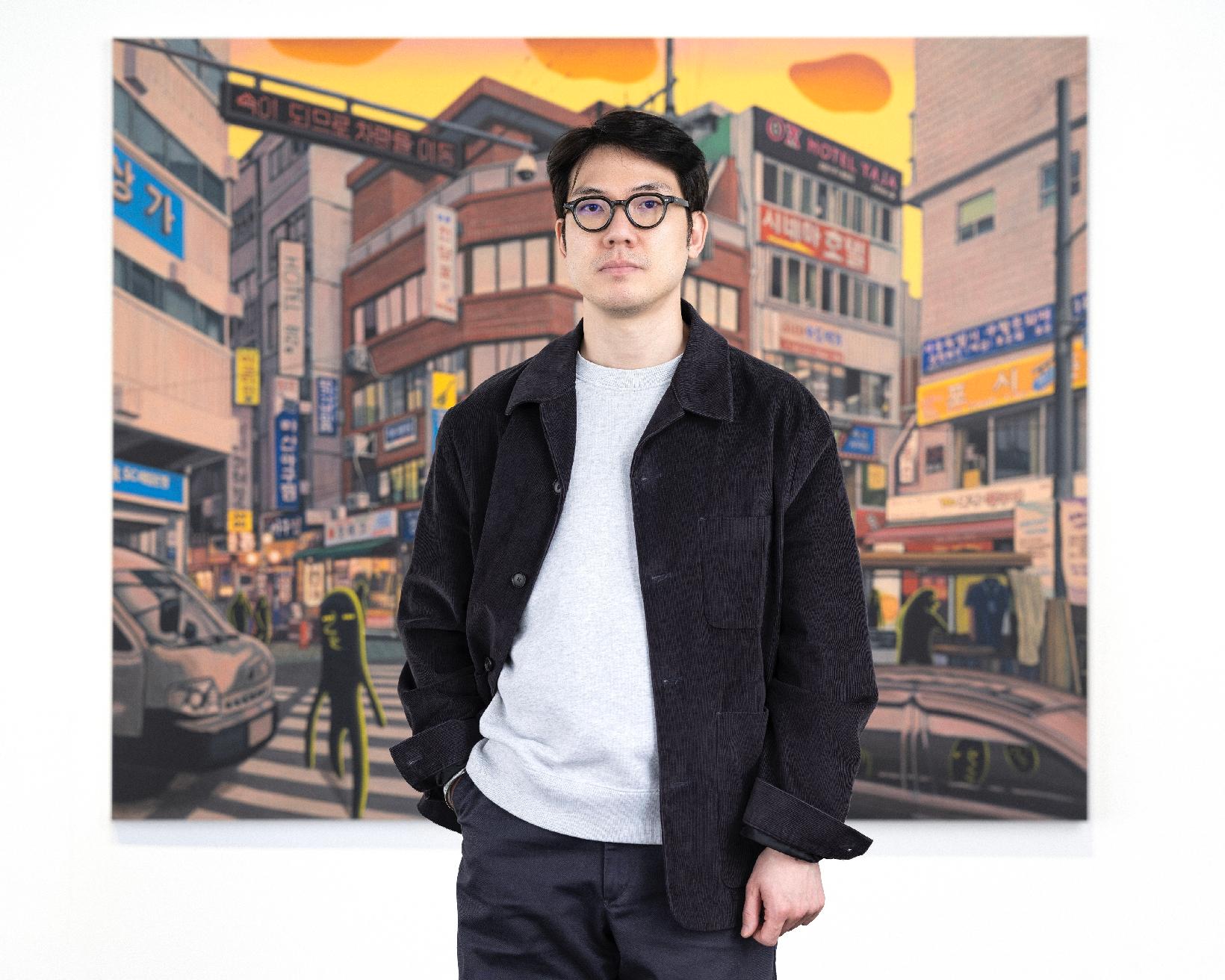
The following interview conversation took place in October 2025 at the studio of the artist Lee Woosung, who at the time was preparing for his exhibition.
Interviewer:
Director Kim Minsoo, Manager Hong Serim
Interviewee:
Artist Lee Woosung
The evolution in your practice since the early 2010s is striking. Your earlier canvases carried a heavier intensity, with elements of fantasy and raw energy, whereas the works since then feel notably gentler in tone.
That's right. The way I painted back then is not how I paint now. In those days, I was intent on reconstructing and recombining images on the canvas. I think much of it was weighted toward expressing my own anxiety. Rather than having the audience view my work comfortably, I wanted them to feel that anxiety alongside me. In that spirit, I painted figures who stared straight forward, out from the canvas, directly meeting the viewer’s gaze. In the works with fire, my interest lay less in symbolic meaning than in the sheer intensity of the image, the feeling of flames roaring to life.
Looking back, I was projecting some internal preoccupation or story outward. A kind of compulsion, you could say. That carried through to my 2012 solo exhibition, and the experience of that show became an occasion to step back and view my work from a distance. Afterward, instead of reconstructing seen images, I began actively drawing encountered people and lived-through moments. The Most Brightest Shining Star (2012), the painting of friends with their arms around each other's shoulders against a red backdrop, came out of that very shift.
Was it around this time that the manhwa-like characters began to appear?
I liked drawing manhwa more than reading them, ever since I was young. My father used to clip manpyeong out of the newspaper for me, saying, "Everything about the world can be expressed in four panels." Even now, I think manpyeong are remarkable. The results never feel burdensome; there is an approachability to them, and they can hold a wide range, from weighty subjects to something light and humorous. I’ve had a steady interest in that form. I did illustration work through school, and after graduating I drew short comic strips for a film festival. I never treated manhwa as a separate, untouchable genre. Somewhere along the way, I’d been thinking: why not bring it into my drawing and painting practice?
Through all these shifts in expression and composition, one thread has remained constant, which was your attention to the qoutidien. What's compelling is that the everyday in your work is not an aestheticized scene but something universally shared.
I believe everything has the potential to become a work (of art). It is not that one has to stage something dramatic. What matters is how you capture what is already scattered all around you, or rather, the will to capture it. The will to see what is lying in plain sight and make it your own through your gaze.
That brings to mind the Baudelairean flâneur, the aesthetic subject who transmutes the fleeting moment on the street into art. How do you hold onto the people, landscapes, and situations you encounter? Do you photograph them?
I have always been drawn to everyday subjects, and when something catches my attention, my instinct is to wonder, "Why shouldn’t this become an artwork?" Whether I am traveling or meeting a friend, if something stirs in me during daily life, I take a photograph, thinking I might paint it someday. From there, it is a process of selecting and bringing certain moments into the work.
Alongside the quotidian, figures have served as an equally central thread in your practice. Over the years, a wide cast of figures has appeared.
I find stories about people most interesting. We get stressed and experience conflicts because of others, but that in itself is drama, isn't it? Through those relationships, the world can look entirely different. For example, when you break up with a lover, there are moments when even the mundane scenery appears different. I think that is why I end up capturing figures and their stories. The faces of each individual are also unique and fascinating. And simply, drawing people has been something I’ve enjoyed since I was a child.
This seems closely connected to how you title your works. The poetic titles, when they meet the image, feel like they extend the sensory field of the painting.
Sometimes I title a work after the painting is finished, stepping back and considering the relationships between paintings. As you suggest, I do think carefully about finding a point of sensory connection between the work and its title. A painting is a scene that is physically still, but in the moment a title is given, a story comes into being.
The question of Minjung Art seems unavoidable. You are often told that your work bears a resemblance, correct?
Yes. I have loved drawing people since I was young, long before I studied it. It was a pure, uninformed. Only later did I come to learn about artists like Shin Hak-chul and Käthe Kollwitz (1867–1945). And for as long as I can remember, when looking at paintings of the human figure, I was drawn to realistic works than the pretty ones. Those paintings inspired me.
I hear the comparison to Minjung Art often, and it sits well with me. Where my work differs, I think, is that I translate my own lived experiences into something closer to an autobiographical essay. Still, I would like to resemble it. I do not want to lose sight of the realities unfolding around me.
A major development in this exhibition is that landscape, previously relegated to the background, holds greater weight on the canvas. Some works include only small manhwa-inflected figures, and others omit them entirely. There are also distinctly Korean scenes: residential housing clusters unique to the country, or stretches of coastal highway that carry a particular local sensibility. Landscape itself seems to communicate here, almost as figures do.
Landscape is not something I had painted extensively until now, but I felt the desire to observe certain scenes from a greater remove, and so I gave it a much larger role. While working, I thought about the distant vantage of Korean sansuhwa as well. What I wanted, though, was for the viewer to look into the landscape and find that there are people within it, their expressions legible through nuance. I was interested in the question, "Why is that figure there, in this landscape?", and in showing the relationship between figure and setting.
Where I had previously focused on the expression on a person's face, this time I was thinking about the place where that person stands: how to let the viewer feel the sensation and nuance of that place, and what compositional devices might draw the eye. Once I actually began this work, I found it was surprisingly time-consuming. Painting landscape turned out to be no small undertaking. The locations in this exhibition are multiple. Some are sites where a particular episode occurred; others are places where I sensed certain things.
Were the specific locations in these works chosen for particular reasons?
The reasons aren’t particularly special; just places where certain memorable things happened or where I sensed something. That is to say, the works are not confined to a region; they span many places. There is a painting of someone sitting on the slope of Seongsan Ilchulbong on Jeju Island, gazing blankly at the landscape. That work is titled We Were There in Silence on the Verge of a New Beginning(2025). It led me to paint rice paddies and other landscapes beyond what I had attempted before.
Another work, We Held Each Other Beneath the Waterfall at Dawn (2025–2026), depicts Jeongbang Waterfall on Jeju Island. The scenery was staggeringly beautiful, but then I came upon a sign explaining that countless people had lost their lives at that very site during the Jeju April 3 Uprising and Massacre. In that moment I thought, "Ah, this is a place of sorrow." The beauty of the landscape and the grief it carries stand opposed, yet they inhabit the same ground, inseparable. If anything, the collision between them left a deeper impression than either could alone. That is the kind of layering I wanted to bring into these works: a landscape where someone may be weeping, but seen from a distance, even that figure becomes part of something beautiful. Registers folded into one another rather than held apart.
The figures within these landscapes give the impression of an anonymous multitude.
That mode actually comes from the self-portrait series I showed in my last solo exhibition. Those simplified figures, rendered in yellow, are limp as though they might slide or pool like something invertebrate. They do not resemble my physical appearance, but I thought of them as self-portraits and conduits of my story at the time I painted them. I cannot call them purely self-portraits for this exhibition either, but I wanted to paint these yellow companions traveling and wandering through landscapes. They are deliberately unspecific: figures whose gender and age remain nebulous.
By way of conclusion, how would you like audiences to experience the works in this exhibition?
I would like them to encounter time in very aggregate sense. Within these paintings are a long and varied expanse of time. They did not come about all at once, or from a single focused theme. Some depict an old neighborhood scenery, a landscape from the past that looks quite different from the present. I also wanted to express what I would call the tainted traces of time that a landscape carries. Everyone has stories tied to places, be they natural landscapes or a cityscape, where what was once there is physically pushed into the past, to make way for a new present. When viewing my work, I welcome interpretations of the landscape or the place, but what I hope for is that people feel the density of time, something anyone can sense in any place.
Caption: Artist interview in the exhibition catalogue of Will There Be an Answer? (Gallery Hyundai, 2026)
본 인터뷰는 전시 준비에 한창이던 2025년 10월, 이우성 작가의 작업실에서 진행되었음을 밝힌다.
인터뷰어:
김민수 디렉터, 홍세림 매니저
인터뷰이:
이우성 작가
2010년대 초반부터 선생님 작품 세계의 변화가 눈에 띕니다. 이전 화면에서는 강한 에너지와 묵직한 뉘앙스, 판타지적인 면이 돋보였는데요. 이후로는 작품 세계의 뉘앙스가 부드럽게 변한 것 같습니다.
그렇죠. 이전 화면은 요즘은 그리지 않는 방식이에요. 당시에는 인위적으로 화면을 재구성하고 재조합하겠다는 의도가 있었어요. 그리고 그때는 저의 불안을 표현하는 데 비중이 컸던 것 같아요. 관객이 제 작품을 편안하게 감상하는 게 아니라, 나의 불안을 함께 느꼈으면 좋겠다는 마음이었어요. 그런 맥락에서 캔버스에 정면을 바라보는 사람들을 그려, 관객과 눈이 마주치도록 시도했어요. 불을 그린 작업에서는 불이 가지고 있는 상징적인 의미보다도 불의 강렬한 이미지, 활활 타오르는 그 느낌을 표현하고 싶었고요. 돌이켜보면 당시에는 내면의 고민이나 이야기를 발산하여 표현하고자 했던 거죠. 욕구라고 해야 할까요? 그렇게 2012년 개인전을 했고, 이를 계기로 제 작업을 멀리 떼어놓고 바라볼 수 있게 되었어요. 이후에는 이전처럼 어떤 화면을 재구성하는 게 아니라, 실제 경험하고 만나는 사람들, 내가 있었던 순간을 적극적으로 가져와서 그림을 그리기 시작했어요. 붉은 배경 위에 친구들이 어깨동무하고 있는 작업 〈가장 빛나는 별〉(2012)도 그런 맥락에서 나온 거예요.
그 시기에 만화적인 캐릭터도 등장한 건가요?
어릴 때부터 만화를 보는 것보다 그리는 걸 좋아했어요. 아버지가 “네 컷에 요즘 세상 돌아가는 이야기가 다 표현되지 않냐”고 하시며, 신문에서 만평을 오려주시기도 했고요. 지금 다시 생각해 봐도 만평은 대단한 것 같아요. 뭐랄까, 결과물이 부담스럽지 않고 친근감이 느껴지고, 무거운 얘기부터 웃기고 재미있는 이야기까지, 폭넓게 담을 수 있는 것 같아 지속적으로 관심을 가졌어요. 학교 다니면서 일러스트 작업을 했고, 졸업하고 영화제에 짧은 만화를 그리기도 했어요. 만화를 범접하지 못할 분리된 장르로 판단하지 않고, 드로잉이나 회화에 접목해도 되지 않을까 은연중 생각해온 거죠.
표현 방식과 화면 구성 등의 변화가 있었지만, 다양한 변화 속에서도 일관적으로 ‘일상’을 주목해 오셨어요. 작가님이 펼치는 ‘일상’은 예쁘게 프레임화된 장면이 아닌, 누구나 갖는 보편적 일상이라는 점에서 흥미롭고요.
모든 게 다 작업이 될 수 있다고 생각해요. 드라마틱한 장면을 연출해야만 하는 게 아니라, 널려져 있는 것들을 어떻게 포착하느냐, 그러니까 포착하려는 의지가 중요해요. 널려 있는 것을 보고 내 시선으로 포착하려는 의지요.
보들레르의 ‘산책자’ 개념이 떠오르네요. 거리의 순간을 예술로 전환하는 미학적 주체요. 작가님은 널려 있는 인물과 풍경, 상황을 어떻게 포착해두세요? 사진 촬영을 해두는 편이신가요?
저는 일상적인 소재에 늘 관심이 있었고, 그런 소재를 대할 때면 ‘이게 왜 작업이 될 수 없는
걸까?’ 하고 고민하는 편이에요. 여행을 가든 친구를 만나든 일상에서 무언가 느껴지면 언젠가 그릴지도 모른다는 생각으로 사진을 찍어둬요. 그중 취사선택을 해서 작업화하는 거죠.
그간 작가님 작업에서 ‘일상’만큼이나 ‘인물’ 또한 주요한 키워드로 작용했고, 다양한 인물이 등장했죠.
사람 이야기가 재밌는 것 같아요. 사람 때문에 스트레스 받기도 하고 갈등도 생기지만, 그 자체가 드라마잖아요. 그 관계 속에서 세상이 다르게 보이기도 하고요. 이를테면, 연인과 헤어지면 늘 보던 풍경도 다르게 보이는 순간이 있잖아요. 그래서 인물들과 이야기를 포착하게 되는 것 같아요. 인물 저마다의 얼굴이 재밌기도 해요. 사람 그리는 걸 어릴 적부터 좋아하기도 했고요.
말씀하시는 부분이 작품들의 제목과도 연관이 되는 것 같아요. 시적인 제목들이 작품과 만나면서 감각이 확장되는 것 같거든요.
작품 제목은 그림을 다 그린 후, 거리를 두고 그림들 간의 관계를 생각하면서 짓기도 해요. 말씀하신 것처럼 작업과 제목 사이에 감각적인 지점이 있었으면 좋겠다고 생각해서 고민하는 편이기도 하고요. 작품 화면은 물리적으로 정지되어 있는 장면인데, 제목을 붙이는 순간 이야기가 생성되잖아요.
민중미술과의 연관성에 대해 이야기를 빼놓을 수 없을 것 같아요. 주변에서 민중미술을 닮은 작업을 한다는 이야기를 종종 들으시는 편이죠?
예, 어릴 때부터 사람 그리는 걸 좋아했거든요. 미술을 전공하기 전부터 아무것도 모르고 좋아했던 거예요. 나중에 신학철 작가나 케테 콜비츠(Käthe Kollwitz)에 대해 알게 되었고요. 또, 예전부터 인물이 그려진 그림을 볼 때, 예쁘게 그려진 것보다 사실적으로 표현된 작업을 좋아했어요. 그런 그림에 영감 받았고요. 말씀대로 민중미술을 닮았다는 얘기를 자주 듣곤 하는데, 저는 그 말이 좋아요. 다만 저는, 제가 경험한 이야기를 좀 더 자전적인 수필처럼 작품화한다는 점에서 다른 면이 있겠죠. 그래도 민중미술을 닮고는 싶어요. 지금 제 주변에서 일어나고 있는 현실도 놓치고 싶지 않거든요.
이번 전시에서 큰 변화라고 한다면, 배경 정도로만 처리되던 ‘풍경’이 화면에서 비중이 커졌다는 점이죠. 만화적으로 표현된 인물이 작게 들어가거나 아예 들어가지 않은 것도 있어요. 한국에만 있는 주택 단지의 풍경이나 지극히 한국적인 해안 도로 등 고유의 정서가 담긴 작품도 있고요. ‘풍경’이 표정이 있는?? ‘인물’처럼 무언가를 전한다는 느낌을 받기도 했어요.
그동안 풍경을 많이 그리지는 않았어요. 그런데 이번엔 어떤 장면을 좀 더 멀리서 바라보고 싶다는 마음에 풍경의 비중을 크게 높였어요. 한국 산수화처럼 멀리서 보는 풍경도 작업 중에 생각해봤었고요. 다만 풍경을 들여다보면, 그 안에 사람들이 있고 그들의 표정을 뉘앙스로 파악할 수 있게 작업하고자 했어요. ‘이 풍경에 왜 인물이 저기에 있어?’ 하는 생각과 동시에 풍경과 인물의 관계를 보여주는 것도 재밌을 것 같았고요. 이전에는 인물의 표정에 초점을 뒀었다면, 이번엔 그 인물이 있는 장소를, 그 감각과 뉘앙스를 느낄 수 있게 하고 들여다보게끔 하는 장치를 고민하며 그렸어요. 막상 이 작업을 시작해 보니 시간 오래 걸리는 거예요. 풍경을 그리는 게 만만치 않구나 싶었죠. 이번 전시에서 소개하는 작품들의 장소는 한 곳이 아니에요. 어떤 에피소드가 있는 장소이기도 하고, 어떤 감각을 느낀 곳이기도 해요.
이번 전시작의 장소는 특정한 이유가 있어서 그리신 건가요?
특별한 이유보다는, 에피소드가 있거나 어떤 느낌을 받았던 장소들이에요. 그래서 한 지역에 국한하지 않고 다양한 곳을 담았어요. 제주도 성산일출봉의 비탈길에 앉아서 멍하니 풍경을 바라보는 작품이 있거든요. 〈새로운 시작 앞에서 우린 그렇게 아무 말 없이 있었어〉(2025) 라는 작업이에요. 이를 시작으로 논이나 다른 풍경도 그리게 된 거고요. 제주도의 정방 폭포를 그린 작업 〈새벽녘 폭포 아래서〉(2025-2026)가 있는데요. 굉장히 멋지고 아름다운 풍경이었는데, 4.3 사건으로 수많은 사람이 여기서 목숨을 잃었다는 사연이 적힌 안내 팻말을 보게 되었어요. ‘아, 슬픈 곳이구나’ 그러니까 아름다움과 슬픔, 둘이 대립하는 풍경인 거죠. 대립과 충돌이 오히려 강한 인상을 남겼고요. 이번 작품들에는 이렇듯, 복합적인 레이어를 쌓아서 보여주고 싶었어요. 아름답지만 슬픔도 있고, 누군가는 울고 있지만 멀리서 보면 그것마저도 아름다워 보이기도 하고요. 중첩된 풍경이면 좋겠다는 마음이었어요.
풍경 속 인물들은 익명의 다수를 보여주는 것 같은 인상이 들어요.
바로 직전 개인전에서 자화상 연작을 선보일 때 보여줬던 방식이에요. 연체동물같이 흘러내리는 듯 보이는 노란색으로 단순화된 사람이요. 저를 닮지는 않았지만, 당시에는 저의 이야기를 담은 자화상이라 생각하고 그렸어요. 이번 전시에서는 완전히 나의 자화상이라고 할 수는 없지만, 이 노란색 친구들이 여행하거나 돌아다니는 풍경을 그려보고 싶었어요. 특정 인물임을 드러내지 않으면서 성별과 나이 모두 두루뭉술하게 애매한 인물들이라 생각해요.
마무리 질문으로, 이번 전시 작품을 관객이 어떻게 봐주셨으면 하세요?
많은 시간을 느꼈으면 해요. 아주 길고 다양한 시간이 담긴 그림들이거든요. 주제를 설정하고 집중해서 한번에 나온 게 아니에요. 오래된 동네 풍경, 지금과는 사뭇 다른 과거의 풍경이기도 하고요. 풍경이 가진 시간의 얼룩을 표현하고자 한 부분도 있거든요. 누구나 장소들에 대한 사연이 있으니까요. 자연 풍경이든 도시 풍경이든 물리적으로 과거로 밀려나고 또 새로운 현재가 오잖아요. 제 작업을 보며 풍경의 상징성이나 그 장소에 대한 해석을 해보는 것도 좋지만, 사람이라면 누구나 어떤 장소에서 포착할 수 있는 시간의 밀도를 느꼈으면 좋겠어요.
캡션: 《너에게 물으면 알 수 있을까?》 전시 도록 (갤러리현대, 2026) 내에 작가 인터뷰