
Bodyscape
Sep 8 – Oct 31, 2021
Gallery Hyundai
“What did I paint?
I painted. Have you actually painted?
Do you know about painting – what painting is?”
- Lee Kun-Yong, “Sketch of Exhaustion” artist’s journal (1963)
Gallery Hyundai presents Bodyscape, a solo exhibition by Lee Kun-Yong (b. 1942), from September 8 to October 31. It is the artist’s second solo exhibition at Gallery Hyundai, following Event-Logical (2016), which focused on experimental performances given by the artist in the 1970s and 1980s, archival photographs, and object artwork incorporating natural materials such as wood and soil. Bodyscape turns its attention to the painting series of the same title that has been the subject of the artist’s recent focus. First presented in 1976, the work in the Bodyscape series takes form via simple line drawings and marks on canvas created by the motions performed by the artist in some physically constrained state. Because of the nature of its “drawing events,” with restrained black-and-white records of the production process and performances conducted in front of viewers at the gallery, the series has generally been interpreted and assessed in the “performance” context. The Bodyscape exhibition concentrates on the virtues of these works as paintings, and on their significance in the history of painting. Thirty-four new paintings are to be presented at Gallery Hyundai’s main space while works of printmaking and paper drawing with materials such as acrylic paint and regular and colored pencil will be presented at Gallery Hyundai Dugahun. Together, they provide a wide-ranging glimpse at Lee Kun-Yong’s work as a painter. This exhibition will also be the first time that nine new Bodyscape works are created and presented in one place.
Lee Kun-Yong is considered a master of Korean experimental art. Beginning his artistic career in earnest during the late 1960s, he was at the very forefront of experimental, avant-garde trends serving as a key member of the A.G. (Korean Avant-Garde Association) and helping to found the academic society S.T. (Space and Time Group). Adopting a unique methodology that he referred to as “logic,” he attempted an artistic interpretation of and communion with the chaotic South Korean political and social situation at the time, all while constantly posing the question, “What is the essence of art?” His avant-garde spirit was not restricted to any one media, but carried on an ongoing connection with its times: the series of logical, conceptual performances he presented in the mid-1970s under the theme and title Event-Logical; his installation-sculptures during the 1980s, in which he subtly varied the characteristic of objects by imposing his presence on natural materials such as wood and stone; his theatrical performances of the 1990s, which took place against a backdrop of personal, cultural, and historical narratives; his large postmodern paintings combining figurative and abstract elements on a single canvas; his installation art, which metaphorically expressed contemporary life by means of everyday personal objects; and the Bodyscape series. The themes that connect this broad-ranging artistic oeuvre are “the body,” “place,” and “relationships.” In his work, Lee has consistently incorporated his own body, the places in which his work is produced and displayed, and a message of “relation” that connects that work with its viewer.
The Bodyscape series reflects the essence of Lee Kun-Yong’s ideas and his original aesthetic concerning the body, place, and relationships. The works have been given poetic, philosophical, and explicit titles based on the date they were first shown, their content and form, variations in their methodology, and different approaches to labeling in Korean and English. These titles include Form of Now (現身), The Method of Drawing, Bodyscape, and Body Drawing. Each title includes a “76,” representing the year that the artist first unveiled his series; a number between one and nine, indicating the methodology; and the year it was produced. In 1976, Lee presented seven Methods of Drawing works – representing a portion of his nine total methodologies – at the 5th ST exhibition at the Publishing Culture Hall, Seoul. For this work, he drew lines from behind the canvas (76-1), with his back to the canvas (76-2), and with the canvas beside him (76-3). He also fixed his wrist and elbow in place with splints, which he successively removed (76-4); placed the canvas between his legs (76-5); stretched his arms out to either side with the canvas just in front of his nose (76-6); and used his own shoulders as an axis as he serenely produced semicircular lines on the canvas (76-7). Other approaches included using his whole body as axis to produce large semicircles (76-8) and drawing wing-shaped lines as he moved his arms and legs vigorously as though jumping up and down (76-9).
The conditions and essential logic of “drawing” through which the Bodyscape series is produced lie in the constraints faced by the artist’s own body and the scope of its accessibility. Restricting his body’s range of movement based on factors such as his height or the length of his limbs, Lee moves only as far as his hands can reach or his body can move. He produces lines on the canvas slowly, as though in a form of practice, while rigorously controlling his own freedom of expression. He has described this process as one of his “body moving forward as its perceives the surface”: “Whereas an artist duly draws something on the surface presented in front of them, I place the canvas in front of myself and draw only what my body allows, without looking at the canvas. It is not a matter of me seeing the surface and drawing something on it as my consciousness dictates. Through the lines drawn by the movements of my arms, I am showing the process of my own body moving forward as it perceives the two-dimensional surface.”
The crucial inspiration behind Lee’s “invention” of the Bodyscape series was his realization that his own body could provide the most outstanding and straightforward medium of all. Representing Korea at the 1973 Biennale de Paris, Lee traveled all around central Paris to produce Corporal Term, a work for which he transported natural trees into the gallery – roots, soil, and all. As he returned to Korea, he became increasingly convinced that he should attempt a form of performance art in which he used the body as an artistic medium. He had also been deeply struck by some of the fresh painting work he had encountered at the Biennale, produced by artists who were experimenting in new ways with fundamental material elements of painting such as the canvas frame and paints. Interpreting painting as a kind of “illusion,” he went on to produce the series Cloth (1974–75), for which he made wrinkles in fabric, splashed paint on it to leave marks from the wrinkles, and then stretched the fabric out again, thus revealing painting itself as an illusion. He also presented his Event-Logical series, which showed the actions of the body in deliberate and logical ways, as in works such as Indoor Measurement, Same Area, and Logic of Place. His later Bodyscape work is a continuation of Corporal Term and Event-Logical in the sense that it employs the artist’s own body as a medium encountering the world, positing the act of drawing as an incident that arises through necessary and logical actions by a constrained body, rather than as the expression of emotion or feeling.
Continuing from 1976 to the present, the Bodyscape series is a subversive form of painting work with few precedents in global art history. It is revolutionary in the way it upends perceptual relations based on the production of paintings in the traditional sense. Boldly abandoning the traditional painting approach of looking directly at the canvas and using the hand to express concepts and ideas from the head, Lee instead reflects as an artist on the essence of the act of “creating images.” For him, the act of painting has been an effort to redefine “expression of the body.” Through this series, the body becomes “both perceiver and expresser” for the first time ever. The subversive in terms of the history of painting continues into a subversion of “systems” and “mechanisms of control.” Lee’s ascetic experiments with constraining his own everyday act of painting as an artist was an ironic form of self-expression for someone who had lived through South Korea’s military dictatorship during the 1970s. He would later recall, “Subverting mechanisms of control was the only way for me to express, represent, and inscribe myself within those altered spaces of lives, where systems and authority had appropriated and invalidated public discursive capabilities.” In the Bodyscape series, the artist expanded the drawing of lines – that most basic language of painting – into philosophical ideas of physical perception and affirmation of “being.” For this work, Lee would win the grand prize at the Lisbon International Show in 1979.
Since first appearing in 1976, the Bodyscape series has undergone different transformations. During the 1970s, Lee selected simple materials such as wooden boards, pens, and pencils to clearly record his own body’s movements and the resulting evidence on the canvas. Focusing on a strict, restrained form of visualization that was closer to simple line-drawing than to pictorial expression, he emphasized the body’s constrained conditions – as though it had been reduced to some form of measuring instrument – as well as the transparency of his work’s internal logic. He also recorded the creation process in photographs, as if to prove that the sequence of repetitive acts was itself a logical event. During the 1980s, he made active use of brushes and acrylic paints in different colors, experimenting with vibrant forms of expression in his painting. In the 1990s, the Bodyscape series combined with the Human Term series, which concerned artistic perceptions and interpretations of life, culture, and history. The Bodyscape methodologies would combine on a single canvas with symbols from national and cultural history, evolving into a comprehensive form of painting. By the 2000s, the canvases of the Bodyscape series became mirrors reflecting social issues and portraits of their historical moment. Lee would print photographs on his canvases showing women on the subway, scenes from the Daegu subway fire, and other images; on top of them, he would produce lines with the Bodyscape methodologies, adding a deeper layer of critical examination of the ways in which the artist’s body/places relate and communicate with people living in the contemporary era. During the 2010s, Lee transformed his Bodyscape series once again with variations in the ways in which his body was constrained and the sizes of his canvases.
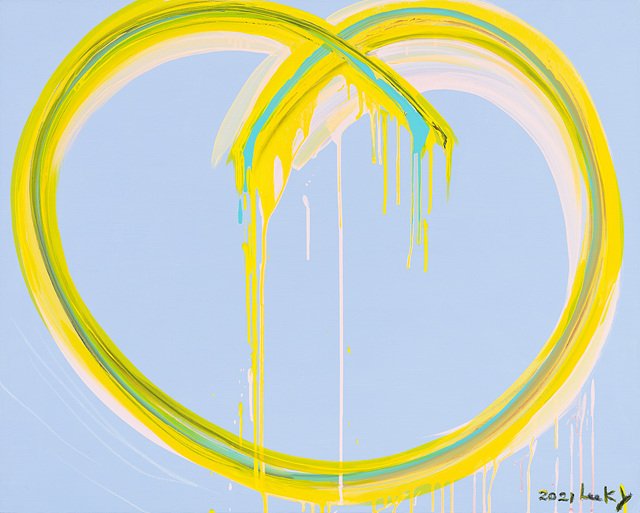
The solo exhibition Bodyscape at Gallery Hyundai offers a vivid look at the flexible, sometimes wild marks left by the body of a veteran artist now in his eighties. The strict controls and element of chance in the creation process result in both clashes and harmonies, producing an even richer and more colorful banquet of painterly colors and expression. On the first floor, the artwork is based on the “76-1” methodology: standing behind the canvas, the artist produced lines naturally through up-and-down motions where his hands could reach, with paints trickles down in different colors over the canvas. The second floor features “76-2” works, where the artist stood with his back to the canvas and drew lines in every direction without being able to see, leaving a blank space only where his own body was. Also on the second floor are “76-3” works, where the artist stood beside the canvas, alternating directions from left to right as his rounded lines came together to form something resembling a heart shape. The same floor includes a large work in which the “76-2” and “76-3” methods come together over a single canvas measuring more than five meters across. In the basement gallery, viewers can encounter new works produced in all nine of the Bodyscape methodologies, along with videos documenting the creation process.
On display at Gallery Hyundai Dugahun are print works and paper-based works in which Lee experiments with different forms of line drawing using acrylic paints, regular and colored pencils, and other materials. Variations on the “76-1” Bodyscape works – produced from behind the canvas where the artist could not see the image – they possess their own distinct virtues that set them apart from the more refined works produced on canvas. The surfaces on which the lines are drawn are packaging from mass-produced consumer items. Lee collects common, everyday packing boxes, which he trims down while preserving their overall shape. On these surfaces, he produces “76-1” lines, which he draws from behind without being able to see. Lee explains that these packing boxes, which were created for purposes of design and practically, offer a vivid illustration of the mechanisms operating in contemporary life. Actively imposing his own body on them to leave marks in the form of lines is his way of communicating with the world, infusing new energy into the discarded boxes. Since their first emergence in the 1970s, Lee Kun-Yong’s contemplations and explanations of the body, place, and relationships remain very much an ongoing process.
“무엇을 그렸을까.
그렸다. 과연 너는 그렸을까?
그린다는 것을 너는 알고 있니. 그린다는 것이 무엇인지.”
- 이건용, 작가의 일기 ‘피로의 스켓취’ 중에서(1963)
갤러리현대는 이건용(b. 1942)의 개인전 《Bodyscape(바디스케이프)》를 9월 8일부터 10월 31일까지 개최한다. 작가가 1970-80년대 발표한 실험적 퍼포먼스와 기록 사진, 나무와 흙과 같은 자연 재료를 활용한 오브제 작품에 주목한 2016년 《이벤트-로지컬》전에 이어 갤러리현대에서 개최하는 두 번째 개인전이다. 《Bodyscape》전은 이건용이 최근 주력하는 동명의 회화 연작에 집중한다. 1976년 첫 발표한 <Bodyscape> 연작은 작가가 신체를 제한한 상황에서 간단한 선 긋기 동작을 수행하며 화면에 흔적을 남기는 방식으로 완성된다. 제작 과정을 담은 절제된 흑백 기록 사진과 전시장의 관람객 앞에서 공연되는 등 “이벤트로서의 드로잉”이라는 속성 때문에 이 연작은 주로 '퍼포먼스'의 맥락에서 해석 및 평가되어 왔다. 《Bodyscape》전은 이 연작이 회화로서 지닌 매력과 회화사적 의미를 집중 조명한다. 갤러리현대 신관 지하부터 2층 전시장에는 신작 회화 34점을, 갤러리현대 두가헌에서는 아크릴 물감, 연필, 색연필 등 다양한 재료로 완성한 종이 드로잉 작품과 판화 작품을 함께 선보여 ‘화가’ 이건용의 회화 세계를 폭넓게 조망할 것이다. 특히 <Bodyscape>의 아홉 연작이 모두 신작으로 제작되어 한 장소에서 공개되는 건 이번 전시가 처음이다. 전시는 온라인 사전 예약제로 운영된다.
‘한국 실험미술의 거장’, 이건용. 1960년대 말부터 본격적으로 미술계에서 활동을 시작한 그는 AG(한국아방가르드 협회)의 주요 작가였으며, 1969년 ST(Space and Time 조형학회)를 결성하는 등 당대의 전위적이고 실험적인 흐름의 최전선에 서 있었다. 작가는 ‘논리’라는 자신만의 방법론을 통해 한국의 혼란한 정치 · 사회적 상황에 예술적 해석과 소통을 시도하는 한편, ‘미술의 본질은 무엇인가’를 끊임없이 질문했다. 1970년대 중반 <이벤트-로지컬>이라는 주제와 제목으로 발표한 논리적이며 개념적인 일련의 퍼포먼스, 1980년대 나무나 돌 등 자연 재료에 개입해 사물의 본래 속성을 미세하게 변주한 설치-조각, 1990년대 개인적 문화적 역사적 서사를 배경으로 한 연극적 퍼포먼스, 한 화면에 구상과 추상적 요소를 결합한 포스트모던적 대형 회화 작품, 개인적 일상 오브제를 통해 현대인의 삶을 은유한 설치미술, 2000년대 이후 변신의 변신을 거듭한 <Bodyscape> 연작까지, 그의 아방가르드 정신은 매체에 국한 되지 않고 시대와 호흡하며 지속되고 있다. 이러한 폭넓은 작품 세계를 관통하는 키워드는 신체, 장소, 관계다. 그는 자신의 ‘신체’와 작품이 제작 및 전시되는 ‘장소’, 그리고 그것을 바라보는 관람객으로 이어지는 ‘관계’의 메시지를 늘 작품에 녹여 냈다.
<Bodyscape> 연작에는 신체, 장소, 관계에 대한 이건용만의 독창적 미학과 사유의 정수가 담겼다. 이 연작은 작품의 발표 시기와 내용과 형식, 방법론의 변주, 국영문 표기 방식 등에 따라 ‘현신(現身)’, ‘The Method of Drawing(드로잉의 방법)’, ‘Bodyscape(바디스케이프)’, ‘신체 드로잉’, ‘신체의 사유(身體의 思惟)’, ‘신체의 풍경’ 등의 시적이고 철학적이며 명시적인 제목으로 명명되었다. 작품 제목에는 연작을 처음 공개한 연도인 ‘76’과 방법론을 구분 짓는 아홉 개의 번호, 제작연도가 따라붙는다. 1976년 이건용은 출판문화회관에서 열린 《제5회 ST전》에서 총 아홉 가지의 방법론 중 일곱 가지의 ‘그리기의 방법(The Method of Drawing)’을 발표했다. 이 작품을 위해 그는 화면의 뒤에서(76-1), 화면을 등지고(76-2), 화면을 옆에 놓고(76-3) 선을 그었다. 또한 손목과 팔꿈치를 부목으로 고정하고 이를 하나둘 풀면서(76-4), 다리 사이에 화면을 놓거나(76-5), 화면을 코 앞에 둔 채 양팔을 활짝 벌리고(76-6), 어깨를 축으로 삼고 반원의 선을 침착하게 화면에 남겼다.(76-7) 이밖에 온몸을 축으로 거대한 반원을 만들거나(76-8), 두 팔과 다리를 위아래로 점프하듯 격렬하게 몸부림치며 날개 형상의 선을 드러냈다.(76-9)
<Bodyscape> 연작이 완성되는 ‘그리기’의 전제 조건이자 필연적인 논리는 작가 신체의 한계 혹은 신체의 가용 범위였다. 이건용은 키, 양팔과 다리의 길이 등에 따라 신체가 움직일 수 있는 범위를 제한하고, 손이 닿는 만큼, 몸이 움직일 수 있는 만큼 이동하며 마치 수행하듯 천천히 선을 화면에 남기며 스스로 표현의 자유를 엄격하게 통제한 것이다. 작가는 이 과정을 “신체가 평면을 지각해 나아가는 과정”이라 설명한다. “화가는 모름지기 자기 앞에 현전해 있는 평면에 무언가를 그리지만, 저는 화면을 제 앞에다 놓고 제 신체가 허용하는 것만큼만, 화면을 보지 않은 상태에서 선을 그리는 겁니다. 그것은 제가 평면을 보고 그 위에 무언가를 의식이 지시하는 대로 그리는 것이 아니라 제 팔이 움직여서 그어진 선을 통해서, 내 신체가 평면을 지각해 나아가는 과정을 보여주는 것이지요.”
<Bodyscape> 연작을 ‘발명’하게 된 결정적 계기는, 작가의 신체가 가장 탁월하고 직접적인 매체가 될 수 있다는 자각이었다. 1973년 파리 비엔날레에 한국 대표로 참석해 자연의 나무를 뿌리와 지층 채 전시장에 옮겨 작품으로 제시하는 <신체항>을 완성하기 위해 파리 시내 곳곳을 움직인 그는 한국으로 돌아올 무렵 몸을 예술의 매체로 쓰는 ‘행위미술’을 해야겠다는 생각을 굳힌다. 또한 비엔날레 현장에서 마주한, 캔버스의 프레임이나 물감 등 회화의 물적 토대를 새롭게 실험하는 작가들의 신선한 회화 작품도 그에게 강한 인상을 남겼다. 이후 작가는 회화를 하나의 ‘환영’으로 해석, 천에 주름을 만들어 물감을 뿌려 주름의 흔적을 남기고 그것을 팽팽하게 펴서, 그림을 ‘환영’ 그 자체로 제시하는 <포>(1974-75) 연작과 <실내측정>, <동일면적>, <장소의 논리> 등 계획적이고 논리적인 방식으로 신체 행위를 전개하는 <이벤트-로지컬> 연작을 공개하기에 이른다. 이후 발표된 <Bodyscape>는 작가의 신체를 세계와 만나는 매체로 활용하고, 그리는 행위를 정서나 감정의 표출이 아닌 신체의 제약이라는 필연적이고 논리적인 행위로 인해 발생한 사건으로 설정했다는 점에서 <신체항>이나 <이벤트-로지컬>의 연장선에 놓인다.
1976년부터 현재까지 지속된 <Bodyscape> 연작은 세계 미술사에서 유래를 찾기 어려운 ‘전복의 회화’다. <Bodyscape> 연작은 전통적 의미의 회화 제작에 따르는 인식 관계를 혁명적으로 전복한다. 그는 화면을 눈으로 마주하고 머리의 생각(개념과 아이디어)을 손으로 옮겨 그리는 전통적인 회화 방법론을 과감하게 폐기하며, 미술가로서 ‘그리는’ 행위의 본질이 무엇인가를 성찰한다. 이건용에게 ‘그린다’는 행위는 ‘신체의 표현’을 재설정하는 작업이었다. 이 연작을 통해 비로소 “신체는 지각자요 표현자”가 된다. 회화사적 전복성은 체제, 통제의 매커니즘의 전복으로도 확장된다. 화가로서의 일상적 행위인 그리기의 방법을 제한하는 금욕적 시도는, 1970년대 군부 독재 시절을 지나온 작가의 역설적인 자기표현이기도 했다. 그는 “체제와 권력이 공공의 담론적 역량을 전유하고 무효화시킨 변질된 삶의 공간에서 나를 표현, 표기하는 방법과 각인시킬 수 있는 유일한 길은 통제의 메커니즘을 전복하는 길”이었다고 회고한다. 회화의 가장 기초적인 언어인 선 긋기를 신체의 지각과 존재의 확인이라는 철학적 사유로 확장한 <Bodyscape> 연작으로, 이건용은 1979년 리스본국제미술제에서 대상을 수상한다.
<Bodyscape> 연작은 1976년 발표된 이후 변신을 거듭해 왔다. 1970년대 작가는 나무판과 펜, 연필 등 단순한 재료를 택해 몸의 움직임과 그 흔적을 화면에 명료하게 기록했다. 그는 회화적 표현보다는 ‘선 드로잉’에 가까운 엄격하고 절제된 시각화에 중점을 두고, 스스로 측정기가 된 듯 제한된 신체의 조건과 작업의 내적 논리가 지닌 투명성을 강조했다. 또한 반복적인 행위들의 나열이 곧 하나의 논리적인 사건임을 증명하듯 사진으로 제작 과정을 남겼다. 1980년대 들어, 다양한 색상의 아크릴 물감과 붓을 본격적으로 사용하면서 생동감 넘치는 회화적 표현을 시도한다. 1990년대 <Bodyscape> 연작은 삶과 문화, 역사에 대한 작가적 인식과 해석을 주제로 삼은 <인간항> 연작과 결합한다. 한 화면에 <Bodyscape>의 방법론과 민족 및 문화사적 기호들이 결합하면서 총체적인 회화로 진화한다. 2000년대에 <Bodyscape> 연작의 화면은 사회적 이슈와 시대상을 반영하는 ‘거울’이 된다. 지하철의 여성, 대구지하철 참사가 일어난 장소 등의 사진을 캔버스에 프린트하고 그 위에 <Bodyscape>의 방법론을 펼쳐, 예술가의 신체-장소가 당대를 살아가는 사람들과 어떻게 관계를 맺고 소통할 수 있는가의 문제의식을 심화한다. 2010년대 들어, <Bodyscape> 연작에서 작가는 신체를 제약하는 방식과 화면의 크기를 변주하여 변형된 형태의 <Bodyscape> 시리즈를 완성한다.
갤러리현대의 개인전 《Bodyscape》에서 팔순을 넘긴 노장의 신체가 남긴 유연하며 때로는 격렬한 몸짓의 흔적을 생생하게 확인한다. 제작 과정의 엄격한 통제와 우연성의 개입이 충돌과 조화를 동시에 이루며, 더욱 다채롭고 풍성한 회화적 색감과 표현의 향연이 펼쳐진다. 전시장 1층에서는 화면의 뒤에서 손이 닿는 영역만큼 상단에서 하단으로 자연스럽게 선이 그어지고 색색의 물감이 화면 위에서 결합해 흘러내리는 ‘76-1’, 2층에서는 화면을 보지 않고 등지고 서서 사방으로 선을 그으며 작가의 신체 부분만을 여백으로 남는 ’76-2’와 화면 옆에 서서 왼쪽과 오른쪽으로 방향을 바꿔 남긴 둥근 선의 조합이 ‘하트’를 연상시키는 ’76-3’이 한 장소에 놓인다. 또한 ’76-2’와 ’76-3’이 한 화면에서 만나는 가로 5m가 넘는 대형 작품도 공개한다. 지하 전시장에서는 <Bodyscape> 연작 총 아홉 가지가 새롭게 제작되어 관람객과 만나며, 제작 과정을 담은 영상도 감상할 수 있다.
갤러리현대 두가헌에서는 아크릴 물감, 연필, 색연필 등을 활용해 다양한 선 드로잉을 실험한 종이 작업과 판화 작품을 공개한다. <Bodyscape> 연작 중 화면을 보지 않고 뒤에서 그리는 ’76-1’의 변주인 이 작품들은, 캔버스에 그려진 정제된 작품들과 또 다른 매력을 지닌다. 선이 그려지는 바탕은 대량 생산된 소비 제품의 포장재이다. 작가는 일상에서 흔히 발견되는 포장 박스를 지속해서 수집하고, 박스의 모양을 살려 재단한다. 이렇게 마련된 밑바탕에 화면을 보지 않고 뒤에서 그리는 ’76-1’의 선들을 긋는다. 그는 디자인과 실용성을 위해 만든 포장 박스가 오늘날 동시대적 삶의 메커니즘을 여실히 드러내는 요소라 설명한다. 그는 여기에 자신의 신체를 적극적으로 개입시켜 선의 흔적을 남김으로써 세상과 소통하고, 버려진 박스에 다시 생기를 불어넣는 것이다. 1970년대 시작된 이건용의 신체-장소-관계에 관한 사유와 탐구는 언제나 현재 진행형이다.
{{ lbCurrent.title }}
{{ lbCurrent.text }}