
I'm Not a Stone
Apr 21 – May 30, 2021
Gallery Hyundai
Gallery Hyundai proudly presents Park Hyunki’s solo exhibition I’m Not a Stone. This exhibition is the third solo exhibition held at the gallery following Park Hyunki: The Pioneer of Korean Video Art that commemorated the tenth anniversary of his passing (2010), and Visible, Invisible (2017) that introduced not only installation works from the early 1990’s and meditative video works but also expressionist paintings and oil stick drawings on Korean paper.
While Park Hyunki (1942-2000) is best recognized within Korea and abroad as the pioneer of Korean video art, his oeuvre is certainly not limited to video. Having studied painting and architecture in college, he worked regularly as an architect and interior designer. He experimented with and presented works in mediums as varied as sculpture, installation, prints, video, performance, painting, drawing, and photo-media. Specifically, I’m Not a Stone highlights works that represent pivotal moments within his vast creative oeuvre, revealing what lies beyond the label of “video artist.” Furthermore, it aims to affirm Park Hyunki’s art historical achievements and significance as he is yet and again reevaluated as an important figure in the history of Asian Contemporary Art.
The ten works highlighted in I’m Not a Stone broadly encompasses Park Hyunki’s career from 1978 to 1997. Untitled (1983) transfers rocks from a riverside to the gallery space to contemplate the relationship between human, art, and nature. The site-specific installation Untitled (ART) (1986) humorously explicates his own ideas on art and architecture. Mandala (1997) edits together religious iconography and pornography using cutting edge digital technology of the time to invoke the sense of moulding to one image. These works, along with Untitled (1988), the largest piece in the “TV Stone Tower” series, have been reproduced under the auspices of the Park Hyunki Estate including family, critics and technicians that worked with the artist. This landmark exhibition marks the first time that these major works are being shown to the public since the artist’s passing.
At the entrance of the basement floor, three small stone towers, Untitled, twinkle under the gallery lights. Displayed on the floor without pedestals, they each consist of 6 to 10 flat, oval stones of different sizes, placed one by one on top of each other to the height of an adult’s waist or knees - reminiscent of totemic stone towers built by hand at the entrance of old villages. The difference being Park builds his stone tower from both natural and manmade stones. He created manmade stones in warm hues of light pink and yellow from synthetic resin then stacked them vertically alternating with the natural stones. Quite early in his career from 1974 to 1978, Park worked on his Sunken (몰, 沒) series where rolls of tissue dampened with water and ink are built into cylindrical pillars or arranged on the floor in “sunken” states. Such methodologies of “stacking” are where his “Stone Tower” series extend from. After first presenting stone towers at his solo exhibition in Seoul Hwarang in 1978, the artist would continue to utilize stones as material throughout the remainder of his life. It is through this juxtaposition of natural stones that had weathered the rivers and riverbeds for countless decades and forged into coarse shapes and textures with the manmade stones of illuminated resin that the artist surveys the boundaries and relationships between nature and manmade, real and fake, material and immaterial between the objects.
For Park, stones are “nature that embraces primordial time and space,” a materialization of our ancestors’ aesthetic conscious, a camera turned towards the world, and a screen to project video images upon. He writes in his artist’s note that he would never forget the stone cairns at Seongangdang at Gogaet-maru that he happened while fleeing his home during the Korean War: “From the front to back of the line of refugees, people passed on a note to pick up stones and throw them towards mounds of stones, small and big. The mounds were like the tombs of deities or like their houses, strange places that linger in my memory as something that transcends imagination. I am still vividly drawn to revisit the site, as if a part of our spirits hide somewhere there. Perhaps the adults were wishing their hopes into those stones, I thought.” Such experiences and memories prompted Park to take stones as the main medium for his works, and the custom of wishing upon stones inspired his conceptual attitude and aesthetic forms in working with nature. Negating westernized notions of “rejecting superstition” that were forced upon him through education during his teenage years, he instead frequented spiritual sites like stone cairns, standing stones, temples, and shamans, and enjoyed collecting antiques.
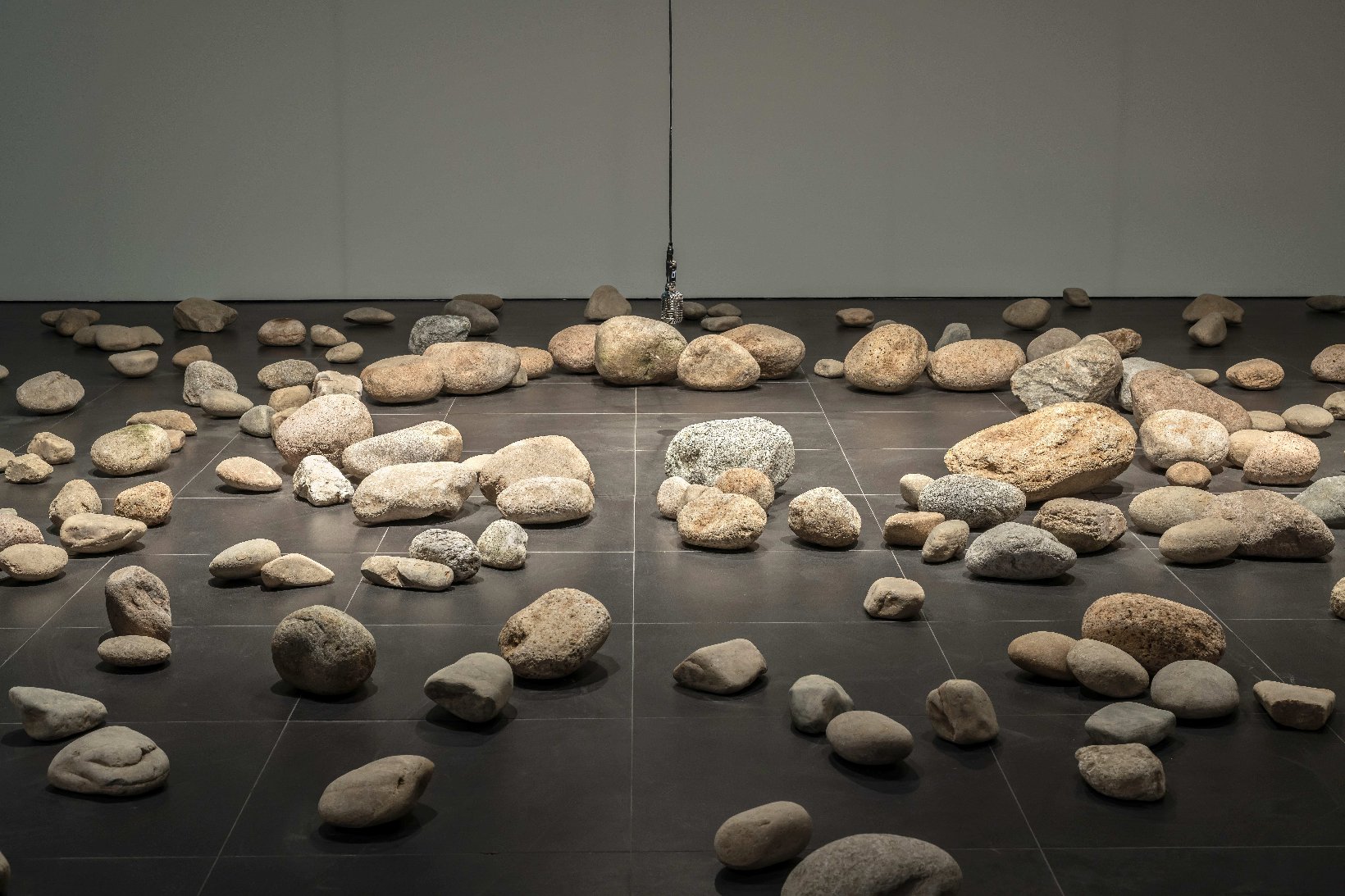
Park invests his pan-naturalist ideas of stones not only being symbols of nature but being themselves animated. In Untitled, also installed in the basement exhibition space, stones of varying sizes lie scattered on the black floor as if swept away from a certain corner of nature. In the center of the room, stones are arranged in a group as if in a circle of conversation. As if we are able to eavesdrop on that conversation, a microphone descends from the ceiling into the center of those stones. Sounds of the city infiltrate the exhibition space and are combined with the echoing sounds of visitors’ footsteps amplified with microphones and speakers thus incorporating natural stones and sounds sampled from outside and from within. This work was first presented at his solo exhibition Park Hyunki: Installation Audio & Video (1983) at Soo Gallery in Daegu alongside Untitled (TV Stone Tower).
In the summer of 1982, Park opened a solo exhibition Media as Translators on the riverbeds of the Nakdong River in Daegu where he presented video installations, performance, and slide projections for two days and one night. The following year, he would turn this on its head and bring this natural scenery into the exhibition space creating an environment where the existence of stone as object constituted a work of art. The exhibition included street sounds and images taken by the artist as he headed to the Soo Gallery from Cubic Design Studio recorded with the camera pointed towards the ground combined with the amplified sounds of visitors stepping on the wooden floors of the gallery. The present exhibition at Gallery Hyundai will attempt a convergence of traversing time between a specific moment in Daegu during the winter of 1983 recorded in sound and the present Spring of 2021 via the medium of infinite temporality inherent in the stones born from nature.
In one corner of the basement floor plays an archival video, documenting through photos, of Park’s performance, conducted without an audience, during that 1983 solo exhibition at Soo Gallery. With the words “I’m Not a Stone” written on his back and “stone and so forth” on his chest and stomach, the artist walks and runs naked between the mounds of stone as if searching for something. He conducts a series of acts like sitting down, crouching like a stone or leaning back against a stone. This performance dramatically reveals Park’s investigation of art as environment and the relationship between language and object, object and people, as well as primordial memories of stones and an instinctive pull towards them. In this way, the artist delivered the strong message that “he is not a stone” but “something other than stone”: a mediator between nature as symbolized by stones and human civilization within the exhibition context. Most importantly, the performance is a self-portrait of the artist himself who carried a camera to riverbeds around Korea, meticulously selecting and documenting stones to become material for his works.
The first floor of the gallery houses the work Untitled (ART) consisting of an assemblage of wooden pieces. Originally presented at his solo exhibition at Ingong Gallery in 1986, the perception of Untitled (ART) and the surrounding space shifts according to the viewer’s perspective and location, shattering expectations of art as an object that only exists so long as it is observed. Wooden construction panels 30 cm wide and 10 cm thick are arranged vertically at more than two meters tall, obstructing the sight and movement of audiences entering the gallery. Visitors must choose their own direction to the left or right and as they move through the space, will learn one by one the composition and form of the piece that appears like the base structure of some construction site. The exhibition space features three wooden structures with irregular gaps between the panels allowing the viewers to view the space beyond or to other visitors. Each structure consists of intersecting straight and curved lines, vertical and horizontal. Visitors carefully tread the narrow interior between the three structures tracing transformations in the space as newly delineated by these structures. Yet, they will find it difficult to grasp the entire form or defined meaning of this work. As the title implies, each structure takes the shape of the letters “A, R, and T” but, due to their height, are only visible from a bird’s eye perspective. We face the irony of stumbling through wooden structures that don’t look like art, while also not being able to figure out whether their shape spells out “ART.” The audience is a crucial element envisioned by the artist as participants and performers that completes the piece. On this work, the artist emphasized, “In a place where people gather, speak, and perform, the visitors are audiences and performers simultaneously.” Untitled (ART) encompasses the artist’s philosophy of incorporating the environment around people into art that questions: “What are the boundaries and authorities of art, and who is the subject of its interpretation?”
To Park Hyunki, space had always been an object of interpretation and analysis. After majoring in painting and architecture in college and earning a living through architecture and interior design alongside his art, spatial studies came to him naturally. He characterized exhibition spaces as “architectural spaces in the city center.” Following an intense focus on videos played on TVs and architectural works arranging stones into towers or mounds, the artist would shift his attention from the mid-1980’s from video to spatial installations utilizing construction materials such as brick and wood. Before presenting Untitled (ART), he displayed a work delineating the space with bricks and recycled planks at his February 1985 solo exhibition at Daegu’s Soo Gallery and then in March an installation of wood and bricks responding to specific site structures at the Culture and Arts Center art institute. These installations created walls out of stacked bricks and delineated space with planks joined both horizontally and vertically - yet the spaces created had no clear inside or outside but instead were closely connected like a Möbius strip. After constructing an “ART” shaped structure in Untitled (1986) in 1986, he takes only the “R” into a separate structure of grey bricks at a solo exhibition at the Shinanobashi Gallery in November of the same year in Japan. These tendencies represent Park’s spatial installations of the 1980’s highlighting the audience experience of the exhibition space itself and no longer merely an object of observation.
The second floor presents Park Hyunki’s iconic works Untitled, or “TV Stone Tower”, and the Mandala series. For Untitled, two large stones on the bottom serve as pedestal, on top of which four large cathode-ray TV monitors rest on top of each other. Each monitor displays a seam where two stacked stones meet creating the effect that the stones in all the monitors are joined seamlessly together. Untitled is a monumental work that was presented at the group exhibition Art now in Japan and Korea: Vertical and Horizontal (1988) at Seibu Art Museum’s Tskasin Hall. The work is the most towering of the "TV stone tower" series standing at over three meters tall reflecting a time when larger TVs with thinner cases and larger display screens started to appear together with the advent of remote controls. Like the stone towers of ancient times, the videos of stones stacked high looking down at us combined with the heaviness of real stones dominate the space with a presence felt even in the dark. This exhibition is the first reproduction of the work since the artist’s passing.
Park Hyunki was much more interested in the visual and sensory materiality of CRT monitors than the narrative content of moving images. After producing his first video work in 1978 of a lighting device reflected in water, he would produce his “TV stone towers” that maintain the form of prior stone towers but replacing artificial stones with TV monitors. The piece received much international acclaim at 1979’s São Paulo Art Biennial and 1980’s Paris Biennale. He wrote: “As I gained confidence that cathode-ray screens can house any and all videos (physically), I started putting in water, carps, and stones.” Park would continue with sculptural video works highlighting the strangeness of coexisting real-life objects and illusions in monitor screens. The artist especially emphasized that the formal methodology of “stacking" embarks from a spiritual experience: “my creative logic (concept) was that of horizontal and vertical, where the accumulation of structures is the expression of humankind’s will as a species. We find this in residences, temples, and ritual altars in human cultures.” Indeed, the TV Stone Tower series often captures images of temples or altars, which, as soon as the TV is turned on, transcend time through the fictional cube of timeless existence. Through Untitled, the exhibition space is transformed into a religious, ritual, and meditative sanctum.
Usage of architectural formal languages like accumulation and construction and the harmony between the sacred and the profane reach their pinnacle in the Mandala series from Park Hyunki’s later works. The other second floor room introduces four pieces of the Mandala series from the mid-1990’s that showcase the early stages of digital video editing techniques. For this exhibition, the gallery closely consulted with Chang Heeduk, the artist’s video engineer, and Shin Yongduk, art critic and advisor to the Park Hyunki estate. These works are projecting video onto similar red-painted floral tributes used in Buddhist rituals that were used in Park’s 1997 exhibition at Kim Post Gallery in New York. Only the red light descending from the ceiling projector remains visible in an otherwise dark gallery. As the video is only visible when leaning close to the ritual tribute, audiences feel a sense of being invited to witness a secret event. With geometric Buddhist icons overlapping and replaying infinitely, particularities of images disappear only leaving behind afterimages and sounds as breathless as heartbeats.
The Mandala series demonstrates a kind of dynamism made possible by digital editing techniques, that are far from the static meditative video works from Park’s earlier years. Short video clips, more than thirty frames per second, are weaved in over a hundred layers creating an illusion of three dimensional movement. The images forming the basis of these frames are split second clips of pornography. They were produced by capturing a single frame from original laser disk videos and then cross-editing 81 times. On top of the pornography, the artist overlaid another layer of chroma-key processed scans from books of Buddhist iconography often used as textbooks for Mandala training. Over all this are juxtaposed 81 Chinese characters from Cheonbu-kyeong scriptures (a scripture of Daejongism, a shamanistic belief system worshipping Dangun, the mythical founding father of the Korean people) explaining principles of the creation of the universe. In this way, the work is a juxtaposition of the most instinctive, secular human act with religious iconography and symbols explaining the creation of the universe and the principles of its movement. The kaleidoscopic images created from countless layers and rhythmical movement captivate the audience. Mandala is rightfully considered a quintessential example of Park’s video art, mirroring his lifelong questioning of human and nature, the source of the universe, and contemplations on its existence that form this great artist’s sublime worldview.
갤러리현대는 박현기의 개인전 《I’m Not a Stone(아임낫어스톤)》을 개최한다. 《I’m Not a Stone》전은 갤러리현대가 기획한 박현기의 세 번째 개인전으로, 작가의 작고 10주기를 기념해 2010년 회고전 형식으로 마련한 《한국 비디오 아트의 선구자 박현기》전, 그의 1990년대 초반의 설치 작품과 후반기의 명상적 영상 작품을 비롯해, 한지에 오일 스틱을 사용한 표현주의적 회화와 드로잉을 처음으로 대거 소개한 2017년의 《보이는 것과 보이지 않는 것(Visible, Invisible)》전을 잇는다.
박현기(1942-2000)는 ‘한국 비디오 아트의 선구자'로 국내외에 명성이 높지만, 그의 작품 세계는 비디오 아트에 국한하지 않는다. 대학에서 회화와 건축을 공부했으며, 줄곧 미술가와 건축 및 인테리어 디자이너로 동시 활약한 박현기는 조각, 설치, 판화, 비디오, 퍼포먼스, 회화, 드로잉, 포토미디어 등 다양한 매체를 전방위로 실험하며 도전적인 작품을 발표했다. 《I’m Not a Stone》전은 박현기의 창작 활동의 전환점이 되는 기념비적 대표작을 집중 조명함으로써, ‘비디오 아티스트’라는 수식에 가려진 그의 방대한 예술 세계에 주목한다. 또한 아시아 현대미술사의 중요한 아티스트로 재평가되고 있는 박현기의 미술사적 성취와 위상을 확인하기 위해 마련됐다.
《I’m Not a Stone》전의 출품작 10점은 1978년부터 1997년까지 박현기의 커리어를 폭넓게 아우른다. 강가의 돌을 전시장에 그대로 옮겨와 인간과 예술 그리고 자연과의 관계를 시적으로 성찰한 <무제>(1983), 신체와 공간, 미술과 건축에 관한 자신만의 아이디어를 유머러스하게 풀어낸 장소 특정적 설치 작품 <무제(ART)>(1986), 당시 최신 디지털 편집 기술로 종교적 도상과 포르노그래피 영상을 한 이미지로 조각하듯 결합한 말년의 대표작 <만다라>(1997), 'TV 돌탑' 연작 중 4m에 가까운 규모로 가장 거대한 <무제>(1988) 등을 유족과 미술평론가, 테크니션으로 구성된 ‘박현기 에스테이트’의 자문과 감수를 거쳐 재제작했으며, 주요 작품은 작가 사후 최초로 공개된다.
지하 전시장 초입에는 조명을 받아 반짝이는 작은 돌탑 3점 <무제>가 있다. 전시장 바닥에 좌대 없이 놓인 이 돌탑들은 넓적하고 둥그스름한 형태에 크기가 다른 돌 6-10개를 성인의 허리춤이나 무릎 아래 정도의 높이로 층층이 쌓아 올린 모습이다. 흡사 옛 마을 어귀에 잡석을 정성껏 올려 쌓은 돌탑의 토템적 장면을 떠올린다. 하지만 이 돌탑은 실재 돌과 인공 돌의 조합으로 구성됐다. 작가는 연한 핑크빛과 노란빛이 감도는 따뜻한 색감을 지닌 인공 돌을 합성 수지로 만들고, 실재 돌과 교차해 수직 구조로 쌓았다. 박현기는 활동 초기인 1974년부터 1978년까지 두루마리 휴지를 물과 잉크로 적셔 무르게하고 이를 원형 기둥처럼 쌓거나 함몰된 상태로 바닥에 정렬한 <몰(沒)> 연작을 지속했는데, 이러한 ‘쌓기’의 방법론의 연장선에서 말그대로 돌을 쌓는 ‘돌탑’ 작품이 탄생했다. 1978년 서울화랑에서 열린 개인전에서 돌탑 작품을 처음 발표한 이후, 작가는 평생동안 돌을 작업의 주재료로 활용했다. 그는 오랜 세월 하천과 그 주변을 구르며 자연 환경의 힘에 의해 다듬어진 투박한 모양과 질감의 실재 돌과 합성 수지의 특성상 조명을 받으면 속이 비춰 맑은 빛을 내는 인공 돌을 병치함으로써, 자연과 인공, 진짜와 가짜, 물질과 비물질, 사물과 사물 사이의 경계와 그 관계를 탐구했다.
박현기에게 돌은 "태고의 시간과 공간을 포용하는 자연”이며, 선조들의 미의식을 간직한 정신적 산물이자, 세상을 비추는 카메라이며, 영상 이미지가 상영되는 스크린이기도 했다. 그는 작가노트에 한국전쟁 당시 피난길에서 마주한 고갯마루의 성황당 돌무더기 전경을 잊지 못한다고 적어두었다. “전쟁 와중에 고갯길을 메운 피난 행렬 앞쪽에서부터 돌을 주우라는 신호가 뒤로 전달되었고, 이윽고 크고 작은 돌무더기를 향하여 던지며 지나고 있었다. 돌무더기는 신들의 무덤 같기도 하고 그들의 거처 같기도 한 상상을 초월한 묘한 장소로 기억난다. 왠지 또 가보고 싶은 충동을 주는 우리의 넋이 숨어 있을 듯싶은 감이 지금도 생생하다. 아마도 어른들은 그 돌 속에 어떤 소망을 빌었던 것 같다.”(작가노트) 이러한 체험과 기억은 그가 돌을 작품의 주재료로 사용하는 계기가 됐으며, 돌에 소원을 비는 사람들의 행위는 자연물을 다루는 개념적 태도와 미적 형식에도 깊은 영향을 미쳤다. 그는 성장기에 주입된 ‘미신타파’ 같은 서구식 교육 내용을 부정하면서, 돌무덤, 선돌, 절터, 당골 등 정신적 장소를 즐겨 찾거나 골동품 수집에 공을 들였다.
돌무더기 풍경 자체가 작품이 되는 지하 전시장의 <무제>는, 돌을 자연의 표상일뿐 아니라 의인화하는 단계로 나아간 박현기의 범자연주의적 사상이 녹아 있다. 자연 속 어딘가에서 휩쓸려 온 것처럼 크기가 다른 돌들이 전시장의 검은 바닥 곳곳에 퍼져 있다. 공간 가운데에는 돌들이 도란도란 둘러 앉아 담소를 나누듯 정열되었다. 그것의 대화를 우리에게 들려주는 장치처럼 천장에서 돌들의 중심으로 마이크가 내려와 있다. 전시장에는 외부의 도심 소리가 들리고, 동시에 전시장을 오가는 관람객의 발자국 소리가 마이크와 엠프를 통해 증폭되어 울려 퍼진다. 자연석과 외부에서 채집한 소리, 내부의 현장 소리로 구성된 이 작품은 1983년 대구 수화랑에서 열린 개인전 《박현기 전: 인스톨레이션 오디오&비디오》에서 <무제(TV 돌탑)>과 함께 발표됐다.
박현기는 1982년 여름, 대구 근교 강정의 낙동강변을 전시장으로 삼고 개인전 《전달자로서의 미디어》를 열며 1박 2일 동안 비디오 설치, 퍼포먼스, 슬라이드 프로젝션 작품을 전시했는데, 이듬해 역으로 전시장에 자연 풍경의 일부를 그대로 옮겨와 돌이라는 사물의 현존 자체가 ‘작품’이 되는 환경을 조성한 것이다. 작가가 운영하던 큐빅 디자인 연구소에서 수화랑까지 카메라를 땅으로 향하게 하여 걸으면서 녹음한 거리의 소리를 재생하고, 마이크로 당시 갤러리의 나무 바닥을 밟는 관람객의 소리를 증폭해 전시장에 울려 퍼지도록 했다. 이 소리를 돌들이 듣고 있는 것처럼 의인화해 돌에 헤드폰을 씌워 사진을 촬영하고 전시 초대장 이미지로 사용하기도 했다. 이번 전시를 통해 자연에서 돌이 만들어지는 엉겁의 시간, 박현기가 소리로 기록한1983년 겨울 대구의 어느 시간, 2021년 봄에 갤러리현대를 찾은 관람객의 시간이 한 작품(공간)에 공존하며 시대를 뛰어넘는 만남이 시도된다.
지하 전시장 한 켠에 재생되는 아카이브 자료 영상은 박현기가 1983년 수화랑의 개인전에서 관람객 없이 펼친 퍼포먼스를 사진으로 기록한 것이다. 작가는 등에는 “I’m Not a Stone”, 가슴과 배에 걸쳐서 “stone and so forth”이라고 쓴 채, 나체로 돌무더기 사이를 탐색하듯 걷고 서성이거나 뛰었고, 돌을 들었다 내려 놓았으며, 돌처럼 웅크려 앉거나 돌에 기대 눕는 일련의 행위를 펼쳤다. 이 퍼포먼스는 박현기의 언어와 사물/사물과 인간의 관계에 관한 탐구, 돌에 대한 원초적 기억과 그것을 향한 본능적 끌림, 환경으로서의 미술에 관한 아이디어를 극적으로 드러낸다. 동시에 ‘나는 돌은 아니’지만, ‘돌 이외의 것’으로서 돌로 표상되는 자연과 미술 전시장으로 표상되는 문명과 인간 사이의 ‘전달자’라는 강렬한 메시지를 담고 있다. 무엇보다, 이 퍼포먼스는 돌을 작품의 재료로 사용하며 카메라를 들고 전국의 강변을 구석구석을 누비며 신중하게 돌을 선택하고 기록하던 작가 자신의 자화상인 셈이다.
전시장 1층에는 목재를 조립해 만든 <무제(ART)>가 있다. 1986년 인공갤러리의 개인전에서 발표한 <무제(ART)>는 관람객의 시점과 위치에 따라 작품과 공간에 관한 지각의 범위가 달라져, 관조의 대상으로만 존재하는 미술에 대한 기대를 깨뜨린다. 30 cm 너비와 10 cm 두께의 건축 자재용 나무판이 수직으로 정렬돼 2m 넘는 높이로 세워져, 전시장에 입장한 관람객의 시선과 진입을 막는다. 관람객은 왼쪽이냐 오른쪽이냐, 자신의 동선을 선택해야 하고 전시장을 이동하며 건축 현장의 가구조물처럼 보이는 작품의 구성과 형태를 하나씩 파악하게 된다. 전시장에는 세 개의 나무 구조물이 놓여 있는데, 나무판 사이의 불규칙한 틈새로 전시장 너머의 공간이나 구조물 사이의 다른 관람객의 모습이 보인다. 세 개의 구조물은 직선과 곡선, 수직과 수평이 교차하며 구성되었다. 관람객은 세 구조물 사이와 구조물의 좁은 내부를 조심스럽게 오가며 작품을 체험하고, 구조물로 새롭게 구획된 공간의 변화를 탐색하는 시간을 보낸다. 하지만 관람객은 이 작품의 온전한 형태와 명확한 의미를 파악하기 어렵다. 제목처럼 세 구조물은 각각 알파벳 A, R, T의 모양을 하고 있는데, 그 높이 때문에 조감의 시선에서만 전체 형태를 확인할 수 있기 때문이다. 미술 작품처럼 보이지 않는 작품인 나무 구조물 사이를 헤매지만, 그것의 모양이 '미술(ART)'인지 명확히 알 수 없는 아이러니한 상황이 연출되는 것이다. 또한 이 작품을 완성하는 중요한 요소는 관람객이다. 작가는 관람객 또한 작품의 참여자이자 연기자가 된다고 보았다. 그는 “사람들이 모이고 말하고 연출하는 장소에 방문하는 사람은 관객임과 동시에 연기자”(작가노트)라고 강조했다. <무제(ART)>에는 인간을 둘러싼 환경 자체가 예술에 포함되어야 한다는 작가의 철학이 담겨 있으며, ‘예술의 경계와 권위는 무엇이며, 해석의 주체는 누구인가?’를 질문한다.
박현기에게 ‘공간’은 늘 해석과 분석의 대상이었다. 회화와 건축을 전공하고, 건축과 인테리어 디자인을 생업으로 삼아 작가 생활과 병행한 그에게 ‘공간 연구’는 지극히 자연스러운 일이었다. 그는 전시장을 “도심의 건축 공간”이라 설정했다. 1980년대 초반까지 영상을 담은 TV와 돌들을 탑이나 돌무덤 등의 건축적 구조로 구현한 작품에 매진한 그는 1980년대 중반부터 비디오를 배제하고 벽돌과 나무 등의 건축 자재만 사용한 공간 설치 작업에 몰두했다. <무제(ART)>를 발표하기 이전, 1985년 2월 대구 수화랑에서 열린 개인전에서 벽돌과 재활용 판자만을 이용하여 전시장을 구획하는 작품을 선보였으며, 같은 해 3월 문예진흥원 미술회관에서 열린 개인전에서도 벽돌과 판자를 이용해 공간의 구조에 반응하는 설치 작품을 발표했다. 벽돌을 쌓아 벽을 만들고 판자를 수직 수평으로 이어 공간을 구획하지만, 이 공간은 안과 밖의 구분이 명료하지 않고 뫼비우스의 띠처럼 서로 긴밀하게 연결되어 있다. 1986년 <무제(ART)>로 특정 형태의 구조물을 만든 작가는 같은 해 11월 일본 시나노바시 갤러리에서 열린 개인전에서는 회색 벽돌을 쌓아 ART 중에서 ‘R’의 형태만 구조물로 제작했다. 이러한 양상은 관조의 대상에서 벗어나 전시장 환경 자체와 관람객의 경험에 초점을 맞춘 박현기의 1980년대 공간 설치 작품을 대표한다.
2층 전시장에는 박현기의 대표작인 ‘TV 돌탑’ <무제>와 <만다라> 연작을 공개한다. 두 개의 큰 돌이 하단에 쌓여 기단 역할을 맡고, 그 위로 4대의 대형 브라운관이 차곡차곡 이어진다. 개별 TV 모니터에는 두 돌을 쌓은 중간 지점이 보이는데, TV 모니터가 쌓여 화면 속 돌들이 자연스럽게 이어진 것과 같은 환영을 만든다. <무제>는 박현기가 1988년 일본 세이부 미술관 츠카신홀에서 열린 그룹전 《일본과 한국 작가로 본 미술의 현재: 수평과 수직》에서 선보인 기념비적 작품으로, 높이가 3m가 넘어 ‘TV 돌탑’ 중에서 가장 거대한 규모다. 이번 전시를 통해 작가 사후 처음으로 재현되었다. 이 작품은 리모컨이 등장하자 텔레비전 외피가 얇아지고 브라운관 화면의 크기가 커진 대형 TV가 보급되던 시대 상황을 반영하며, 점차 신전(神殿)화된 공간 설치 작업으로 발전해 간 ‘TV-돌탑’의 변화 양상을 상징적으로 드러낸다. 고대의 돌탑처럼, 인간을 내려다보는 듯 높게 쌓인 돌 영상과 실재 돌의 육중한 스케일과 존재감은 어둠 속에서도 강조되며 공간을 장악한다.
박현기는 무빙 이미지가 연출하는 서사에 관심을 두지 않고, CRT 모니터의 시감각적 물질성에 집중했다. 1978년 물에 비친 조명 기구를 영상으로 기록한 첫 비디오 작품을 제작한 그는, 이전의 돌탑 형태는 유지하되, 인공 돌의 자리를 TV 모니터에 상영되는 돌 영상으로 교체한 ‘TV 돌탑’을 제작했다. 이 작품을 1979년 상파울로 비엔날레와 1980년 파리 비엔날레에 선보여 국제적 주목을 받기 시작했다. 그는 “브라운관 속에 어떤 영상도 (물리적으로) 담을 수 있다는 확신을 가지면서 물도 담고 붕어도 넣고 돌도 넣었다.”(작가노트) 박현기는 실재 대상과 모니터 화면의 환영 이미지가 공존하는 생경함을 강조하는 조각적 비디오 작업을 이어갔다. 특히 작가는 ‘쌓는다’는 형식적 방법론이 정신적 체험에서 출발한다고 강조했다. “내 작업논리(컨셉)는 수평과 수직의 작업논리였으며, 구조물의 축적은 인간의 종적의지를 표현하는 수단으로 고정되며, 인간의 주거공간, 신전이나 의식을 위한 제단 등에서 찾아볼 수 있다.” ‘TV 돌탑’ 연작에서 종종 신전이나 제단의 모습이 포착되는데, TV가 켜지는 순간 영상의 돌은 시공을 초월해 가상의 큐브 속에 영원히 존재하게 된다. <무제>를 통해 전시장은 성소(聖所)와 같은 종교적이고 제의적이며 명상적인 공간으로 전환된다.
축적과 축조라는 건축적 조형 언어의 사용과 '성'과 '속'의 조화는 박현기 말년의 대표작 <만다라> 연작에서 정점에 달한다. 2층 안쪽 전시장에는 작가가 초기 디지털 영상 편집 기술이 도입되던 1990년대 중반에 집중한 <만다라> 연작 4점을 공개한다. 전시를 위해 작가 생전에 비디오 작업의 엔지니어였던 장희덕과 ‘박현기 에스테이트’의 자문위원인 미술평론가 신용덕의 고증을 거쳤으며, 1997년 뉴욕 킴 포스트 갤러리의 상영 방식과 동일하게 붉은색 옷칠이 된 불교 의례용 헌화대 위에 영상을 투사한다. 어두운 전시장에는 천장에 고정된 프로젝터에서 내려오는 붉은 불빛만이 보이며, 의례용 헌화대에 가까이 다가가서 내려 봐야 영상을 볼 수 있기 때문에 관람객은 비밀스러운 장면의 목격자로 초대받은 느낌을 받는다. 기하학적 불교 도상이 겹쳐져 무한 반복 재생되는 가운데, 구체적인 형상의 이미지는 사라지고, 심장 박동처럼 속도감 있는 사운드와 도상의 잔상만 남긴다.
<만다라> 시리즈는 박현기가 이전에 발표한 정적이고 명상적인 비디오 작업과는 달리, 디지털 편집 기술을 적용한 역동적인 비디오 작품이다. 초당 30프레임 이상의 짧은 영상 클립은 백 여 겹 넘는 레이어로 직조돼서 입체적으로 움직이는 착시를 일으킨다. 프레임의 기초를 이루는 이미지는 찰나적인 포르노 영상이다. 레이저 디스크 원본 영상에서 1조각씩 캡처한 화면을 81번 교차편집하는 과정을 거쳤다. 포르노 영상 위로 티벳 불교에서 만다라 수련의 교본으로 즐겨 사용하는 불교 도상 모음집을 한 장씩 스캔한 후 크로마키 처리를 한 레이어를 얹혔다. 여기에 우주창조의 이치를 81자로 풀이하는 천부경의 한자가 겹쳐진다. 가장 세속적인 인간의 본능 행위와 종교적 도상, 천지창조와 그 운행의 묘리를 설명하는데 사용되는 기호가 합쳐진 것이다. 무수한 레이어로 완성된 만화경적 이미지와 리드미컬한 움직임이 관람객의 시선을 붙잡는 <만다라>는 박현기가 창조한 비디오 아트의 정수로 평가 받으며, 그가 평생 질문한 인간과 자연, 나아가 우주의 근원과 그 존재에 대한 성찰과 숭고한 세계관이 반영되어 있다.
Selected Works
Installation Views
{{ lbCurrent.title }}
{{ lbCurrent.text }}