
John Pai
Meditation: Myth and Memory
Sep 10 – Nov 28, 2026
New York Project Space
“Memory is like an extended womb integral to nearly every human endeavor. It’s a bit unnerving, but then again perhaps also amusing, to think that maybe it has a life of its own.”
—John Pai, In Memory’s Lair catalogue, Gallery Hyundai, January 28, 2013
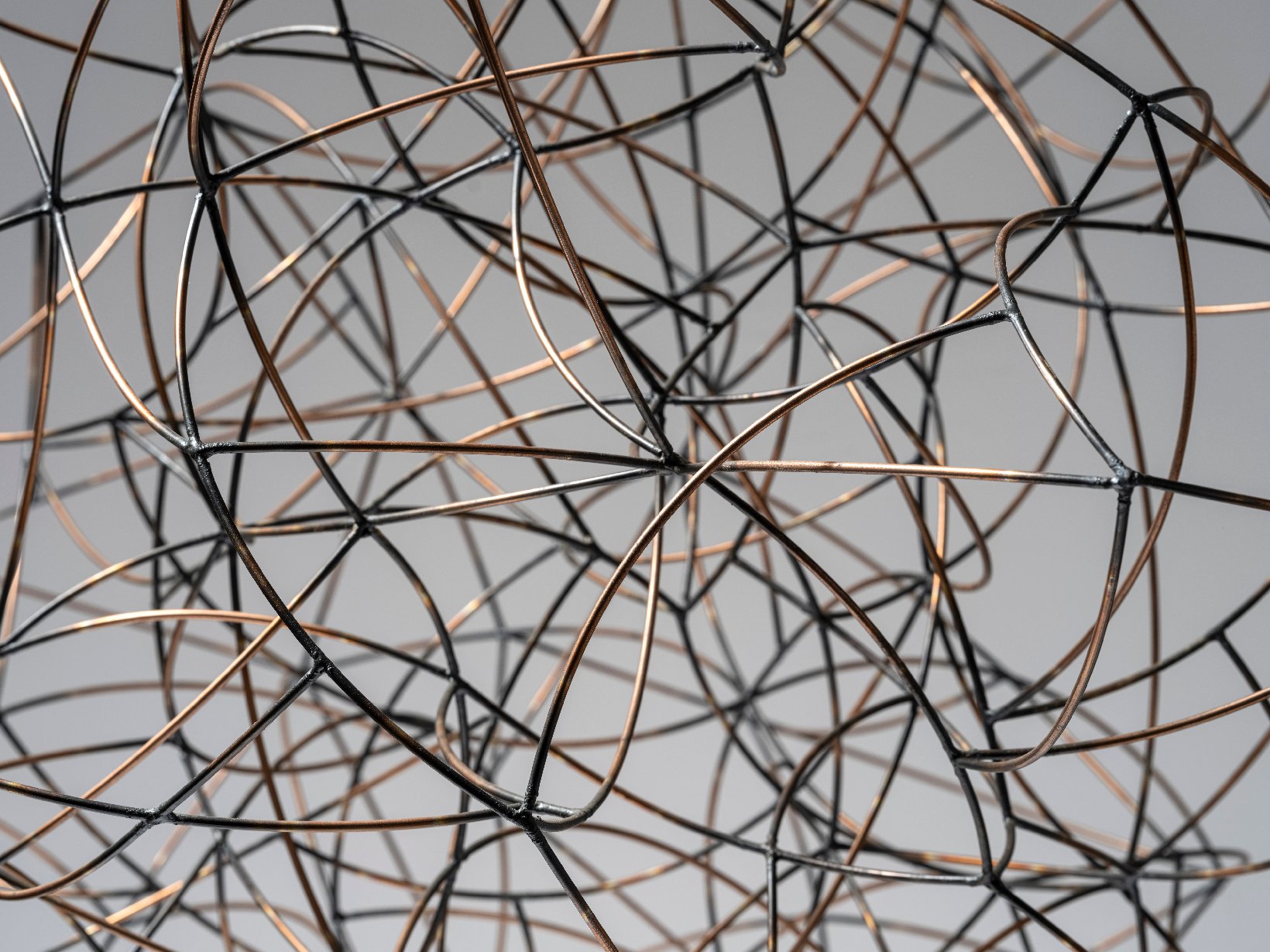
Gallery Hyundai is pleased to present Meditation: Myth and Memory, an exhibition of Korean American sculptor John Pai, a major force in the Korean American diaspora of the last half-century. Pai is gaining heightened recognition for his indisputable contributions to sculpting with steel, a signature method of hand-welding numerous thin, short steel rods into a “drawing in space,” as well as his groundbreaking pedagogical methods since becoming the youngest appointed professor at Pratt Institute in 1965. All of Pai’s sculptures are born out of a dynamic field of inquiry unbridled by discipline, traversing topology, physics, phenomenology, and musical processes of improvisation. The presentation opens and centers around his major and most recent series Heaven and Earth (2024) as well as the Entropy’s Sirens (1997) trio, marking the first occasion it is presented as a group of three including two previously unseen pieces, accompanied also by a selection of sculptures and drawings.
This exhibition seeks to provide a space for meditation where myth and memory, as in Pai’s world, could be considered as companions, at times synchronous, and at times on their own path. In the Heaven and Earth series, a single point becomes a line, then a form, and appears to trail off to gesture to the space around it, going past the artist’s agency and into another realm. This work manifests Pai’s guiding ethos, where the artist’s mind (and the memories contained inside the artist) inform his beginning, but the development of the work is made in conversation with the material and the work. This conversational and improvisational method shows Pai’s belief that memories are not stable but are always vulnerable to change, sometimes appearing closer to myth than reality. Pai has always likened his improvisation to music, as Pai himself is a multi-instrumentalist, having grown up in a musically gifted family, and later becoming a lover of jazz. Completed when Pai was eighty-seven years old, this grouping of sculptures reveals an artist in his maturity who still remains playful, responsive, and deeply curious.
Walking further into the gallery, viewers are greeted by a trio of sculptures including Entropy’s Sirens (1997) and two previously unseen pieces, Metamorphosis (1996) and Cosmos (1996). Though made three decades ago, they appear contemporaneous to Heaven and Earth, echoing Pai’s engagement with phenomenology and existentialism. While working with line or the grid, Pai disrupts so-called Western modernist notions conventionally associated with them—as art historian Yeon Shim Chung has written in her 2024 essay “John Pai: Welding and Sculpting Fluid Steel”: “[Pai’s works] catalyze variable situations marked by indeterminacy and vulnerability.” Held together not by geometry but what the artist describes as “a force of attraction and reproductive process that is both romantic and vicious,” the trio appears as equal parts freehand drawing and some miraculous natural growth, creating variable configurations of negative space with every turn of the viewer’s perspective.
A pair of works from 2012, After Matisse and Constellation, bridges the two states of energy in the Heaven and Earth and Entropy’s Sirens series. Rather than the visible form of a constellation, they capture the delicate dynamics of matter as it is torn between forces of expansion and contraction—unsurprising for an artist who was fascinated by physics and topology throughout his career. Perhaps then, A Reminder (1988) that reveals itself in the rear gallery, more solid and imposing than any other piece in the exhibition due to the compact welding of short steel rods, is what remains after such constellations finally give way to collapse: the embers of a Big Freeze that nevertheless contain the whispers of a new star.
Born in Seoul, Korea in 1937 during the Japanese occupation (1910–1045) to parents who devoted their life to the independence of Korea and its rebuilding, John Pai moved to the United States in his early teens. Pai has stated: “The growing presence of Korean culture in my consciousness makes me feel the need to pick up the thread of cultural continuity and dig into the richness of its visions, not necessarily through specific rituals, traditions, or written history, but through more primal means—by exploring the subconscious.” By his exploration of the subconscious, Pai has created a body of work that moves in and through his memories – but they leap beyond into narrative and myth that is our collective life force.
“기억이란 인간의 만사에 중심축을 이루는 ‘확장된 자궁’과 같은 것이다. 때로는 오싹하고, 때로는 놀랍도록 흥미로우며, 여러모로 자신만의 생명을 가지고 있는 것만 같은 존재가 기억이다.”
—존 배, 갤러리현대 『기억의 은신처』 도록, 2013년 1월 28일
갤러리현대 뉴욕 프로젝트 스페이스는 코리안 아메리칸 조각가 존 배의 개인전 《Meditation: Myth and Memory》를 개최한다. 존 배는 지난 반세기 동안 코리안 아메리칸 디아스포라 공동체를 대표하는 작가 및 교육자로 다방면의 활약을 펼쳐 왔다. 그는 가늘고 짧은 철사를 손수 용접해 ‘공간 속의 드로잉’을 완성하는 독자적 방법론을 발전시키며 국제적 무대에서 주목받아 왔고, 1965년 프랫 인스티튜트(Pratt Institute)의 최연소 교수로 임명된 이후 획기적인 다학제적 커리큘럼을 창시했다. 그의 작업은 학제를 막론하고 위상학, 물리학, 현상학, 즉흥 음악 등 폭넓은 영역을 지속적으로 연구한 결과물이기도 하다. 이번 전시에서는 그의 주요 연작인 〈하늘과 대지(Heaven and Earth)〉(2024)와 〈엔트로피의 사이렌(Entropy’s Sirens)〉(1997) 삼부작 중 두 점이 전시를 통해 최초 공개된다. 또한 작가의 끊임없는 탐구정신과 물질적 실험을 보여주는 다양한 조각과 드로잉도 함께 소개된다.
특히 이번 전시는 존 배의 작업을 통해 그의 세계처럼 신화와 기억이 공존하는 명상적 공간을 구현한다. 신화와 기억의 세계는 각자 다른 길을 따라갈 수도 있고 함께 작동할 때도 있지만 결코 한 자리에 머무르지 않는다. 작가와 물질 사이의 긴밀한 관계와 매체에 대한 지속적 탐구는 〈하늘과 대지〉 연작에서 드러난다. 각각의 점은 선으로, 그리고 형상으로 발전하며 조각을 둘러싼 주변 공간으로 손짓처럼 스며들고, 작가의 의도 너머에 자리한 미지의 세계로 확장된다. 작업의 시작은 작가 내면의 인상과 기억에서 출발하지만, 결국 물질과의 대화, 작업 자체가 보여주는 반응을 바탕으로 완성된다. 작가와 작품이 서로 소통하며 완성되는 과정은 작가의 즉흥적인 방법론에서 드러나는 철학을 보여준다. 따라서 작가에게 기억이란 영구적인 대상이 아니라 쉴 새 없이 요동치는 ‘현재’에 따라 변화하는, 때로는 현실보다 신화에 가까운 존재로 인식된다. 음악에 열정적이었던 가족 환경에서 자라며 여러 악기를 다룰 줄 아는 연주가이자 재즈 애호가로 평생을 보내온 작가는 이러한 즉흥성을 음악과 자주 비교해 왔다. 여든일곱의 작가의 손에서 태어난 이 연작은 그의 노련함 속에 공존하고 있는 장난스러움과 호기심을 숨김없이 보여준다.
갤러리 안쪽에서 〈엔트로피의 사이렌〉(1997)과 두 점의 미공개작 〈우주(Cosmos)〉(1996), 〈변형(Metamorphosis)〉(1996)으로 이루어진 삼부작이 관객들을 맞이한다. 세 작업은 30여 년 전에 제작되었음에도 마치 〈하늘과 대지〉와 현상학, 실존주의를 둘러싼 동시대적 대화를 주고받는 듯하다. 존 배는 선이나 그리드를 이용해 유사한 시각적 체계들에서 연상되는 서양 모더니즘적 사고관을 해체하고자 한다. 미술사학자 정연심 교수가 2024년 에세이 「존 배: 유동(流動)하는 철 조각」에서 말했듯, “일종의 모호한 불확실성(indeterminacy, contingency), 혹은 상처받기 쉬운(vulnerability) 가변적 상황을 유발”하는 것이다. 이번 삼부작 역시 기하학적 체계가 아닌, 작가의 말처럼 오로지 “끌림의 힘과 재생산의 과정, 그 속에 공존하는 낭만과 잔인함”으로 결속된 듯하다. 자유 드로잉 같기도, 자연이 품어 낸 놀라운 형상 같기도 한 세 조각은 틈틈이 자리한 여백이 관객의 위치에 따라 시시각각 다른 구성을 만들어 낸다.
2012년에 제작된 〈마티스 이후(After Matisse)〉와 〈별자리(Constellation)〉는 서로 다른 파동을 보여주는 〈하늘과 대지〉와 〈엔트로피의 사이렌〉을 연결해 주는 다리와도 같다. 별자리의 가시적인 형상 대신 확장과 수축 사이에 아슬아슬하게 붙들린 미묘한 역학 관계를 암시하는 작업으로, 작가의 오랜 관심 분야인 물리학과 위상학의 영향을 엿볼 수 있다. 갤러리 안쪽에 위치한 〈암시(A Reminder)〉(1988)는 짧은 철사를 촘촘히 용접하여 보다 밀도가 높고 묵직함을 보여준다. 이는 마치 별 무리들이 결국 붕괴한 뒤 열적 사멸 이후에 남은 재, 그 속에서 새로 태어난 별들의 속삭임을 연상하게 한다.
존 배는 1937년, 일제강점기 아래 서울에서 태어나 한국의 독립과 재건에 일평생을 바친 부모님 수하에서 자랐고, 십대 초반에 미국으로 이민했다. 그는 『Liquid Steel』 모노그라프에서 이렇게 말한 바 있다. “나의 의식 속에서 한국 문화의 존재감이 점점 확대되고 있다. 문화적 지속성에 일부 기여하자면, 풍부한 문화적 시야를 보다 집중적으로 탐구할 필요성을 느낀다. 특정한 의례나 전통, 기술된 역사보다는 보다 원초적인 방식을, 무의식을 통해서 탐구하고 싶다.” 이처럼 무의식의 탐사를 통해 태어난 작업들은 존 배 자신의 기억을 통로 삼아 숨쉬고, 개인의 기억을 넘어 집단적인 생명력을 지닌 서사와 신화의 영역으로 뛰어든다.
Selected Works
Installation Views
Stories
{{ lbCurrent.title }}
{{ lbCurrent.text }}