
Art Basel in Basel 2025
Jun 17 – Jun 22, 2025
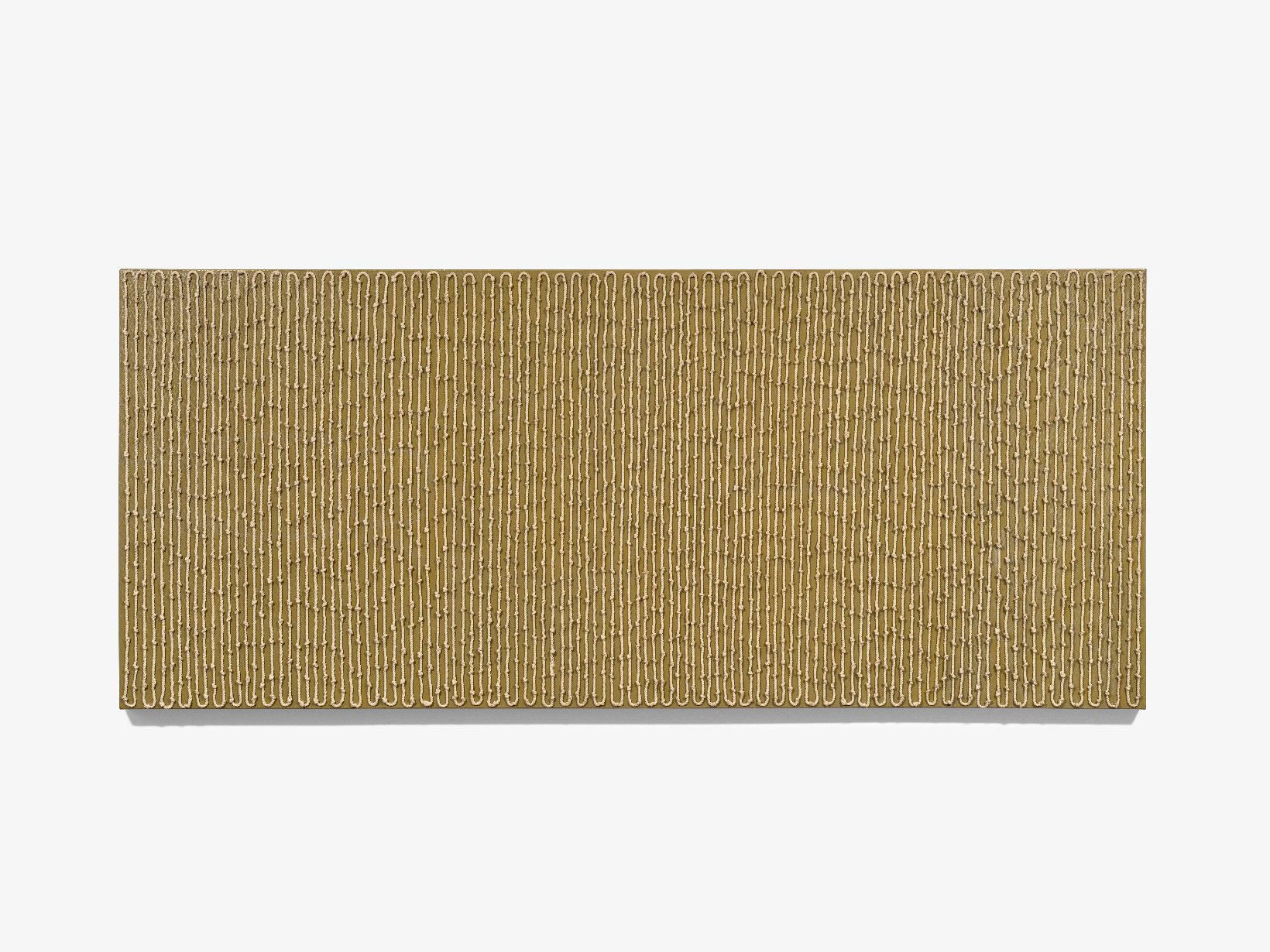
“Ironically, the act of ‘tying’ creates an optical illusion about the material’s physical properties, and in the process, I found myself drawn to the effect it has of conjuring a sense of vitality.”
— Seung-taek Lee, in conversation with Hans Ulrich Obrist, August 2020
Gallery Hyundai presents a solo booth of Korean avant-garde pioneer Seung-taek Lee (b. 1932) at Art Basel in Basel. Since the 1950s, Lee has pushed the boundaries of Korean contemporary art through a wide range of media, including sculpture, painting, installation, performance, land art, photo-painting, and collage. During the 1960s and 1970s, when movements such as Arte Povera, Conceptual art, and Land art were shaping the Western art world, Lee pursued his own experiments with materials, forms, and viewers’ perception, challenging the conventional boundaries of traditional sculpture. This presentation centers on Lee’s renowned “bound” series, an epitome of Lee’s original concept of “non-sculpture” that guided his longstanding pursuit of a new sculptural language. By dismantling the formal qualities of traditional sculpture and imbuing objects and materials with traces of tension, Lee’s work offers a compelling redefinition of sculpture.
Seung-taek Lee’s world of “non-sculpture” can be divided into two major categories. First, in the “non-material” series, natural phenomena without tangible volume—such as wind, smoke, and fire—are momentarily “sculpted” into installations and performances, allowing viewers to visually experience their fleeting presence. Gallery Hyundai’s upcoming presentation at Art Basel in Basel highlights the second group, the “bound” series. This body of work deviates from traditional sculpting techniques such as carving or modeling in favor of binding, constraining, or preserving the traces of restraint in everyday objects. This series represents a key aesthetic methodology in Lee’s pursuit of “non-sculpture”: the reversal of original forms and qualities of objects and the subversion of familiar aspects of daily life, which distinguishes Lee from his contemporaries.
Gallery Hyundai’s booth G13 features nearly 30 representative pieces from the artist’s “bound” series, continuing from the 1960s into the present. In Godret Stone, Tied Porcelain, Tied Stone, and Rope Painting, Lee suppresses the material properties of objects and imbues tension by binding everyday objects like stones, porcelain, books, and canvases. His key work, the Tied Stone series, draws inspiration from the ridged contour of godret stones, traditionally used in Korea to weigh down threads when weaving mats or screens. By wrapping stones in wire or rope, Lee not only emphasizes their materiality but also realizes a kind of “metaphorical sculpting” which transforms solid objects into a surprising illusion of malleability. He applied this binding technique to a range of objects such as ceramics, female torsos, books, and canvases, making familiar forms unfamiliar towards the visual effect of “a revitalizing perspective” and transcending the boundaries of sculpture and of conventional concepts of objects through their form.
The relationship between Seung-taek Lee and Gallery Hyundai began around 2009, when the CEO of Gallery Hyundai, HyungTeh Do, accompanied him at an interview with Hans Ulrich Obrist around the time Lee received the Nam June Paik Art Center Prize. Captivated by Lee’s groundbreaking artistic vision, Gallery Hyundai began promoting his work, leading to domestic and international exhibitions. Since 2012, the gallery has represented Lee at Frieze New York, Frieze London, Art Basel Miami Beach, and Art Basel in Basel, as well as in collaborations with major art institutions and galleries, including Lévy Gorvy in New York and Venice, White Cube Gallery in London, and Canal Projects in New York. This led to a notable duo exhibition with James Lee Byars in collaboration with Michael Werner Gallery in London and Venice. As a result, in 2012, when Lee was still relatively unknown in the art world, his works were acquired solely for their artistic quality by the Tate Modern in London. This milestone paved the way for further acquisitions by the Museum of Modern Art in New York, M+ in Hong Kong, the Guggenheim Abu Dhabi, and other major international institutions, firmly securing his place in major modern and contemporary art collections. In March 2024, Lee’s first English monograph was published by Rizzoli New York. Lee has held multiple exhibitions at Gallery Hyundai, starting with Upside Down in 2014, followed by solo exhibitions in 2015 and 2022. When the gallery initially proposed an exhibition to the artist, Lee was hesitant as he had never imagined exhibiting in a commercial gallery in his 80-year career and wondered why Gallery Hyundai would visit his studio. However, through nearly 15 years of dedicated support, Lee has garnered international recognition as a foundational figure in Asian avant-garde experimental art.
Seung-taek Lee’s work was recently acquired in May 2025 by the eminent Dia Art Foundation in New York. Additionally, his Godret Stone is currently on view in the collection exhibition MMCA Collection: Korean Contemporary Art at the National Museum of Modern and Contemporary Art, Korea (MMCA) in Seoul, alongside works by other leading Korean artists. The exhibition provides an in-depth look at the evolution of Korean art within shifting sociopolitical contexts, while at once exploring its relationship to global art movements, highlighting both the distinctive and universal dimensions of Korean contemporary art.
“아이러니하게도 ‘묶기’라는 행위는 재료의 물성에 대한 착시를 일으키며, 생명력에 대한 환영을 불러오는 효과를 작업 과정에서 몰두하게 된 것 같습니다.”
— 이승택, 한스 울리히 오브리스트와의 인터뷰, 2020년 8월
갤러리현대는 ‘아트바젤 바젤’에서 한국 아방가르드 미술의 선구자 이승택(b. 1932)의 솔로 부스를 선보인다. 이승택은 1950년대부터 활동을 시작해 지금까지 조각, 평면, 설치, 퍼포먼스, 대지미술, 포토페인팅, 콜라주 등 다양한 매체를 넘나들며 한국 현대미술의 경계를 확장해 왔다. 1960–70년대 서구 미술계에서 아르테 포베라(Arte Povera), 개념 미술(Conceptual Art), 대지 예술(Land Art) 등이 큰 흐름을 주도했던 시기에 작가는 전통적 조각의 한계를 뛰어넘고자 재료와 형식, 감상자의 수용 방식 등에 대해 끊임없이 실험해 왔다. 작가가 일찍이 제시한 독자적 개념인 ‘비조각’에 기반한 대표 연작 ‘묶기’ 시리즈를 중심으로 구성된 이번 프레젠테이션은, 전통적인 조각의 조형성을 해체하고 사물과 물질에 긴장의 흔적을 부여함으로써 새로운 조각의 언어를 탐구해 온 이승택의 예술세계를 집중적으로 조명한다.
이승택의 ‘비조각’의 세계는 크게 두 범주로 구분된다. 하나는 바람, 연기, 불과 같은 물질적인 양감이 없는 자연 현상을 우리가 시각적으로 체험할 수 있도록 순간적으로 ‘조각’한 설치 및 퍼포먼스 형식의 ‘비물질’ 시리즈다. 아트바젤 바젤에서 선보이는 다른 하나는 소조하거나 조각하는 방식을 벗어나 일상의 사물을 묶거나 혹은 매어진 흔적을 간직한 오브제 형식으로 마무리되는 ‘묶기’ 시리즈이다. 특히 ‘묶기’ 시리즈는 사물의 형태와 본성을 뒤집고 낯익은 일상을 전복시키는 ‘비조각’을 향한 작가의 주요한 미적 방법론이었으며, 이는 당대 다른 작가들과 차별되는 지점이다.
갤러리현대의 부스 G13에서는 이승택의 ‘묶기’ 시리즈 중 1960년대부터 현재까지 이어져 온 대표작 약 30점을 선보인다. 〈고드랫돌〉, 〈매어진 백자〉, 〈매어진 돌〉, 〈노끈 캔버스〉 등은 돌, 백자, 책, 캔버스 등 일상적인 사물을 노끈, 철사 등으로 감고 묶어 사물의 물성을 억제하고 긴장감을 부여한 작업들이다. 대표작 중 하나인 〈매어진 돌〉 시리즈는 선조들이 발이나 돗자리를 엮을 때 끈을 감아 늘어뜨리던, 홈이 파인 고드랫돌에서 착안했다. 돌에 철사나 노끈을 감아 물질성을 강조하는 동시에, 단단한 물질을 유연하게 전환하는 은유적 조형으로 기능한다. 작가는 도자기, 여성의 토르소, 책, 캔버스 등 다양한 사물을 노끈과 철사로 묶는 행위를 통해, 익숙한 형상을 낯설게 만들고 시각적 전환을 유도한다. 이와 같은 ‘묶기’의 방법론은 단순한 형식 실험을 넘어 조각의 경계를 재정의하고, 관념적 확장을 시도하는 핵심 조형 언어로 작동한다.
갤러리현대와의 인연은 2009년 백남준 아트센터 국제예술상 수상쯤에 한스 울리히 오브리스트와의 인터뷰에 도형태 부회장이 동행하며 시작되었다. 인터뷰를 계기로 작가의 놀라운 작업 세계에 매료된 갤러리현대는 2012년부터 국내 전시는 물론 프리즈 뉴욕, 프리즈 런던, 아트 바젤 마이애미, 아트 바젤 바젤과 더불어, 뉴욕과 베니스에서의 레비고비 갤러리, 런던의 화이트 큐브 갤러리, 뉴욕의 현대미술 기관인 캐널 프로젝트, 런던과 베니스에서 마이클 버너 갤러리와 협업하여 제임스 리 바이어스와 2인전을 성사시켰다. 그 결과 2012년 당시 잘 알려지지 않은 미술가였던 이승택의 작품이 오직 작품성만으로 런던의 테이트 모던의 현대 미술 컬렉션에 편입되었으며, 이후 뉴욕현대미술관(MoMA)과 홍콩의 M+, 아부다비의 구겐하임미술관 등 유수의 현대 미술 컬렉션에 소장되었다. 2024년 3월에는 이승택의 최초 영문 모노그래프가 리졸리 뉴욕에서 출판되었다. 갤러리현대에서는 2014년 《거꾸로》를 시작으로 2015년과 2022년에 개인전을 개최했다. 처음 갤러리 전시를 제안했을 때 이승택은 팔십 평생 동안 상업 화랑에서의 전시는 상상해 본 적이 없다며, 갤러리현대가 왜 작업실을 찾아오냐는 반응이었다. 이후 15년가량 작가의 대표작을 꾸준히 프로모션한 결과로 해외 메이저 미술관과 영향력 있는 서구 컬렉터들로부터 아시안 아방가르드의 실험 정신의 원조라는 평가를 받으며 세계적인 작가로 인정받고, 다양한 컬렉션에 소장되게 되었다.
이승택의 작품이 지난 5월 뉴욕을 기반으로 하는 세계적인 재단, 디아 아트 파운데이션에 소장되었다. 또한, 그의 〈고드랫돌〉 작품이 한국의 사회적 상황 속에서 이뤄졌던 미술의 변화와 전개에 더불어 국제 미술의 흐름과의 관계와 한국현대미술의 특수성과 보편성을 동시에 살필 수 있는 국립현대미술관 서울관의 상설전 《한국현대미술 하이라이트》에서 한국 현대미술의 주요한 작가들의 작업과 함께 소개되고 있다.
Installation Views
{{ lbCurrent.title }}
{{ lbCurrent.text }}