
Robert Indiana
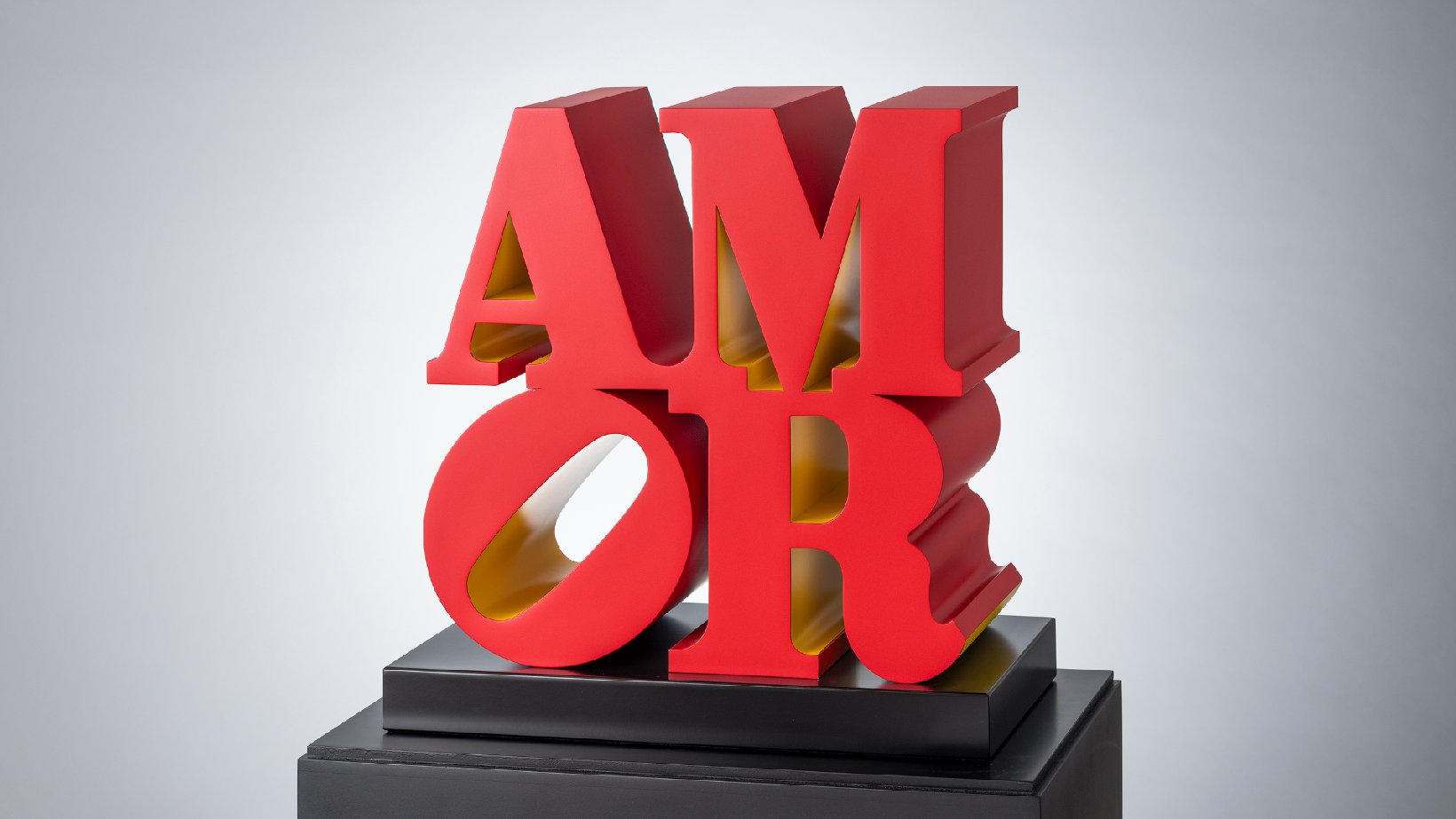
A self-proclaimed “American painter of signs” and one of the preeminent figures in postwar American art, Robert Indiana (1928–2018, born Robert Clark) played a central role in the development of assemblage art, Pop art, and printmaking. Drawing on American identity, the ordinary experience of daily life, and the power of signs and language, Indiana developed an iconic visual language that operates on both public and deeply personal registers. After serving in the U.S. Air Force, Indiana studied at the School of the Art Institute of Chicago, where he received his B.F.A. in 1954, followed by studies at the Skowhegan School of Painting and Sculpture in Maine and the Edinburgh College of Art in Scotland.
Indiana used everyday language, familiar objects, nontraditional materials, and the visual vocabulary of signs, billboards, and commercial logos to examine American identity and transform the viewer’s daily experience into the realm of fine art. His most celebrated works, including the LOVE and HOPE series, use words that are both instantly recognizable and culturally overdetermined, giving them personal, social, and political resonance. With their bold colors, clear forms, and direct messages, these works may at first recall the visual immediacy of Pop art. Yet Indiana’s practice also carries a critical edge, reflecting on popular culture, consumerism, and the contradictions of the American Dream. As he once remarked of LOVE, “It was a spiritual concept. It isn’t a sculpture of love any longer. It’s become the very theme of love itself.”
Over the course of his career, Indiana participated in numerous solo and group exhibitions and individual projects. His inclusion in the 1961 exhibition The Art of Assemblage at the Museum of Modern Art and the 1962 International Exhibition of the New Realists at Sidney Janis Gallery helped establish his reputation as one of the most inventive artists of his generation. His work is held in major institutional collections in the United States, including the Museum of Modern Art and the Whitney Museum of American Art in New York; the Art Institute of Chicago; the National Gallery of Art, the Hirshhorn Museum and Sculpture Garden, and the Smithsonian American Art Museum in Washington, D.C.; the San Francisco Museum of Modern Art; the Menil Collection, Houston; and the Buffalo AKG Art Museum, New York. Internationally, his work can be found in institutions including Tate Modern, London; Neue Nationalgalerie, Berlin; mumok, Vienna; Museum Ludwig, Cologne; Van Abbemuseum, Eindhoven; and the Art Gallery of Ontario, Toronto, among many others.
“미국의 기호 화가” 로버트 인디애나는 전후시대 미국의 가장 중요한 작가 중 한명이며 아상블라주, 팝아트, 그리고 조판에 큰 영향을 미친 아티스트이다. 미국과 미국인의 정체성, 일상 속의 소소한 경험, 그리고 기호와 언어가 가지는 큰 영향은 인디애나의 작품에서 뚜렷하게 드러나는 주제인데, 작품을 통해 그는 개개인뿐만 아니라 공공의 차원에서까지 그 메시지를 전달한다. 미국 공군 제대 후 인디애나는 아트인스티튜트오브시카고와 에딘버러예술대학에서 수학한 후 다시 미국으로 돌아와 본격적으로 작가로서의 활동을 시작하였다.
인디애나는 평범한 일상 속의 언어와 사물들을 사용하여 미국인의 정체성이라는 근본적인 질문을 던지고, 작품을 통해 일상을 흔히 “예술”이라 칭해지는 차원으로 고조시킨다. 관객이 쉽게 알아볼 수 있는 기호, 빌보드, 그리고 상품의 로고 등을 사용하여 인디애나는 너무나도 잘 알려진 LOVE와 HOPE 시리즈를 탄생시킨다. 두 단어는 일상 속에서 가장 많이 쓰이는 – 혹은 남용되는 – 말인데, 인디애나는 이 작품들이 더 이상 사랑이나 희망의 조각이 아닌, 관념 그 자체가 주제가 되어버렸다고 말한다. 외관으로 보이는 조각의 단순함과 원색의 배합은 1950년대에 탄생한 팝아트를 연상시키기도 하는데, 오히려 작가는 이러한 유사성을 통해서 당대의 소비지상주의와 미디어 매체를 비판하고 있다.
인디애나의 작품들은 수많은 개인전과 그룹전에 전시되었고, 뉴욕현대미술관과 휘트니미술관, 워싱턴국립미술관, 허쉬혼미술관과 조각공원, 스미소니언미술관, 올브라이트녹스아트갤러리, 샌프란시스코근현대미술관 등 미국 내의 대표적인 미술관에도 소장되어 있으며 미국 외에서는 네덜란드국립미술관, 독일과 오스트리아의 루드비히뮤지엄, 중국 상해미술관, 예루살렘의 이스라엘뮤지엄 등에서도 인디애나를 만나볼 수 있다.
Selected Works
{{ lbCurrent.title }}
{{ lbCurrent.text }}