
Kim Sung Yoon
“The past, as a space, remains a space of nothingness because it innately cannot exist as a tangible entity in the present. However, we cannot doubt its “place” in reality just because the past, as a space, does not physically exist. Due to the “certainty” attributed to this space of nothingness, the past can morph into a vast realm of utopian hope and endless possibilities…For this reason, I am fascinated by archives and believe that it is the only vessel of hope in today’s world.”—Kim Sung Yoon
Kim Sung Yoon (b. 1985) explores the possibilities of representation and the spatiotemporal dimensions of the painted surface in an era saturated with digital imagery. Living in an age of ceaseless cutting-edge technological innovations, Kim upholds the pleasures gleaned from hands-on artistry and labor, continuously exploring different methods to represent his subjects. Often appropriating the institutionalized techniques of the Old Masters or other art historical icons, Kim devotes his attention to diversifying the range of canons and techniques for his mark-making practice over the categorization of themes or subjects. He seamlessly integrates a broad spectrum of works and cultural contexts from art history, such as portraiture and still life, but decidedly frames these images with the artist’s gaze, altogether creating a textured pictorial plane that references a range of times and geographies (or spaces), contemporary life, and everyday experiences.
For his first solo exhibition at Gallery Hyundai in 2011, Kim envisioned how the 19th century painter John Singer Sargent (1856–1925) might have portrayed the first modern Olympians. Upon extensively studying historical archives, Kim collaborated with sitters to recreate the appearances of these early athletes, creating portraits that intriguingly blend reality with the work of an iconic painter. By referencing works from specific periods in art history, Kim spans from the past to present, juxtaposing elements from paintings made centuries ago with those of today on a single canvas.
In 2014, Kim explored themes of the transitional disconnection and anguish faced as a young artist in his solo exhibition titled Dead Man. Of the works that were on view, Man in the Box (2012), portraying a man hiding in a box, framed questions that the artist posed to himself on whether the adoption of traditional painting formats would represent a regression back to the past, or a leap towards a new direction. Borrowing from the context of the then-popular “zombie apocalypse,” Kim put an end to the appropriation of Sargent’s signature technique and signified a new body of work to come. Furthermore, the hypothetical situation of the “apocalypse” allowed the artist liberty in selecting his choice formats, referring to his past studies and contemplation on painting. Creating dialogues transcending time and space, Kim depicted his favorite artists as zombies, incorporated and twisted elements from iconic paintings through his unique lens, and directly referenced works by fellow artists on the pictorial plane.
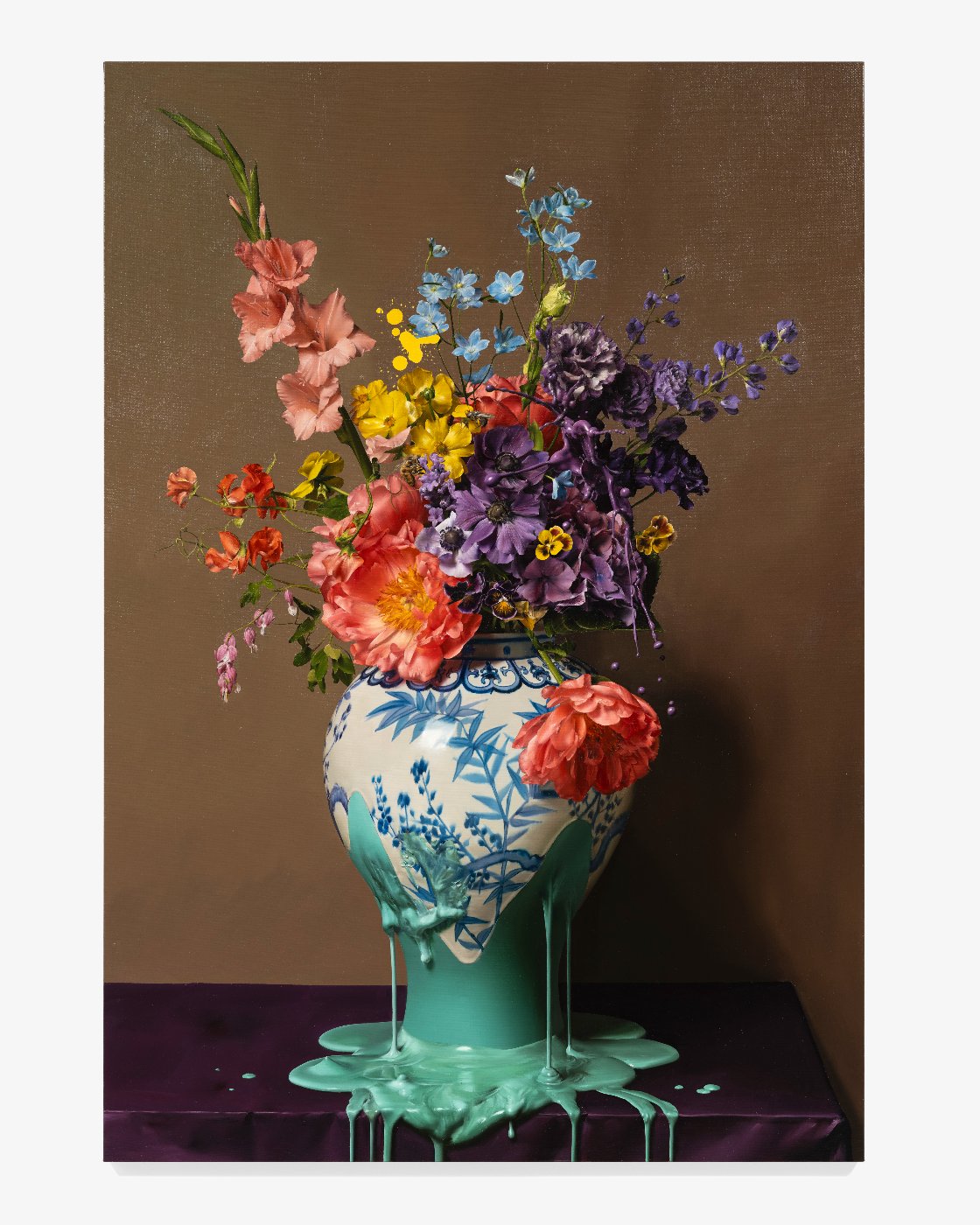
Kim’s body of floral still lifes consists an ongoing series since his solo exhibition Arrangement at Gallery Hyundai in 2019. Based on his reflection on flowers, Kim reinterprets the meaning of the floral still life genre and the art of flower arrangement with a contemporary twist, utilizing commercial glass bottles as vases. The colors of these corporate logos determine the color of the frames, at the bottom of which the logo itself is drawn. While employing the corporate logo as both a universal form of representation and a symbol of capitalism, at the same time Kim ironically alludes to the inversion of values as instilled in the floral still life genre.
The artist collects and rearranges digital images of flowers from different regions and seasons, using graphic tools to place these flora within a single vase and thereby generating still lifes that transcend dimensions of time and space. By also creating discrete spatial and temporal layers on the canvas with dissonant images such as two-dimensional animation, flower petals shedding, and splashes of paint, the artist endeavors to overcome the flatness of the surface plane. Furthermore, the ceramic vases that hold the bouquets of flowers in Kim’s works are painstaking depictions of existing works by his fellow artist and ceramicist. Yoo Eui Jeong, who employs traditional techniques to structure the ceramics, but then applies motley contemporary references including contemporary patterns, images, and at times commercial logos. By incorporating Yoo’s ceramic works into his own paintings, Kim’s canvases embody rich cultural diversity and the convergence of multiple contexts, altogether creating an unfamiliar, yet at the same time eerily recognizable landscapes.
Kim Sung Yoon received his BFA in Painting at Kookmin University in 2011. He has held solo exhibitions at numerous galleries and institutions including Gallery Hyundai, Seoul (2019, 2014, 2011); Gallery Purple, Namyangju (2017); and Space Can, Seoul (2014). Kim was also part of group exhibitions at the Andong Culture & Art Center, Andong (2023); Ilmin Museum of Art, Seoul (2023); Museum of Contemporary Art, Busan (2022); Jeju Museum of Art, Jeju (2022); Pohang Museum of Steel Art, Pohang (2017); Incheon Art Platform, Incheon (2015); and Seoul Olympic Museum of Art, Seoul (2013). Kim has been involved in programs such as the Gallery Purple Studio in 2016, Incheon Art Platform Residency in 2014, and was awarded the 33rd JoongAng Fine Arts Prize Exhibition.
“과거라는 공간은 지금은 실체일 수 없다는 것을 그 근본적인 성격으로 갖기에 우리에게 아무것도 아닌 공간으로 남겨진다. 그렇지만 존재하지 않는다고 해서 그 ‘지위’까지 의심할 순 없을 것이다. 아무것도 아닌 공간에 부여되는 ‘분명했음’으로 인해 과거는 유토피아적 희망과 그 어떤 것이든 가능케 하는 광활한 영역으로서 화할 수 있다. … 그렇기 때문에 나는 아카이브에 매료되고 또한 오늘날에 있어서 그곳만이 희망이 가능한 공간 이라 생각한다.”—작가노트 중에서
김성윤은 디지털 이미지가 만연한 시대에 회화가 직면하는 재현의 가능성과 평면 화면의 시공간을 탐구한다. 그는 첨단의 기술이 발전한 시대에 손으로 작품을 제작하는 과정에서 얻는 즐거움을 중시하며, 구상적인 화면에 다양한 이미지의 레이어를 쌓아 올려 시공간을 압축한다. 특히 김성윤은 근대 서양 미술사에서 주요한 족적을 남긴 회화 작가들의 기법을 차용하여, 회화의 기술적 측면에 주목하고 주제나 소재보다는 기법의 다양성에 중점을 둔다. 김성윤은 인물화, 정물화 등 미술사의 여러 장르와 문화적 맥락을 작가의 시선과 함께 한 화면에 담아 다양한 시공간과 현대의 삶, 일상이 레이어로 쌓인 독창적인 작품을 완성한다.
2011년, 갤러리현대와 함께 한 첫 번째 개인전에서 김성윤은 19세기 화가 존 싱어 사전트(John Singer Sargent, 1856–1925)가 초기 올림픽 아카이브의 선수들을 그렸다면 어떠했을지 상상력을 발휘했다. 옛 자료를 수집하여 섭외한 모델에게 당시 올림픽 선수들의 모습을 재현 및 연출함으로써 초기 근대 올림픽 선수들의 초상화를 현실과 타인의 작업이 중첩된 흥미로운 방식의 작품을 선보였다. 미술사의 여러 작업을 끌어오는 작업 방식은 당대부터 현재까지의 시간을 아우르는, 다채로운 시간의 레이어가 쌓인 화면을 선사한다. 그는 회화의 여러 요소를 섞고, 몇 백 년 전 그려진 그림과 오늘 그림의 위치를 한 면에 가져다 붙였다.
2014년 김성윤은 《Dead Man》 전에서 젊은 작가로서 처한 과도기적 단절과 고뇌를 표현하였다. 특히 상자 속에 숨은 사람을 표현한 작품 〈상자 속에 숨은 사람 〉(2012)은 과거 형식을 차용하는 창작의 방식이 과거로 숨는 것인지, 혹은 새로운 방향으로 나아가는 것인지에 대한 스스로에게 의문을 던진 작품이다. 당시 작가는 종말적인 상황인 ‘좀비 묵시록’이라는 설정으로 기존의 작업에 대한 종말을 고하고, 새로운 시작을 예고했다. 또한, ‘종말’이라는 가설적 상황은 작가에게 형식의 자유로움을 더해주어, 그는 그 동안의 회화에 대한 연구와 고민들을 작품의 다양한 참고 자료로 사용했다. 작가가 존경하는 화가들을 좀비로 그리거나, 좋아하는 회화 작품을 그만의 독특한 시선을 가미하여 화면에 끌어들였다. 또한, 교류가 있던 작가들의 작품을 개입시켜 작품 속에서 그들과 소통하기도 했다.
김성윤은 “꽃 정물화” 연작을 2019년 갤러리현대에서 열린 개인전 《Arrangement》에서 시작하여 현재까지 지속해오고 있다. “꽃 정물화” 연작에서 작가는 자신이 경험한 꽃을 기반으로, 현대적인 시각에서의 꽃 그림의 의미를 새롭게 해석한다. 산업용 유리병을 화병으로 사용하면서 기존의 꽃꽂이 방식을 현대적으로 재해석했다. 작가는 꽃의 화병으로 사용된 식료품 유리병 로고의 색상으로 액자를 채우고 아랫부분에는 해당 로고를 인쇄해 넣어, 보편적 표상과 자본주의의 상징과도 같은 브랜드 로고를 전면에 내세워 꽃 정물이 가지는 전통적인 상징과 의미를 비틀고 그 전도된 가치를 은유적으로 담아냈다.
또한 작가는 개화 시기와 지역이 다른 꽃들을 온라인상에서 수집하고, 그래픽 툴로 재배열하여 한 화병에 꽂아 시공간을 뛰어넘는 꽃 정물화 작업을 지속하고 있다. 작가는 캔버스에 2D 애니메이션을 삽입하거나, 부서지는 꽃, 흩뿌려지는 꽃, 인간의 형상을 띄는 꽃, 화면 위로 뿌려진 물감 등 현실에서는 불가능한 시공간을 작품에 담아, 작가만의 독특한 회화적 시공간이 담긴 꽃 정물화를 완성한다. 꽃을 담고 있는 다양한 문양, 로고, 그리고 형태가 그려진 화병을 자유롭게 활용하는 김성윤은 동료 도예 작가인 유의정(1981년생)의 작품에 꽃을 꽂아 캔버스에 담는다. 전통적 기법과 현대적인 기법을 오가며 동시대의 문화적 혼종성을 담는 유의정의 작품을 시공간을 초월하는 꽃들과 함께 한 화면에 그려내어, 다층적인 레이어가 조화를 이루는 익숙하지만 낯선 회화의 시공간을 구축한다.
김성윤은 2011년 국민대학교 회화과를 졸업했다. 갤러리현대, 서울(2019), 갤러리퍼플, 남양주(2017), 스페이스캔, 서울(2014) 등에서 개인전을 가졌고, 안동문화예술의전당, 안동(2023), 일민미술관, 서울(2023), 부산현대미술관, 부산(2022), 제주도립미술관, 제주(2022), 포항시립미술관, 포항(2017), 인천 아트플랫폼, 인천(2015), 소마미술관, 서울(2013) 등 다수의 단체전에 참여하였고, 갤러리퍼플 스튜디오(2016), 인천아트플랫폼 레지던시(2014) 등의 레지던시 프로그램에 참여했고, 2011년 제33회 중앙미술대전 선정 작가로 선정되는 등 활발한 활동을 지속하고 있다.
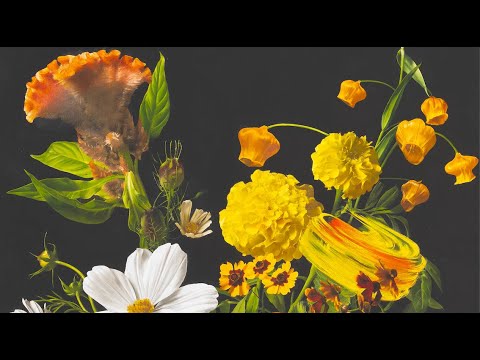
Video
Kim Sung Yoon 김성윤
Frieze LA 2024
Selected Works
{{ lbCurrent.title }}
{{ lbCurrent.text }}